EU and Mercosur Sign Landmark Free Trade Agreement, Strengthening Europe–South America Economic Ties
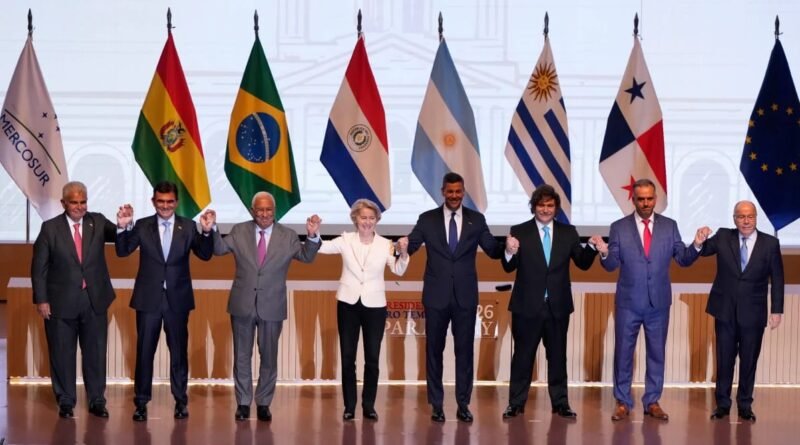
The European Union and the Mercosur bloc of South American nations have formally signed a landmark free trade agreement in Asunción, Paraguay, concluding more than 25 years of complex and often stalled negotiations aimed at deepening commercial ties at a time of rising global protectionism and trade tensions.
The signing marks a significant geopolitical achievement for the European Union as it seeks to strengthen its presence in resource-rich South America amid increasing competition from the United States and China. The agreement also underscores South America’s commitment to maintaining diversified trade and diplomatic relationships, even as U.S. President Donald Trump asserts stronger influence in the Western Hemisphere.
European Commission President Ursula von der Leyen described the deal as geopolitically critical, emphasizing its importance at a moment when skepticism toward free trade has resurfaced globally. Her remarks came as President Trump announced new 10% tariffs on eight European countries over their opposition to American control of Greenland. Von der Leyen stressed that the EU is choosing fair trade over tariffs and long-term partnerships over economic isolation, highlighting the agreement as a pathway to shared prosperity.
The ceremony was attended by the presidents of Argentina, Uruguay, and Paraguay, along with Brazil’s foreign minister, reflecting the broad political backing within the Mercosur bloc. Driven by South America’s major agricultural exporters and Europe’s industrial sectors seeking expanded markets for automobiles, machinery, and manufactured goods, the agreement creates one of the world’s largest free trade zones, covering more than 700 million consumers and promising lower prices and expanded market access.
Despite the historic signing, the deal must still be ratified by the European Parliament, a step that remains politically sensitive. Protectionist groups on both sides of the Atlantic, particularly European farmers concerned about competition from South American agricultural imports, have strongly opposed the agreement. Recent protests across Europe, including tractor blockades, highlight the potential challenges ahead.
The agreement will eliminate over 90% of tariffs on goods and services traded between the EU and Mercosur, although some tariffs will be phased out over 10 to 15 years. Sensitive agricultural products such as beef will be subject to strict quotas, along with safeguard measures and continued EU subsidies designed to address farmers’ concerns. These provisions helped win support from countries such as Italy, a major agricultural producer.
France remains opposed to the deal, with President Emmanuel Macron warning that dissatisfaction among farmers could strengthen far-right political movements ahead of the 2027 presidential election. Trade experts note that the agreement’s future now depends largely on political support within the European Parliament, which could ultimately determine whether the EU–Mercosur free trade pact enters into force.
The EU–Mercosur agreement is widely seen as a critical step in reshaping global trade flows, reinforcing multilateral cooperation, and countering the rise of tariffs and trade barriers in an increasingly fragmented global economy.