A Year of Highs and Lows: Port of Los Angeles Remains America’s Busiest Container Hub
The Port of Los Angeles (POLA) marked a year of sharp contrasts at its annual State of the Port event, revealing strong cargo performance alongside major operational challenges, including a high-profile vessel fire late in 2025.
Held at the AltaSea waterfront venue in San Pedro, the event was co-hosted with the Pacific Merchant Shipping Association (PMSA) and drew around 930 representatives from labor unions, government, and the maritime business community. The gathering was led by POLA Executive Director Gene Seroka, with opening remarks from Los Angeles Mayor Karen Bass.
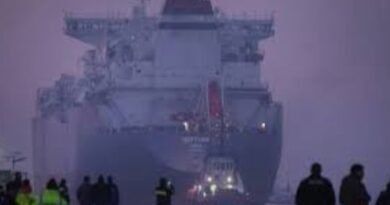
Mayor Bass underscored the port’s critical role in the regional and national economy, praising Seroka’s leadership during a year shaped by geopolitical uncertainty and shifting tariff policies. She also commended the Los Angeles Fire Department, the U.S. Coast Guard, and other agencies for their coordinated response to the fire aboard the container ship ONE Henry Hudson in November 2025. The damaged vessel departed the port just one day before the event.
Opening the 11th edition of the State of the Port, Seroka paid tribute to the emergency responders involved in the incident, presenting awards and sharing a video montage of media coverage and first-hand accounts from multiple agencies. He then turned to the broader picture of port performance, emphasizing infrastructure growth, digital innovation, and environmental progress.
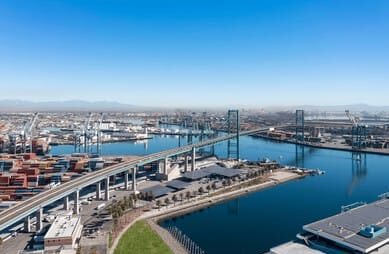
Describing 2025 as “a year like no other,” Seroka called it “something of a rollercoaster” due to global trade disruptions and policy uncertainty. Despite these headwinds, the Port of Los Angeles recorded its third-best year ever for container throughput, handling 10.2 million TEUs. This milestone secured its position as the busiest container port in the United States for the 26th consecutive year.
“At a time when the global trade map is being redrawn, we must be ready for what’s coming,” Seroka said, stressing the need to build larger, smarter, and more sustainable port infrastructure.
Among the major expansion plans highlighted was the proposed Pier 500 container terminal. Planned as a 200-acre facility with two new berths and roughly 3,000 linear feet of quay, Seroka described it as potentially “the cleanest cargo terminal in the world.” Additional projects include modernization of the port’s operations center, development of a new Maritime Support Facility on Terminal Island for chassis management, expansion of Fenix Marine Services at Pier 300, and a significant capacity increase at the LA TIL terminal serving MSC and other carriers.
Digital transformation was another key focus. Seroka pointed to the Port Optimizer, a cloud-based platform developed with Wabtec, which he said provides supply chain visibility unmatched by any other U.S. port. He also highlighted the Universal Truck Appointment System, designed to improve gate efficiency and truck routing. Cooperation with the neighboring Port of Long Beach (POLB) continues in this area, with a new grant enabling shared access to appointment data across both ports.
Environmental performance featured prominently in the update. Seroka cited the ports’ long-running Clean Air Action Plan, noting that the Port of Los Angeles has achieved its lowest-ever air emissions on a per-TEU basis. A newly signed cooperation agreement with POLB aims to accelerate the transition to zero-emission technologies across the San Pedro Bay port complex.
Federal support is playing a role as well. An Environmental Protection Agency (EPA) grant is funding battery-electric cargo handling equipment, new charging infrastructure, and a large fleet of zero-emission drayage trucks. Future initiatives include a methanol bunkering pilot program and the development of a “Green Corridor” connecting Southern California with Shanghai, in partnership with the Port of Long Beach.
Closing the event, Seroka thanked stakeholders for their continued support, concluding that no other port complex globally is addressing trade uncertainty, infrastructure demands, and environmental goals “at this pace, and with this level of success.”