Destin Fire Control District Adds High-Speed M-19 Coastal Fireboat to Florida Fleet
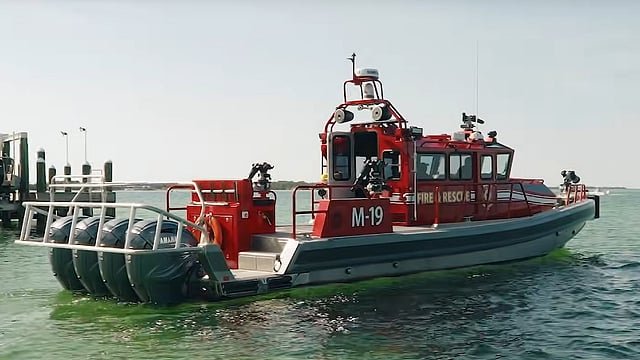
The Destin Fire Control District (DFCD), home to Florida’s largest fleet of firefighting vessels, has received a state-of-the-art 52-foot (16-meter) coastal fireboat, the M-19, from Mobile, Alabama-based boatbuilder Silver Ships.
The aluminum deep-V hull vessel is powered by four 425hp Yamaha outboard engines, enabling a top speed of 45 knots. Equipped with two Darley firefighting pumps capable of discharging 3,000 gallons (11,000 liters) per minute, M-19 provides 360-degree firefighting coverage via two forward and two aft monitors. One monitor is remotely controlled, minimizing crew exposure during hazardous operations.
Designed for multi-mission operations, M-19 serves as a firefighting, rescue, and ambulance vessel, responding to structure fires on or near the water. The climate-controlled cabin is equipped for patient care, including vital monitors and IV equipment for severe medical emergencies such as cardiac episodes. The aft deck accommodates rescued survivors or additional emergency equipment, including dive gear, with passageways on either side of the wheelhouse for smooth operational flow.
Durability and advanced technology define the vessel’s design. The wheelhouse features upward-facing windows for enhanced situational awareness, reverse-angled windscreens to reduce glare, and shock-mitigating decking and seating. The vessel also includes a Teledyne FLIR thermal camera for low-visibility search-and-rescue operations and Simrad radar for navigation. The hull meets American Bureau of Shipping high-speed craft class rules, with a heavy-duty breaching plate and high-capacity deck drains.
M-19 is expected to provide medical assistance to the local commercial fishing fleet and support the U.S. military, with Destin’s three nearby military bases classifying the vessel as a federal asset. Its enclosed cabin and outboard motors make it suitable for operations in rough seas, particularly the challenging East Pass.
Acquired at a cost of US$1.5 million, nearly half of the funding was covered by a federal grant, reflecting the vessel’s strategic importance to both local and federal emergency response operations.