Italy Launches First Next-Generation OPV Ugolino Vivaldi to Strengthen Italian Navy Maritime Security
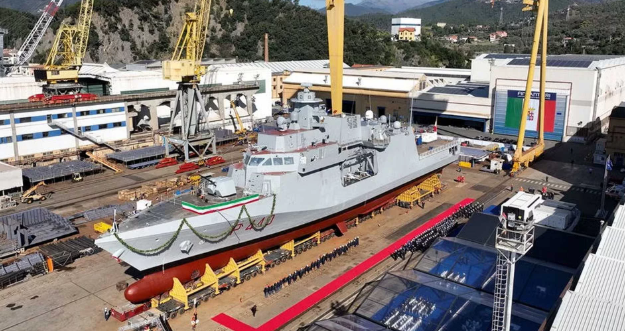
Italian shipbuilder Fincantieri has launched Ugolino Vivaldi, the first of four next-generation Offshore Patrol Vessels (OPVs) ordered by the Italian Navy, marking a significant milestone in Italy’s naval modernization program. The 95-meter vessel is designed to enhance maritime surveillance, protect Italy’s Exclusive Economic Zone (EEZ), and reinforce sea line security operations across the Mediterranean.
The launch ceremony took place on February 21, 2026, at Fincantieri’s Riva Trigoso shipyard. The program has been assigned to Orizzonte Sistemi Navali, a joint venture between Fincantieri (51%) and Leonardo (49%), under contract from the Naval Armaments Directorate within Italy’s National Armaments Directorate. Senior representatives from the Navy, regional authorities, and industry attended the event, highlighting the project’s institutional and industrial importance.
Measuring approximately 95 meters in length with a displacement of around 2,400 tons, Ugolino Vivaldi can accommodate 93 crew members. The vessel is optimized for persistent maritime domain awareness missions, merchant traffic monitoring, enforcement operations within Italy’s EEZ, and the protection of strategic communication lines. It is also equipped to support counter-pollution operations, including response to toxic liquid spills, reflecting Italy’s dual security and environmental priorities in heavily trafficked Mediterranean waters.
A key innovation of the new OPV class is its integrated naval cockpit system, originally developed for the Italian Navy’s PPA multi-purpose combat ships. Designed through collaboration between Fincantieri NexTech and Leonardo, the cockpit consolidates propulsion control, steering, platform management, and selected combat system functions into a unified command station. Engines, rudders, and core onboard systems can be managed by just two operators,a pilot and co-pilot,significantly reducing crew workload while improving navigational safety and reaction speed.
This advanced automation represents a generational shift in Italian naval ship design. By minimizing personnel requirements for ship handling and platform supervision, the OPV enhances operational sustainability and reduces long-term workforce costs. At the same time, available crew capacity can be allocated to boarding teams, maritime interdiction operations, and crisis-response missions.
Although detailed weapon configurations have not been publicly disclosed, the vessel is expected to incorporate scalable combat system components aligned with Italy’s network-centric naval doctrine. This would allow the OPV to operate within distributed maritime task groups, sharing sensor and tactical data with frigates, maritime patrol aircraft, and NATO command structures. As a result, the ship functions not merely as a constabulary platform but as a digitally connected surveillance and enforcement asset capable of supporting both national missions and NATO tasking.
Strategically, the program addresses increasing operational demands in the central Mediterranean, including the protection of subsea infrastructure, energy corridors, and high-density commercial shipping routes. The introduction of modern, digitally integrated patrol vessels enables the Navy to allocate high-end frigates and destroyers to deterrence patrols and alliance commitments while maintaining persistent maritime presence closer to home waters.

For Fincantieri, the launch reinforces its standing in the global patrol vessel market through its FCX product family, emphasizing modularity, export adaptability, and integrated combat systems. The industrial framework under Orizzonte Sistemi Navali further strengthens coordination between hull construction and combat system integration, consolidating Italy’s naval industrial base amid rising European and global competition.
The launch of Ugolino Vivaldi represents both a production milestone and a strategic step in reshaping Italy’s maritime security architecture. As the remaining three vessels advance through construction, the program will play a key role in balancing sustained operational presence, fiscal sustainability, and alliance interoperability in an increasingly contested Mediterranean environment.