US Navy Blockade on Iran Ports Sparks Strait of Hormuz Crisis, Threatening Global Oil Shipping and Maritime Trade Routes
Tensions across the global shipping industry surged after Donald Trump ordered the US Navy to enforce a sweeping maritime blockade targeting Iran’s ports while launching high-risk mine countermeasure operations in the strategically vital Strait of Hormuz, a move that could reshape international energy trade, tanker routes, and freight markets.
The directive, confirmed by United States Central Command (CENTCOM), places immediate pressure on Iran’s maritime trade network by restricting vessel access to its ports and authorizing interception of ships suspected of paying transit tolls to Tehran. The order extends beyond the Persian Gulf, signaling potential enforcement in international waters, an escalation that analysts say introduces significant geopolitical and legal complexity to global shipping lanes.
Global oil logistics, already under strain, face heightened disruption as the Strait of Hormuz, responsible for roughly 20% of the world’s oil and LNG flows, remains a focal point of the conflict. Maritime security experts warn that any interference in this corridor could trigger sharp volatility in crude oil prices, tanker insurance premiums, and freight rates across Asia, Europe, and the Middle East.
The naval strategy reflects a shift from air dominance to complex sea control operations, combining economic warfare with tactical enforcement. A blockade, under international naval doctrine, aims to cut off an adversary’s revenue streams by restricting exports and imports. However, enforcing such an operation requires overwhelming maritime superiority, continuous surveillance, and coordinated fleet deployment—factors that make execution both costly and operationally intense.
Security analysts highlight that Iran retains asymmetric capabilities that could challenge US naval dominance, including fast-attack boats, anti-ship missiles, naval drones, and sea mines. These threats significantly raise the risk profile for commercial shipping, offshore energy infrastructure, and naval patrol units operating in the region.
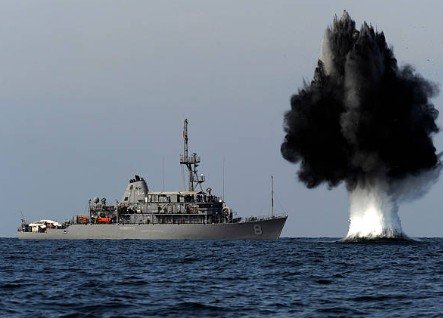
Adding to the stakes, the US Navy has initiated preliminary mine-clearing efforts in the Strait, with guided-missile destroyers entering the corridor to prepare for potential large-scale minesweeping operations. While these vessels are not specialized mine hunters, their presence signals the start of a broader effort to secure one of the world’s most critical maritime choke points.
Naval experts point out that modern mine warfare remains one of the most dangerous threats to shipping. Iran is believed to possess a diverse arsenal of naval mines, including magnetic, acoustic, and pressure-triggered devices capable of targeting oil tankers and container vessels. Advanced variants can evade detection, delay detonation, or combine multiple triggering mechanisms, making them extremely difficult to neutralize.
Clearing such threats requires a combination of underwater drones, mine countermeasure vessels, and aerial surveillance systems. However, limitations in US minesweeping capacity mean Washington may need to rely on allied naval forces, particularly from Gulf States, to ensure safe passage through the Strait.
The enforcement strategy may also involve selective interception of merchant vessels under international “prize law,” allowing naval forces to board, search, and potentially seize ships suspected of supporting Iran’s trade. This approach, analysts say, could be more flexible than a full blockade while still exerting economic pressure.
With over 100 vessels typically transiting the Strait daily, even limited disruption could send shockwaves through global supply chains, affecting everything from crude oil shipments to containerized trade. Industry stakeholders, including shipping companies, insurers, and energy traders, are closely monitoring developments as the risk of escalation grows.
Read: US Naval Blockade of Strait of Hormuz: Trump Triggers Global Shipping Crisis and Oil Price Surge
As maritime operations intensify, the unfolding situation in the Strait of Hormuz is rapidly becoming one of the most critical flashpoints for global shipping, energy security, and naval strategy, raising the stakes for international trade and stability across key shipping corridors.