Pakistan and China Sign Landmark MoUs on Karachi Seawater Desalination, Agri-Tech and Tea Trade at Changsha Summit
President Asif Ali Zardari witnesses three strategic agreements spanning water security, smart agriculture, and bilateral commodity trade ,a concrete step forward in Pakistan-China economic partnership.
Key Takeaway: Three binding MoUs inked in Changsha cover a seawater desalination plant for Karachi, agricultural technology cooperation across Sindh, and a cross-border tea industry partnership , all witnessed by Pakistan’s head of state.
In a significant push to deepen practical economic ties under the China-Pakistan Economic Corridor (CPEC) framework, President Asif Ali Zardari witnessed the signing of three high-value memorandums of understanding between Pakistani and Chinese entities on the sidelines of his state visit to Changsha, China. The agreements target three sectors with direct implications for Pakistan’s long-term economic resilience: water infrastructure, agricultural innovation, and international commodity trade.
MoU 1 — Seawater desalination plant for Karachi: tackling Pakistan’s water crisis
The first and arguably most strategically significant agreement was concluded between the Government of Sindh’s Local Government department and Lucion Environmental Technology Group of China. The MoU establishes a framework for collaboration on a seawater desalination project in Karachi , one of the world’s most populous coastal megacities, long suffering from severe water supply deficits.
The agreement was signed by Sindh Senior Minister Mr. Sharjeel Inam Memon on behalf of the Government of Sindh, and by Mr. Yuhui, Secretary of the Party Branch and Chairman of Lucion Environmental Technology Group, from the Chinese side.
For the maritime and port infrastructure sector, the development of a large-scale coastal desalination facility carries major significance. Such projects require sophisticated marine civil engineering, offshore water intake systems, and integration with coastal port logistics , making Karachi’s waterfront a focal point for both water security investment and broader blue economy development.
MoU 2 — Agricultural technology cooperation to modernize Sindh’s farming supply chain
The second MoU was signed between the Government of Sindh and Long Ping Hi-tech Information Company, a leading Chinese agri-tech firm, to advance cooperation in agricultural technology. The agreement was inked by Sindh Senior Minister Mr. Sharjeel Inam Memon and Mr. Chen Zhixin, Chairman of Longping High-Tech Information Company.
The deal has direct implications for Pakistan’s agricultural export supply chain , a sector deeply intertwined with port throughput and maritime freight volumes at Karachi Port and Port Qasim. Improved crop yields, smart farming systems, and precision agriculture technology translate directly into higher volumes of agricultural commodity exports, boosting demand for bulk carrier shipping, cold-chain logistics, and containerized freight services.
MoU 3 — Pakistan-China tea industry partnership opens new bilateral trade corridor
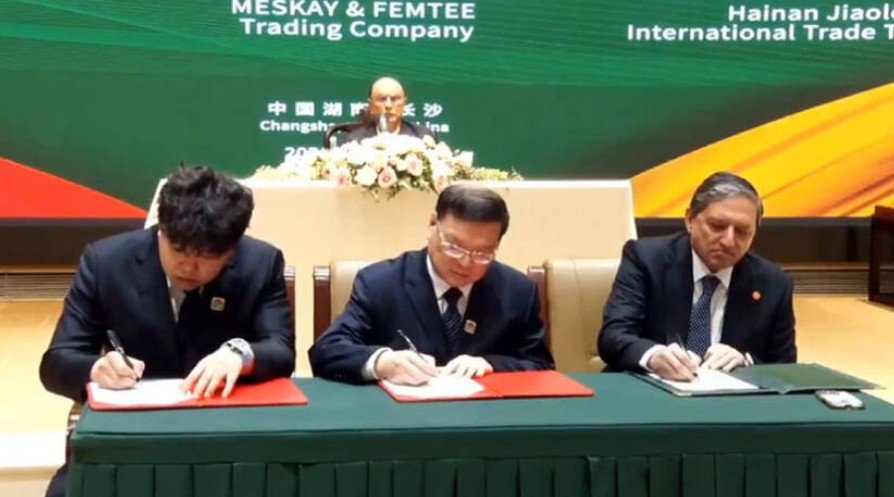
The third agreement ,and the one with the most direct implications for bilateral commodity trade and freight shipping ,was concluded between MESKAY & FEMTEE Trading Company (Pakistan), Hunan Tea Group, and Jiaolong International Technology (Hainan) to promote comprehensive cooperation across all areas of the tea industry.
The MoU explicitly aims to support the development of the tea sector in both countries while strengthening economic, trade, and people-to-people ties. It was signed by Senator Saleem Mandviwalla from the Pakistani side, and by Mr. Zhou Chongwang, Party Secretary and Chairman of Hunan Tea Group, and Mr. Hao Jiaolong, Chairman of Hainan Jiaolong International Trade Technology, from the Chinese side.
Pakistan is among the world’s largest tea importers, with the bulk of its supply historically sourced from Kenya and shipped through Indian Ocean sea lanes. A structured trade partnership with one of China’s foremost tea-producing provinces opens the possibility of a significant shift in sourcing patterns , with potential to redirect volumes onto the CPEC overland trade route or through Chinese ports onto Pakistan-bound shipping lines.
Senior officials and diplomats witness historic signings
The signing ceremony was attended by Syed Qasim Naveed Qamar, Special Assistant to the Chief Minister of Sindh for Investment and Public-Private Partnership Projects; Ali Hassan Barohi, Chief Secretary of Sindh; and Khalil Hashmi, Pakistan’s Ambassador to China. The high-level attendance underscores the government’s intent to move these agreements from paper to implementation quickly.
Why this matters for maritime trade and port investment
Taken together, the three MoUs signal a deliberate expansion of Pakistan-China cooperation into sectors that sit at the nexus of water infrastructure, food supply chains, and commodity trade , all of which have direct downstream effects on port traffic, shipping demand, and maritime investment in Pakistan. As CPEC enters its second decade, deals like these shift the conversation from road and energy infrastructure toward industrial cooperation, trade route diversification, and coastal development ,themes that will shape the regional maritime economy for years to come.
For shipping companies, port developers, commodity traders, and maritime insurers watching Pakistan’s growth trajectory, Changsha has just sent a clear signal: the next phase of Pakistan-China economic integration is well underway.
Read: Pakistan-China Naval Drill Sea Guardian IV Boosts Maritime Security in Arabian Sea