Scientists discover world’s largest known coral : a 2,000-year-old giant thriving in one of the ocean’s most acidic underwater environments
NOAA researchers have found a record-breaking Porites coral colony in the Mariana Islands, spanning the size of three basketball courts and growing inside a volcanic crater where CO₂ vents simulate future ocean acidification conditions.
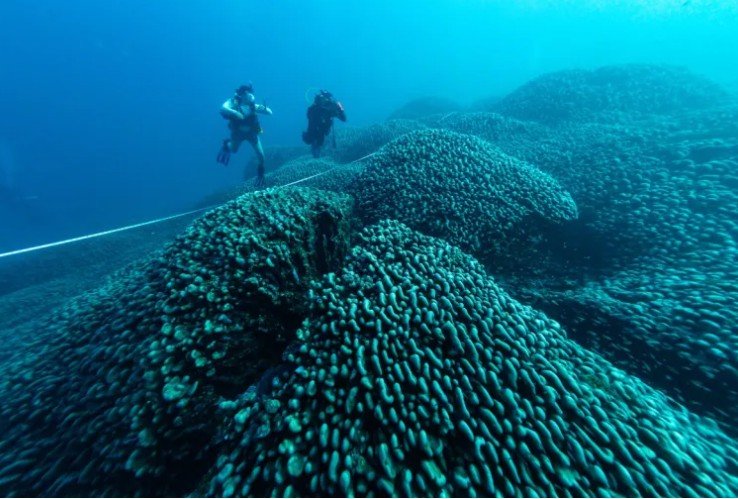
Deep inside the submerged caldera of the Maug Islands , a remote volcanic cluster roughly 450 miles north of Guam , NOAA scientists have confirmed what may be the largest Porites coral colony ever recorded on Earth. Standing over 100 feet tall and stretching nearly 200 feet wide at its base, the ancient reef formation is not only a world record in coral biology; it is a living archive of ocean history that could reshape how marine conservationists and climate scientists understand coral reef survival.
The discovery was made during the 2025 National Coral Reef Monitoring Program surveys, though local communities in the Commonwealth of the Northern Mariana Islands had long been aware of the structure’s existence. What makes the find extraordinary , beyond its sheer physical scale ,is where the coral chose to grow.
A natural laboratory for ocean acidification research
The Maug caldera is no ordinary ocean floor. Carbon dioxide bubbles constantly from hydrothermal vents along the seafloor, creating seawater chemistry that closely mirrors what climate models predict global oceans will look like by the end of this century if greenhouse gas emissions continue unchecked. NOAA scientists who first explored the site described the sensation as “swimming in a glass of champagne.”
That acidic environment is precisely what makes this coral discovery so scientifically significant. Ocean acidification ,caused by seawater absorbing atmospheric CO₂ ,weakens the calcium carbonate structures that corals depend on to build their skeletons. Yet this ancient colony of Porites rus has survived and expanded in proximity to those same conditions for what researchers estimate may be over two millennia.
“It is remarkable to see a resilient and thriving mega coral, and a dead zone near the carbon dioxide vents in the same area , with the giant coral thriving just a few hundred yards away.” — Hannah Barkley, Chief Scientist, NOAA Coral Reef Monitoring Program
The contrast is stark and instructive. Within a short distance of the CO₂ vents, reef life collapses entirely. But a few hundred yards away, this ancient megacoral continues to thrive , making the Maug caldera one of the most valuable in-situ ocean acidification research sites within U.S. waters, and a critical location for studying reef resilience and coral bleaching resistance at the ecosystem level.
How do scientists date a coral that leaves no growth rings?
Unlike trees, which produce clear annual rings, Porites corals present a challenge for age determination. Hannah Barkley noted that “it is difficult to tell the true age of this coral because it doesn’t produce growth bands like other corals.” The NOAA team therefore applied an outward radial growth estimate , roughly 0.4 inches per year , to arrive at an age projection exceeding 2,050 years. That estimate places the coral’s origins somewhere in the era of ancient Rome.
More precise dating would require coral core sampling and laboratory analysis, techniques NOAA has previously deployed at Maug for tracking ocean chemistry over time. If confirmed, the coral would be among the oldest known living reef organisms on the planet , a genuinely rare find in the field of marine biology and deep-sea ecosystem research.
Economic context: Healthy coral reefs in U.S. waters generate an estimated $3.4 billion annually in ecosystem services , including coastal storm protection, fisheries support, and tourism , and can absorb up to 97% of incoming wave energy, making reef conservation a direct economic and infrastructure priority.
A bright spot against a backdrop of global reef decline
The timing of this discovery is bittersweet. The world’s reefs are under sustained pressure from marine heatwaves, mass coral bleaching events, and the compounding effects of ocean acidification. NOAA data shows that the third global coral bleaching event , which ran from 2014 to 2017 ,exposed more than 75% of the world’s reefs to bleaching-level thermal stress, with nearly 30% facing mortality-level conditions.
Read
- Deep-Sea Breakthrough: Scientists Discover 117+ New Marine Species in Coral Sea Expedition
- US Maritime Policy Shift: NOAA Reopens Northeast Canyons Marine Monument to Commercial Fishing Industry
The Mariana Islands themselves are not immune. NOAA’s own monitoring data suggests the region has lost approximately half of its coral cover over the past two decades. The megacoral’s survival does not contradict this broader decline , it punctuates it. Scientists caution that a single resilient colony, however extraordinary, is not a substitute for healthy reef ecosystems at scale.
What the coral does offer is something arguably more valuable in conservation science: a testable hypothesis about what reef resilience looks like, and where it comes from. Understanding the biological and environmental factors that allowed this specific colony to outlast two millennia , including proximity to naturally acidified water ,could inform marine protected area management, coral restoration programs, and climate adaptation strategies worldwide.
Protected waters and Indigenous heritage
The megacoral sits within the boundaries of the Mariana Trench Marine National Monument, established in 2009, which provides the site with federal protection. NOAA has confirmed that an advisory council is working to assign the coral a culturally appropriate name that honors the Indigenous Chamorro and Carolinian heritage of the region , a meaningful step in integrating Indigenous knowledge and stewardship into formal ocean conservation frameworks.
Thomas Oliver, chief scientist with the monitoring program, acknowledged the logistical challenge the structure itself posed: “This coral was so big, we actually couldn’t easily measure it due to dive safety restrictions.” Further expeditions using submersibles or remotely operated vehicles may eventually yield more precise measurements and core samples ,potentially rewriting what marine biologists understand about coral longevity, deep reef ecology, and the outer limits of biological resilience in a changing ocean.