Pakistan Navy commissions its most advanced submarine ever, and the name alone carries the weight of history
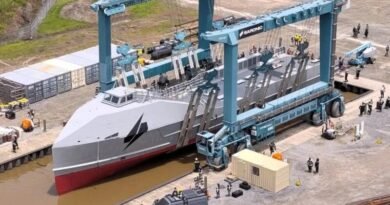
In a ceremony held in Sanya, China, Pakistan formally inducted PNS/M HANGOR, the first of the new Hangor-class submarines, into active service, a vessel equipped with Air Independent Propulsion, cutting-edge weapons systems, and a legacy tied to the most storied moment in South Asian naval history.

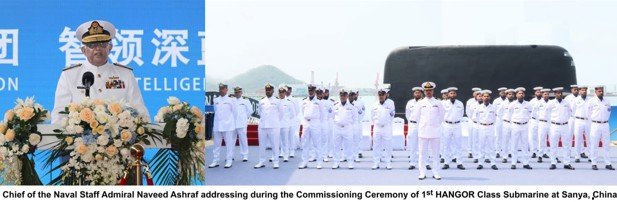
There are commissioning ceremonies, and then there are moments. What unfolded at the Chinese port city of Sanya was clearly the latter. Pakistan’s President Asif Ali Zardari flew in as chief guest to personally preside over the induction of PNS/M HANGOR , the lead vessel of Pakistan Navy’s new Hangor-class submarine program , into operational service. Chief of the Naval Staff Admiral Naveed Ashraf stood alongside him, and the message from Islamabad to the wider region was unambiguous: Pakistan’s naval modernization is no longer a work in progress.
The submarine is a product of Pakistan-China defence cooperation, built in China and representing one of the most significant capability upgrades to the Pakistan Navy’s undersea warfare fleet in decades. It arrives at a moment when competition over maritime trade routes, energy corridors, and naval dominance in the Arabian Sea and broader Indian Ocean Region is intensifying across multiple fronts.
Why Air Independent Propulsion changes the equation
The most operationally significant feature of the Hangor-class is its Air Independent Propulsion system ,a technology that allows a conventional submarine to operate submerged for significantly longer periods without surfacing to run diesel engines or snorkels. In contested waters, this translates directly into stealth, endurance, and deterrence.
Admiral Naveed Ashraf underlined the strategic rationale clearly during the ceremony, noting that disruptions at critical maritime choke points are increasingly threatening global trade and energy security. For Pakistan, whose economic lifeline runs through the Arabian Sea , including the China-Pakistan Economic Corridor’s deep-sea port at Gwadar ,the ability to credibly defend those sea lanes is not merely a military priority, it is an economic one.
“HANGOR Class Submarines , armed with state-of-the-art weapons, advanced sensors and Air Independent Propulsion , will be key in preserving maritime order and stability in the region.” — Admiral Naveed Ashraf, Chief of the Naval Staff, Pakistan Navy
The submarines are described as capable of protecting the security of vital Sea Lines of Communication across the Arabian Sea and into the wider Indian Ocean , the same corridors through which an estimated 80% of the world’s traded oil flows, and through which Pakistan’s own import-export economy depends.
A name that carries 50 years of history
The choice of name is not incidental. In 1971, the original PNS Hangor became the first submarine in the world to sink an enemy warship in combat since the Second World War, sending the Indian frigate INS Khukri to the bottom of the Arabian Sea during the Indo-Pakistani War. That single engagement cemented the Hangor’s place in South Asian military history ,and in the consciousness of the Pakistan Navy.
Admiral Ashraf invoked that legacy directly, stating that PNS/M HANGOR will carry this illustrious history forward as the country modernizes its fleet. The reuse of the name is a deliberate signal , both domestically and to regional audiences ,that Pakistan views undersea deterrence as a cornerstone of its naval doctrine, not a peripheral capability.
Pakistan-China naval partnership enters a new phase
The ceremony in Sanya is a visible marker of how deeply Pakistan-China defence cooperation has matured. The Hangor-class program is a joint endeavour, and the attendance of senior officials from both the Pakistan Navy and the People’s Liberation Army Navy at the commissioning reflects the institutional depth of that relationship. President Zardari described the event as another chapter in the time-tested and enriching friendship between the two countries.
For China, assisting Pakistan in building a capable blue-water submarine force is consistent with its broader strategic interest in a stable and friendly maritime environment along its trade and energy routes through the Indian Ocean. For Pakistan, the technology transfer and co-production dimensions of the Hangor program represent a long-term investment in indigenous naval shipbuilding capacity.
Read :Pakistan-China Naval Drill Sea Guardian IV Boosts Maritime Security in Arabian Sea
Pakistan’s Prime Minister and Chief of Army Staff also extended formal congratulations to the nation and the Navy on the milestone ,a sign of the cross-institutional significance attached to the induction. The commissioning of the first Hangor-class submarine is not the end of a procurement story. It is the opening of a new chapter in how Pakistan projects power, deters aggression, and secures its economic interests from beneath the surface of the sea.