Deep-Sea Mining and Critical Mineral Supply Chains: Why the U.S. Is Finally Moving on Ocean Seabed Resources
Congressional hearings, a $10 billion federal reserve program, and a streamlined regulatory framework signal the United States is shifting from interest to action on offshore critical minerals ,a sector that could reshape domestic supply chains and reduce dependence on China.
Momentum around critical mineral supply chains in Washington is no longer hypothetical. Policymakers are now focused on practical steps to expand domestic access to the raw materials that underpin national security, advanced manufacturing, and modern energy systems. Ocean seabed minerals ,including cobalt, nickel, manganese, copper, and rare earth elements ,are front and center of this conversation, and the offshore industry is prepared to play a central role.
Congressional focus on deep-sea mining grows
Congressional attention is growing fast. A House Natural Resources Subcommittee hearing recently examined regulatory barriers to deep-sea mining and how to position American companies to lead. A March 26 House Science, Space, and Technology Subcommittee hearing focused on the strategic and economic stakes of U.S. seabed mineral development and reducing dependence on Chinese critical mineral supply chains. Both hearings draw the same conclusion: offshore minerals are now a genuine Congressional priority.
Why critical minerals matter: batteries, semiconductors, and energy transition
Cobalt, nickel, manganese, copper, and rare earth elements are embedded in the technologies modern life depends on ,including EV batteries, power systems, semiconductors, aircraft, ships, and data centers. Demand is rising as fast as electrification and AI integration accelerate. Geopolitical competitors ,China above all , dominate large portions of the global critical mineral supply chain, giving the U.S. strong reason to develop reliable domestic and allied sources.
These same competitors have moved aggressively to expand their influence over international seabed governance and deepen their strategic presence in critical ocean corridors, making U.S. action more urgent than ever.
U.S. offshore seabed resources: polymetallic nodules and rare earth deposits
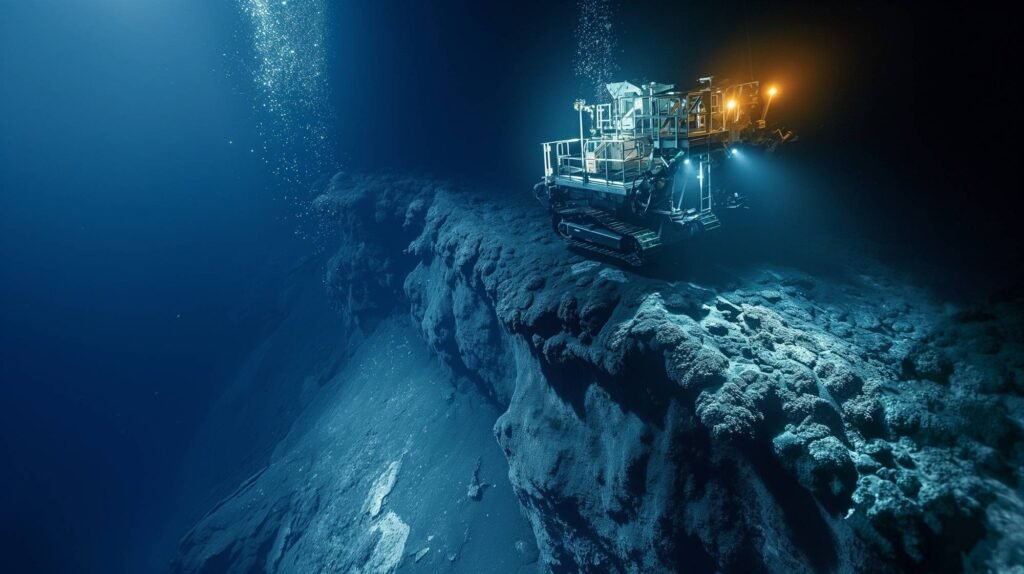
The United States has real offshore potential. In both international waters and areas falling within U.S. domestic waters and those of its allies, significant deposits of polymetallic nodules, manganese crust, copper-rich sulfides, and other seabed resources rich in critical minerals can be found. Developing them does not require building a new industry from scratch ,it requires applying existing offshore expertise to a new resource opportunity.
America’s offshore sector already responsibly brings the tools ocean mineral exploration and commercial recovery require: advanced geophysical surveying, subsea robotics, remotely operated systems, real-time monitoring, and a deeply ingrained culture of safety and environmental performance. That technical overlap gives the United States a clear advantage in a sector where operational experience will matter as much as policy ambition.
Project Vault: a $10 billion U.S. strategic critical minerals reserve
Federal policy is beginning to match that potential. The Trump administration recently announced Project Vault, a public-private partnership backed by $10 billion in Export-Import Bank financing to build a U.S. Strategic Critical Minerals Reserve covering all 60 minerals on the U.S. Geological Survey’s Critical Minerals List. Unlike traditional government stockpiles, Project Vault is demand-led: manufacturers identify which materials they need, at what volumes, and make long-term financial commitments to ensure availability during supply disruptions.
NOAA regulatory reform and the Deep Seabed Hard Mineral Resources Act
On the regulatory side, the National Oceanic and Atmospheric Administration (NOAA) recently finalized revisions to its regulations under the Deep Seabed Hard Mineral Resources Act, creating a consolidated application process for exploration licenses and commercial recovery permits. The updated framework streamlines a regulatory structure to reflect scientific and technological progress, while maintaining environmental review and oversight.
NOAA also announced a major offshore seabed mapping initiative near American Samoa, covering more than 30,000 square nautical miles of federal waters. Beginning in early 2026, the effort will generate publicly accessible data on seabed geology, environmental conditions, and mineral prospectivity , supplementing decades of prior research in international waters. Good data is the foundation of responsible development and of sound regulation.
Offshore energy infrastructure meets critical mineral extraction
Together, these steps signal a shift from conceptual interest to practical engagement. As global competition for critical minerals and rare earth elements intensifies, the U.S. is uniquely positioned to lead , having pioneered technology development, scientific research, and environmental impact assessments, and possessing the only fully developed regulatory framework for ocean mineral exploration in national and international waters.
Deep-sea mineral extraction also fits naturally alongside traditional offshore energy activity. The vessels, ports, fabrication facilities, skilled workforce, and breakthrough innovations that support oil and gas , and emerging sectors like offshore wind energy and carbon capture , can support mineral exploration too, extending the value of existing infrastructure while accelerating the broader offshore economy.
U.S. leadership in ocean mineral development: what’s at stake
The U.S. is no longer asking whether ocean minerals matter , it’s moving to action. Sustaining that momentum requires regulatory agencies to keep frameworks predictable, science-based, and adaptable as technology evolves. The offshore sector already has what it takes to lead responsibly: the vessels, subsea technologies, geophysical expertise, and safety culture built over decades in the Gulf of Mexico and beyond.
Read:Ex-Rio Tinto CEO’s Deep-Sea Mining Firm Merges with Odyssey Marine in $1 Billion Deal
That foundation, combined with Washington’s recent policy moves, gives industry the confidence to invest in a frontier the U.S. helped pioneer. Early leadership here means shaping the operational standards, environmental safeguards for deep-sea mining, and international norms that will govern the sector for years. Done right, ocean mineral development strengthens domestic critical mineral supply chains, reduces dependence on foreign sources, supports high-value jobs, and reinforces the industrial base on which U.S. economic and national security depend.