Op-Ed: The Invisible Anchor: Women, Pakistan’s Maritime Economy, and its Rising Blue Economy Potential
On a day the world marks women in maritime, Pakistan’s coastal women weave nets and split fish , invisible to policy, indispensable to the sea.
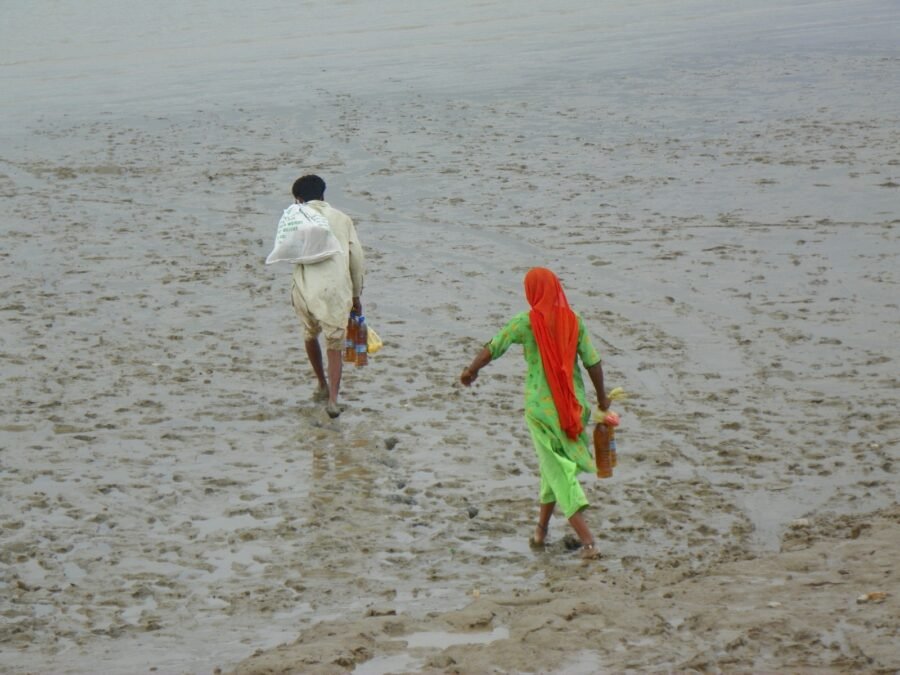
Feature Image Credit: Mr. Moazzam — This photograph was taken at Mero Dablo, capturing a couple leaving for their village after heavy rains.
I .The Global Frame: From Policy to Practice
Today, 18 May 2026, the International Maritime Organization (IMO) observes the International Day for Women in Maritime under the theme “From Policy to Practice: Advancing Gender Equality for Maritime Excellence.”
The choice of words is not incidental , it is an admission. After years of resolutions, commitments, and award ceremonies, IMO Secretary-General Arsenio Dominguez acknowledged this week: “Despite our longstanding commitment to fostering gender diversity across the maritime sector, persistent challenges remain. It is time to reflect deeply and ask, where are we falling short, and what practical measures can we implement to move beyond rhetoric and achieve meaningful, lasting change?” (IMO, 2026)
The question hangs in London today. But it resonates with particular urgency in Karachi, in Pasni, in Ormara , where women do not wait for IMO handbooks to contribute to the maritime economy. They already do, in silence, in poverty, and with calloused hands.
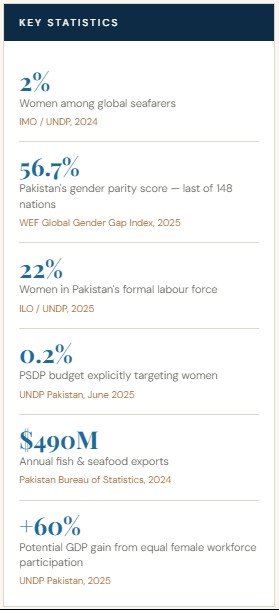
The statistics are grim but instructive. According to IMO data, women constitute just 2 percent of seafarers globally and hold fewer than 20 percent of shore-based positions (UNDP, 2024). UNCTAD has noted that while women make up most of the workforce in coastal and maritime fisheries, they occupy the lowest-paid, lowest-status, and least-protected jobs in those sectors (UNCTAD, 2021). The global blue economy, celebrated in ministerial speeches, is built on the structural invisibilisation of female labour.
II. The Image and What it Tells us
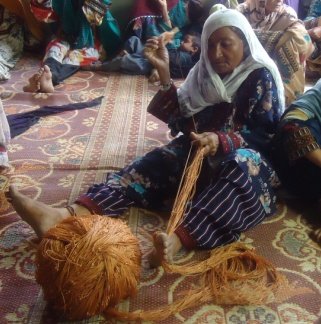
The photograph above speaks with quiet clarity. An elderly woman sits cross-legged on the floor, her hands moving with practiced precision as she gathers coils of orange fibre into a fishing net. Around her, other women share the same careful work. There is no machinery, no industrial setting, no formal documentation of wages. Instead, there is inherited knowledge, passed through generations, expressed through touch, rhythm, and repetition ,and a steady sense of purpose tied to the sea.
This is maritime work. It is pre-harvest, pre-voyage, pre-export ,and therefore economically foundational. The net she weaves will haul fish from Pakistan’s Exclusive Economic Zone, fish that will pass through a supply chain ultimately valued in hundreds of millions of dollars. Pakistan exports fish and seafood worth between USD 350–490 million annually to China, the Middle East, and the European Union (Pakistan Bureau of Statistics, 2024). According to Bacha et al.’s study Sustainable Development of Marine Fisheries in Pakistan, the sector supports 400,000 people directly and approximately one million indirectly (Bacha et al., 2020). The woman in this photograph is part of that economy. She has never been formally counted in it.
Research published in the Pakistan Journal of Gender Studies documents that women in Pakistan’s smaller coastal communities are “heavily involved in the processing and sale of seafood” and play a dominant role in the post-harvest segment of the fisheries value chain (Pakistan Journal of Gender Studies, n.d.). Yet they remain structurally excluded from formal recognition, credit systems, cooperatives, and policy design.
III. Pakistan’s Compounded Gender Deficit
One cannot meaningfully analyse women in Pakistan’s maritime economy without locating that analysis within the country’s broader gender catastrophe. Pakistan ranked last among 148 countries in the World Economic Forum’s Global Gender Gap Index 2025, with an overall parity score of 56.7 percent , a second consecutive annual decline from the high of 57.7 percent recorded in 2023 (WEF, 2025; The Express Tribune, June 2025). Only 22 percent of Pakistani women participate in the formal labour force, compared to 81 percent of men (ILO/UNDP, 2025).
In the maritime sector specifically, this deficit compounds. Balochistan , home to Pakistan’s longest coastline and most resource-rich fishing grounds , “still lacks processing and export facilities,” and most fish must be transported to Karachi before value is added. Sammi Gull, a woman fisherfolk representative from the province, has articulated the structural bind with disarming clarity: “We need women-led, community-based processing units in Balochistan. We have the raw material and the skills, just not the access to infrastructure.” (The Express Tribune / ICSF, December 2025)
The infrastructure gap is not an accident of geography. It is the consequence of a development paradigm that has consistently overlooked the gendered structure of the fishing economy. UNDP’s analysis of Pakistan’s federal development budget for FY 2025–26 reveals that explicit women-focused projects constitute just 0.2 percent of the Public Sector Development Programme , a decline from previous years (UNDP Pakistan, June 2025).
IV. The Policy Moment: Building a Stronger Future for Women in Pakistan’s Maritime Economy
Any serious discussion on women in Pakistan’s maritime sector must also recognize the important policy steps now emerging at the national level. In July 2025, Pakistan’s Ministry of Maritime Affairs, under the leadership of Federal Minister Muhammad Junaid Anwar Chaudhry, launched the National Fisheries and Aquaculture Policy (2025–2035) in collaboration with the Food and Agriculture Organization.
The 10-year framework places gender inclusion alongside climate resilience, environmental sustainability, fisheries modernization, and institutional reform as key priorities for the future of Pakistan’s blue economy. The policy signals a growing recognition that women are essential stakeholders in fisheries, aquaculture, seafood processing, coastal livelihoods, and maritime sustainability.
At the same time, the minister has promoted the idea of a blue circular economy, where marine waste is transformed into economic opportunity through integrated systems linking fisheries, aquaculture, recycling, and coastal development. This reflects an important shift in how Pakistan views its coastline , not merely as a geographic boundary, but as a driver of inclusive economic growth and maritime innovation.
While these policy initiatives are still evolving, they create a valuable foundation for future reforms that can further strengthen women’s participation in the maritime economy. Expanding women-led fisheries cooperatives, improving access to financing, formalizing the role of female fish processors and net-weavers, and increasing representation in maritime decision-making can help translate policy ambitions into long-term social and economic progress.
The theme of the International Day for Women in Maritime 2026 — “From Policy to Practice” — aligns closely with this opportunity. For Pakistan, the moment represents not only a challenge, but a promising pathway toward a more inclusive, resilient, and globally competitive maritime sector.
“Strengthening women’s participation in Pakistan’s maritime and coastal economy is not just a social inclusion goal, but a strategic requirement for sustainable blue economy growth. Their involvement in fisheries, aquaculture, and coastal resource management can significantly enhance both community resilience and economic productivity.” — Mr. Moazzam, Technical Advisor at World Wide Fund for Nature
Related : Engagement of women in fisheries in Pakistan: Two case studies
V. The Economic Opportunity of Inclusion
The case for greater gender inclusion in Pakistan’s maritime sector is not only a social imperative , it is a major economic opportunity. According to United Nations Development Programme estimates, if women in Pakistan participated in the formal labour force at the same rate as men, the country’s GDP could increase by nearly 60 percent. At the global level, United Nations Conference on Trade and Development projects that advancing gender equality across the blue economy could contribute up to USD 13 trillion to the world economy by 2030.
For Pakistan, the maritime sector presents significant untapped potential. Although fisheries and aquaculture currently contribute less than 0.5 percent to national GDP, the country’s emerging National Fisheries and Aquaculture Policy has the capacity to unlock nearly USD 10 billion in economic value over the next decade. Reaching this target will depend on expanding opportunities, skills, and formal recognition for the thousands of women already contributing to fisheries processing, coastal livelihoods, aquaculture, seafood value chains, and community-based marine activities.
The launch of the IMO’s 2026 Handbook on Gender Mainstreaming by Momoko Kitada offers a timely framework for progress. Developed to support maritime administrations, ports, shipping companies, and training institutions, the handbook provides practical guidance on integrating gender perspectives into maritime policies and operations.
As a member state of the International Maritime Organization, Pakistan now has an important opportunity to transform global commitments into local progress , strengthening inclusion from Lyari to Gwadar and helping build a more resilient, innovative, and sustainable blue economy for future generations.
“From Policy to Practice” is a theme. In Pakistan’s coastal communities, it must become a transfer of power, resources, and recognition to the women who have long done the work that the policies were written to describe.

References
- International Maritime Organization (IMO). (2026). International Day for Women in Maritime 2026: ‘From Policy to Practice: Advancing Gender Equality for Maritime Excellence.’ IMO Press Briefing, 15 May 2026. imo.org
- IMO Secretary-General Arsenio Dominguez. (2026). Statement on International Day for Women in Maritime. Quoted in Seatrade Maritime / Marine Link, 18 May 2026.
- UNDP Pacific. (2024). Women’s Vital Role toward achieving a Sustainable Ocean Future. undp.org/pacific
- UNCTAD. (2021). The blue economy is an ocean of opportunity to advance gender equality. unctad.org
- Profit by Pakistan Today. (July 2025). Pakistan unveils 10-year policy to harness blue economy and modernize fisheries sector. profit.pakistantoday.com.pk
- The Express Tribune / ICSF. (December 2025). World Fisheries Day: Balochistan’s vanishing catch. tribune.com.pk; icsf.net
- UNDP Pakistan. (June 2025). Reading Between the Index Lines: What Pakistan’s Budget Reveals About the Gender Gap. undp.org/pakistan
- UNDP Pakistan. (2025). Time for Pakistan’s Private Sector to Lead the Charge on Gender. undp.org/pakistan
- Pakistan Bureau of Statistics / ResearchGate. (2024/2020). Sustainable Development of Marine Fisheries in Pakistan; fisheries export data.
- Pakistan Journal of Gender Studies. Women in Pakistan’s Fisheries Sector. socialsciencejournals.pjgs-ws.com
- Daily Pakistan. (October 2025). Waves of Wealth: Why Pakistan Must Invest in its Blue Economy. dailypakistan.com.pk