First U.S.-Built Jones Act Rock Installation Vessel Acadia Delivered as Offshore Wind Market Shifts Toward Global Opportunities
The first U.S.-built Jones Act-compliant rock installation vessel has officially entered service, marking a major milestone for the American shipbuilding industry despite dramatic changes in the offshore wind market that reshaped its original mission.
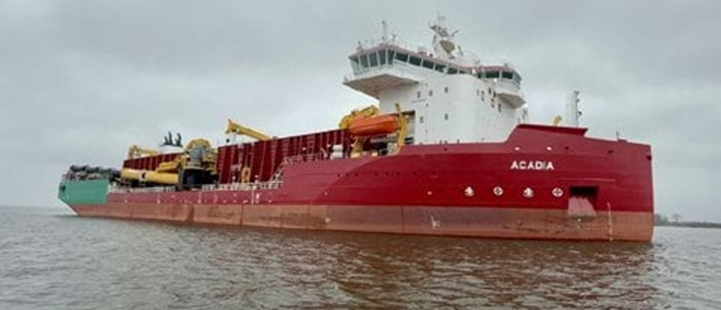
Great Lakes Dredge & Dock Company (GLDD) took delivery of the advanced offshore construction vessel Acadia from Hanwha Philly Shipyard on June 25, completing one of the most specialized commercial shipbuilding projects ever undertaken in the United States.
Originally ordered in November 2021 to capitalize on the rapidly expanding U.S. offshore wind industry, the vessel was designed to support seabed rock installation for wind farm foundations and subsea cable protection. However, changing market conditions and reduced momentum in the U.S. offshore wind sector have prompted the company to expand the vessel’s operational strategy into international offshore energy markets.
Despite the shift, Acadia remains one of the world’s most technologically advanced rock installation vessels and the only vessel of its type constructed in the United States under the Jones Act.
The 140-meter (460-foot) offshore support vessel can transport up to 20,000 metric tons of rock and is equipped with a DP-2 dynamic positioning system capable of delivering highly accurate subsea rock placement in water depths of approximately 65 meters (215 feet). The vessel also features biofuel-ready propulsion, battery capability, shore power connectivity, and accommodation for up to 45 personnel, supporting modern environmental and operational standards.
Great Lakes Dredge & Dock President and CEO Lasse Petterson said the delivery positions the company at the forefront of subsea rock installation services across both U.S. and international offshore energy markets. He added that the vessel represents a significant step in the company’s long-term strategy to expand beyond traditional dredging into offshore infrastructure and renewable energy projects.
Immediately following delivery, Acadia will mobilize for Equinor’s Empire Wind 1 offshore wind project off the coast of New York. Once that project is completed, the vessel is scheduled to move directly to Ørsted’s Sunrise Wind development, also located offshore New York.
While additional U.S. offshore wind contracts, including Empire Wind II, did not proceed amid efforts by the Trump administration to halt offshore wind expansion, Great Lakes confirmed that Acadia will transition to Europe after completing its U.S. assignments. There, the vessel will begin rock installation work for a major offshore wind developer, securing employment for most of 2027 and strengthening the company’s international offshore construction presence.
Hanwha Philly Shipyard CEO David Kim described the vessel’s delivery as far more than the completion of a single ship, saying it demonstrates the Philadelphia shipyard’s ability to build highly specialized vessels supporting critical offshore infrastructure and energy development.
The project was inherited by Hanwha following its acquisition of the Philadelphia shipyard and experienced significant delays during construction. Great Lakes had previously expected the vessel to be ready for service by the fourth quarter of 2024. However, construction disputes led to a lawsuit filed in late 2024, during which court filings indicated the shipyard had projected an estimated delivery date of September 30, 2026. Delivery has now been successfully completed.
Hanwha Philly Shipyard continues to finish several legacy contracts inherited through the acquisition. The shipyard is preparing to deliver the MARAD training vessel Lone Star State following successful sea trials, while construction also continues on California’s new training ship.
In parallel, assembly work is progressing on two of the three next-generation containerships ordered by Matson. The first vessel is expected to be delivered during the first quarter of 2027, with the remaining ships scheduled for delivery in the third quarter of 2027 and the second quarter of 2028.
The shipyard is also positioning itself for renewed growth in American shipbuilding supported by South Korean investment. Hanwha has already been linked to future construction programs involving its affiliated shipping business, including medium-range (MR) oil and chemical tankers as well as outfitting an LNG carrier intended for the U.S. export market. If completed, the LNG carrier would become the first vessel of its type ordered in the United States in many years, highlighting renewed momentum in domestic commercial shipbuilding.
Read: Korea and US Deepen Maritime Alliance with $150 Billion Shipbuilding Partnership
The successful delivery of Acadia underscores both the resilience of the U.S. shipbuilding sector and the growing importance of specialized offshore construction vessels as global demand continues to rise for offshore wind, subsea cable protection, marine infrastructure, and offshore energy projects across international markets.