Korean Nuclear-Powered Containership Design Wins ABS Approval, Marking Major Step for Future Green Shipping
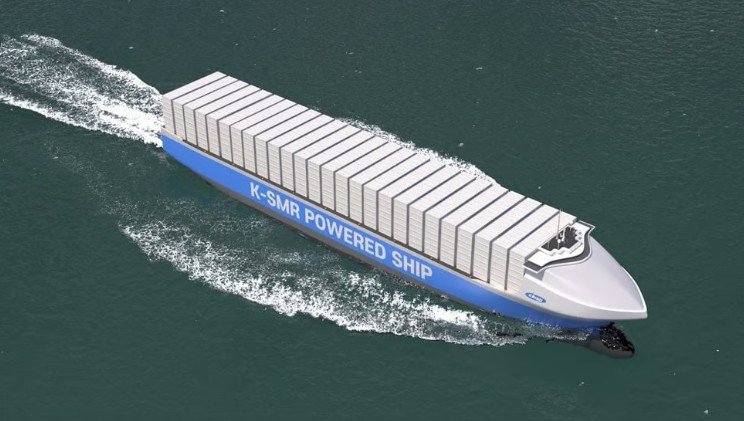
The future of zero-emission shipping moved a step closer to reality after Korean researchers, in collaboration with Samsung Heavy Industries (SHI), received Approval in Principle (AiP) from the American Bureau of Shipping (ABS) for an innovative 15,000 TEU nuclear-powered containership equipped with molten salt small modular reactors (SMRs).
The project is being jointly developed by the Korea Atomic Energy Research Institute (KAERI), the Korea Research Institute of Ships & Ocean Engineering (KRISO), and Samsung Heavy Industries. The initiative aims to create a next-generation container vessel capable of delivering high efficiency, improved safety, and carbon-free propulsion for long-distance maritime transport.
Unlike conventional marine reactors, the proposed design utilizes molten salt reactor technology, where nuclear fuel is dissolved within molten salt. According to the research team, this technology offers enhanced safety because, in the event of an unexpected shutdown, the molten salt solidifies and naturally encapsulates the nuclear fuel, reducing potential risks.
A defining feature of the vessel is its dual Small Modular Reactor (SMR) configuration, providing operational redundancy while allowing the onboard power management system to efficiently match electricity generation with the ship’s varying power requirements. The design also incorporates surplus energy storage, ensuring additional power availability whenever operational demands increase.
Beyond the reactor technology, researchers collaborated closely with Samsung Heavy Industries on the ship’s hull configuration, reactor placement, propulsion systems, and integrated power control technologies. The vessel has been designed to achieve a service speed of approximately 25 knots while remaining compatible with the Neopanamax locks of the Panama Canal, enabling global trading flexibility.
Engineers strategically positioned the reactors near the center of the hull to reduce the impact of wave motions and improve protection in the unlikely event of a collision. The nuclear propulsion arrangement also eliminates the need for traditional fuel tanks and a large exhaust funnel, creating additional space onboard while improving overall vessel efficiency.
Crew safety remained a key priority throughout the design process. The accommodation areas were carefully arranged to provide effective radiation shielding without compromising navigational visibility from the bridge.
Following an extensive technical review, ABS verified the feasibility and safety aspects of the concept before issuing the Approval in Principle, recognizing the design as a significant advancement in the development of future marine nuclear technology.
Read: South Korea’s Shipbuilding Giants Launch $150 Billion U.S. Maritime Investment Alliance
Cho Jin-young, Director of the Advanced Reactor Research Institute, described the achievement as an important milestone for the project and highlighted its role within South Korea’s K-Moonshot initiative, a national program focused on advancing breakthrough future technologies.
The development team says the next phase will focus on refining the integration between the ship and its nuclear reactors, conducting additional safety verification, advancing the detailed engineering design, and eventually testing and demonstrating the core technologies required to commercialize a nuclear-powered containership.
As the maritime industry searches for practical pathways toward decarbonization, projects involving Small Modular Reactors, nuclear marine propulsion, and next-generation container ships are attracting growing international attention. While significant regulatory and operational challenges remain before commercial deployment, the ABS approval represents a notable milestone in the evolution of sustainable deep-sea shipping.