Global Container Freight Rates Decline for Second Consecutive Week as Drewry WCI Falls to $4,374 per 40ft Container
Global container freight rates continued their downward trend for the second consecutive week, with the Drewry World Container Index (WCI) declining by 4% to $4,374 per 40-foot container on 23 July 2026. The decline was mainly driven by lower spot freight rates on major Asia–Europe and Transpacific shipping routes, as increased vessel capacity and softer demand created pressure on the global container shipping market.
The Drewry World Container Index (WCI) is widely recognized as an independent global benchmark used by shipping companies, freight forwarders, importers, exporters, and procurement teams for index-linked container freight contracts. The index tracks container spot rates across major global trade lanes and provides insights into the direction of international ocean freight markets.
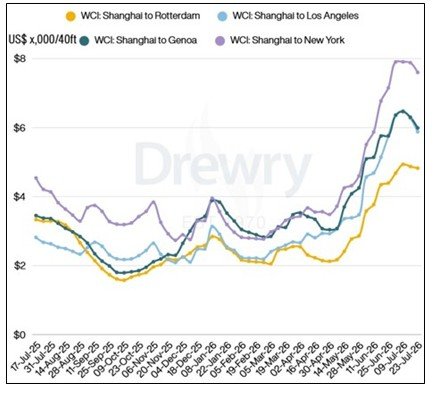
According to Drewry Supply Chain Advisors, spot freight rates on the Shanghai–Los Angeles route decreased by 6% to $5,878 per 40ft container, while rates from Shanghai to New York declined by 4% to $7,598 per 40ft container. The reduction was attributed to increased shipping capacity on the Transpacific trade route and easing demand conditions.
Drewry’s Container Capacity Insight indicated that six blank sailings are scheduled on the Transpacific route for the following week, compared with nine blank sailings during the current week. The reduction in cancelled voyages suggests greater vessel availability and higher capacity deployment by ocean carriers, contributing to a widening gap between supply and demand. Drewry expects Transpacific freight rates to remain relatively stable in the near term.
The global container shipping market is also facing uncertainty due to changing international trade policies. Existing 10% US import tariffs were scheduled to expire on 24 July 2026, while new tariff measures are expected to be introduced in early August. The uncertainty surrounding future tariff policies may influence global supply chains, cargo volumes, and ocean freight pricing.
Asia–Europe Container Freight Rates Show Further Decline
Freight rates on major Asia–Europe routes also recorded declines during the latest assessment. Spot rates from Shanghai to Genoa fell by 5% to $5,988 per 40ft container, while rates from Shanghai to Rotterdam decreased by 1% to $4,824 per 40ft container.
Drewry reported that four blank sailings are planned on the Asia–Europe trade route next week, two more than the previous week. The increase in available capacity, combined with weakening demand, indicates further pressure on freight prices. Drewry expects Asia–Europe container rates to decrease slightly in the coming week.
Geopolitical Risks Continue to Influence Shipping Costs
Despite the decline in container freight rates, geopolitical developments remain a major factor affecting global maritime trade. Continued tensions between the United States and Iran, along with concerns regarding security conditions around the Strait of Hormuz, have prompted several shipping carriers to announce Emergency Fuel Surcharges (EFS) effective from August 2026.
The Strait of Hormuz remains a strategically important maritime chokepoint for global energy transportation and regional shipping operations. Any disruption in this region could increase operating costs for shipping lines and influence future ocean freight pricing.
Global Shipping Market Outlook
The latest WCI assessment shows that major East–West container shipping routes are experiencing declining freight rates for the second consecutive week as carriers add capacity while cargo demand moderates. However, uncertainty related to geopolitical risks, fuel costs, and international tariff policies could continue shaping the global container shipping outlook in the coming months.
Shipping companies, logistics providers, and global supply chain operators are closely monitoring freight rate movements, vessel capacity deployment, and trade policy developments to manage transportation costs and supply chain risks.
The Drewry World Container Index assessment is based on ocean spot market freight rates covering approximately 6,700 global port pairs, with thousands of routes monitored through Drewry’s container freight intelligence services.