BIMCO: 130 Container Ships Stranded in Persian Gulf as Iran Conflict Disrupts Global Shipping & Strait of Hormuz Trade
Around 130 container ships are currently stranded in the Persian Gulf, severely disrupting global maritime logistics and container shipping operations, according to the latest BIMCO Container Shipping Market Overview & Outlook, March 2026. The crisis follows the onset of attacks on Iran on February 28, effectively halting transits through the Strait of Hormuz and isolating key Persian Gulf ports from major global trade routes. This disruption impacts roughly 1.5% of the world’s container fleet capacity, while nearly 10% of the global container fleet is indirectly affected due to the interconnectedness of regional trade with Pakistan, India, and other Asian ports.


BIMCO’s Chief Shipping Analyst, Niels Rasmussen, highlighted that the war has compounded uncertainties already fueled by fluctuating US trade tariffs, including the 15% across-the-board tariff introduced recently after a Supreme Court ruling invalidated many 2025–2026 import duties. As a result, approximately 3% of global container volumes remain blocked, directly influencing about 5% of global ship demand.
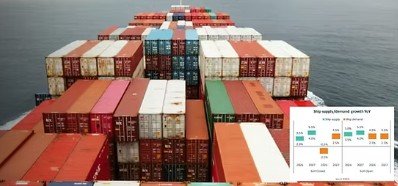
The outlook for the global container market remains volatile, with BIMCO presenting two forecast scenarios: one where the Strait of Hormuz remains closed indefinitely (SoH Closed), and another assuming an imminent reopening (SoH Open). While global ship supply growth remains mostly unaffected, demand is projected to decline by 5% in 2026. Ships stranded in the Persian Gulf are likely to be laid up, idled, or reassigned for contingencies, rather than redeployed to other trade lanes, creating a localized but significant weakening of the global supply-demand balance.
The conflict also escalates risk along other critical shipping routes, particularly the Red Sea, due to Iran’s connections with the Houthis, further delaying Suez Canal rerouting normalization. Even if Strait of Hormuz transits resume shortly, lingering uncertainties in global container shipping will continue to influence liner operators, cargo costs, and international trade dynamics. Higher oil prices and reduced cargo volumes are expected to add substantial operational costs for shipping lines, emphasizing the strategic importance of securing key maritime corridors in Middle East shipping logistics.