China Controls Shipbuilding Volume, but Korea Retains Edge in LNG Ships and Advanced Maritime Technology
China now dominates global shipbuilding orders, but South Korea is fighting back in high-end vessels such as LNG carriers, as rising geopolitical tensions reshape the maritime industry and global supply chains.
In 2025, Chinese shipyards secured 63 percent of global new vessel orders, far ahead of South Korea’s 21 percent and Japan’s 5 percent, according to London-based Clarkson Research Services. Chinese state data placed the figure even higher at 69 percent, underscoring Beijing’s tightening grip on global shipbuilding.
China also led in new orders, ship completions and total order backlogs last year, reflecting the scale and coordination of its state-backed maritime ecosystem. Over the past two decades, Beijing has poured billions into designating shipbuilding as a strategic industry, linking shipyards, shipping companies and state-owned lenders in a tightly integrated system aimed at global dominance.
China’s global shipbuilding share has surged from below 5 percent in the early 2000s to more than 50 percent by the early 2020s. Following the 2008 financial crisis, Chinese yards rapidly expanded capacity in bulk carriers, oil tankers and container ships, outpacing competitors in Japan and South Korea.
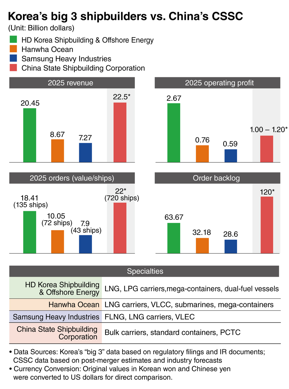
At the center of this expansion is China State Shipbuilding Corp. (CSSC), the world’s largest shipbuilding conglomerate. Formed through the merger of two major state-owned shipbuilders, CSSC consolidated market share and reduced internal competition. Industry estimates put CSSC’s standalone global market share at over 20 percent, exceeding the combined share of South Korea’s three largest shipbuilders.
China’s dual-use shipyard model, where facilities produce both commercial vessels and naval ships, has raised concerns in Washington and other capitals. Analysts warn that commercial shipbuilding profits and technical know-how could support China’s military modernization.
Despite China’s commanding lead in volume, South Korea remains dominant in high-value ship segments. Korean shipbuilders control roughly 70 percent of the global LNG carrier market and maintain an order backlog exceeding 200 LNG vessels as of early 2026.
Leading Korean players, HD Hyundai Heavy Industries, Hanwha Ocean and Samsung Heavy Industries, specialize in complex vessels such as liquefied natural gas (LNG) carriers, dual-fuel container ships, ultra-large container vessels and advanced offshore platforms.
LNG carriers are among the most technologically demanding commercial ships. They must transport gas at minus 163 degrees Celsius using advanced membrane containment systems that minimize boil-off gas. Korean shipyards have built decades of expertise in this field, backed by fierce domestic competition and a strong track record in on-time delivery and operational reliability.
Major oil and energy companies typically prioritize proven engineering capability, warranty support and delivery certainty over price alone ,advantages that have long favored South Korean builders.
However, China is quickly closing the gap. As of January this year, Chinese shipyards had secured at least 13 LNG carrier orders, compared with eight for South Korean firms. CSSC subsidiaries such as Hudong-Zhonghua and Jiangnan Shipyard are leading China’s push into the LNG carrier market.
China is leveraging domestic LNG shipping demand to build technical know-how and operational experience. Analysts say continuous state-backed orders will inevitably improve Chinese capabilities in high-end vessels.
One area where China still lags is in critical components for advanced ships. While Chinese shipyards excel at hull construction and mass production, high-value vessels such as LNG carriers, cruise ships and aircraft carriers still rely heavily on imported core systems.
Industry sources estimate that China’s most advanced vessels contain only 30 to 40 percent domestically produced components. Advanced engines, including dual-fuel engines capable of running on methanol and ammonia, are often sourced from South Korea, Europe and Japan.
According to data from the Korea International Trade Association, South Korea exported $1.29 billion worth of ship engines and related components to China last year, up 24 percent year-on-year. The engine segment remains a strategic pressure point, though China is accelerating localization efforts.
Geopolitical tensions are also reshaping the competitive landscape. In October 2025, the United States imposed substantial port fees on vessels built, owned or operated by Chinese entities. Beijing responded with reciprocal port charges on ships with US ties. Although both sides agreed to a temporary pause, the measures could return later this year, adding uncertainty to global shipping markets.
As a result, some Western shipping companies are diversifying vessel orders away from China to reduce political and regulatory risk. This shift has created fresh opportunities for South Korean shipyards.
Under the “Make American Shipbuilding Great Again” initiative, Seoul and Washington are exploring deeper shipbuilding cooperation, combining Korean industrial infrastructure and operational expertise with US advanced technologies. Industry experts argue that joint standardization of LNG vessels and related maritime technologies could create global benchmarks that are harder for Chinese competitors to penetrate.
While China currently rules global shipbuilding by sheer volume, South Korea’s competitive edge increasingly rests on high-end engineering, critical components and geopolitical alignment. The long-term balance of power in the global maritime industry may depend not only on cost and capacity, but on technology leadership, supply chain resilience and strategic partnerships.
Related:
- Four New Transpetro Tankers to Feature Kongsberg Maritime Integrated Systems
- Pakistan and Rwanda Explore Direct Maritime Links to Boost Trade and Shipping
- MSC Returns to Mid-Sized Containership Market with New Orders
- Meriaura Signs Contract for 6,800-DWT Open Deck Carrier in China
- Trump Administration Unveils Maritime Action Plan to Revive US Shipbuilding and Counter China’s Dominance