Greece Leads UN Roundtable on Maritime Trade Security and Global Supply Chains
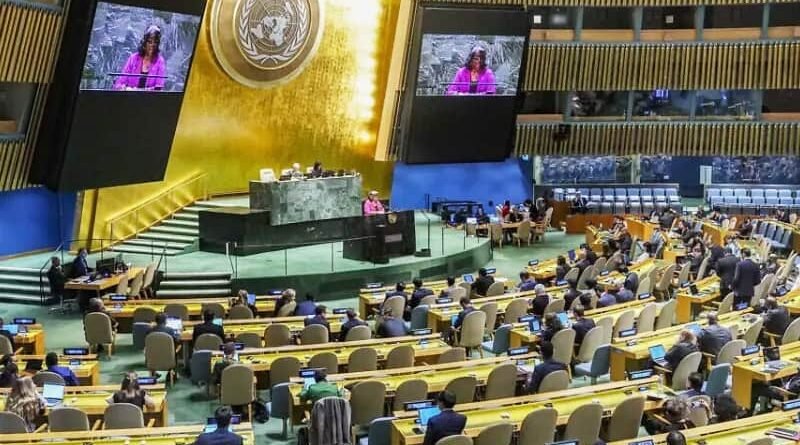
Greece placed maritime security and the protection of global supply chains at the center of international attention by hosting a high-level roundtable at United Nations Headquarters in New York on January 29, 2026. The event was co-organized by the Permanent Mission of Greece to the UN and the Delphi Economic Forum, drawing policymakers, maritime security specialists, and industry leaders.
Titled “From the High Seas to the Consumer: Securing Maritime Trade and the Global Economy,” the discussion focused on how instability at sea affects the global economy, trade flows, and geopolitical stability.
Greek Foreign Minister Giorgos Gerapetritis delivered the keynote address, while opening remarks were given by Greece’s Permanent Representative to the UN, Ambassador Agi Baltas, and Symeon Tsomokos, Founder and Chairman of the Delphi Economic Forum.
Gerapetritis underscored that maritime security is a core element of Greece’s national strategy, pointing to the country’s long-standing maritime tradition and geoeconomic weight as a global shipping leader. He noted that the Greek-owned fleet represents more than 20% of the global fleet and over 61% of the European Union fleet, even though Greece accounts for just 0.2% of global GDP.
He reaffirmed Greece’s firm commitment to international law and the law of the sea, stressing that freedom of navigation must be safeguarded under established legal frameworks. Highlighting the sector’s global importance, he reminded participants that over 80% of world trade by volume is transported by sea, directly influencing supply chains, food security, and energy security.
The minister warned that both conventional and emerging risks are threatening maritime trade, including piracy, terrorism, drone attacks, and hybrid threats. At the operational level, he highlighted Greece’s leading role in the EU naval operation “Aspides” in the Red Sea, as well as its participation in Operations “Atalanta” and “Irini.” He also emphasized the need for joint action to counter illegal activities associated with the so-called shadow fleet.
To address these challenges, Gerapetritis outlined three priorities: stronger action through the United Nations, the International Maritime Organization (IMO), and the European Union; deeper cooperation between governments and the maritime industry; and preventive collective measures to uphold an effective rules-based maritime order.
Placing maritime security in a broader geopolitical context, he warned that multilateralism and the rules-based international system are under growing pressure. He called for a “values-based realism” and described the United Nations as an essential forum for global cooperation. Concluding, he linked safe maritime trade to peace, saying secure sea trade is not only an economic necessity but also a pillar of cooperation and mutual understanding among nations.
Symeon Tsomokos described the event as the first time the Delphi Economic Forum has been held at the historic UN Headquarters, calling it a significant moment that reflects strong support for multilateral diplomacy. He noted that Greece’s maritime heritage and role in global shipping place it in a unique position to lead such discussions.
Ambassador Baltas highlighted the immediate global consequences of maritime security threats, stressing that disruptions to shipping affect markets, regions, and consumers worldwide. She described maritime trade security as inherently global and referenced recent Greek initiatives, including a high-level open debate on maritime security during Greece’s presidency of the UN Security Council, a side event during the UN General Assembly High-Level Week in September, and an Arria-formula Security Council meeting in November focused on maritime security and seafarer protection.
Baltas expressed confidence that the roundtable, which brought together leading experts, would further raise the profile of maritime security within the UN system. She emphasized that international and regional coordination remains essential for strengthening maritime security and supporting global peace and stability.
Participants agreed on the need for a comprehensive and coordinated international response. Key themes included stronger public-private cooperation, improved maritime domain awareness, protection of critical sea lanes, and enhancing the resilience of global supply chains. The discussion also aimed to identify practical steps to protect seafarers and safeguard the economic well-being of consumers worldwide.
Panelists included Steven Wills from the Center for Maritime Strategy and the Navy League of the United States, Gregory Ehrie, Director of Security at the Port Authority of New York and New Jersey, and Julia Nesheiwat, Distinguished Fellow at the Atlantic Council’s Global Energy Center, who joined online. The session was moderated by journalist and ERT presenter Fanis Papathanasiou.