Heavy Metals in Coastal Waters: Risks to Seafood Safety and Human Health
By Mariam Ghulam Mustafa
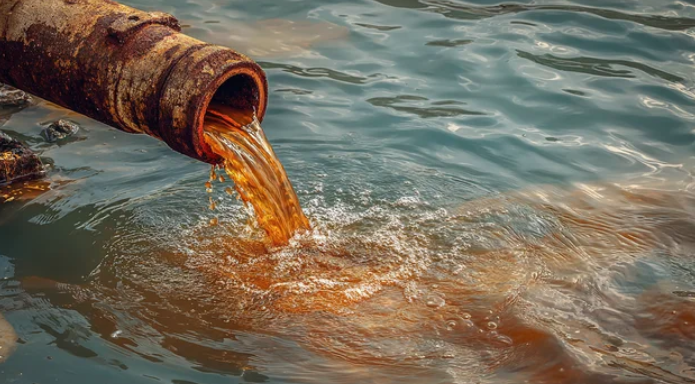
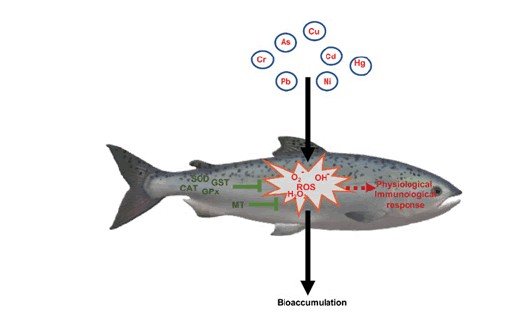
Coastal water has been a source of livelihood for humans for a long time and a cultural identity for millions of people. Heavy metals enter coastal waters through industrial effluent, oil spillage, and volcanic activity. These metals are first consumed by plankton, then by small fish, which are subsequently affected. Small fish are then eaten by larger fish, leading to the accumulation of metals in their bodies, a process referred to as bioaccumulation.
The common fish and seafood organisms affected by heavy metal contamination include several commercially important species. These include fish such as Miichthys miiuy, Lateolabrax maculatus, and Cynoglossus joyneri; crabs such as Portunus trituberculatus and Charybdis japonica; shrimp species including Exopalaemon carinicauda, Penaeus chinensis, and Oratosquilla oratoria; and edible molluscs such as Ostrea gigas, Rapana venosa, and Bullacta exarata. Research indicates that crabs, shrimps, and edible molluscs accumulate significantly higher concentrations of heavy metals,particularly cadmium,than fish, confirming bioaccumulation and transfer of metals through the marine food chain (Xu et al., 2025).
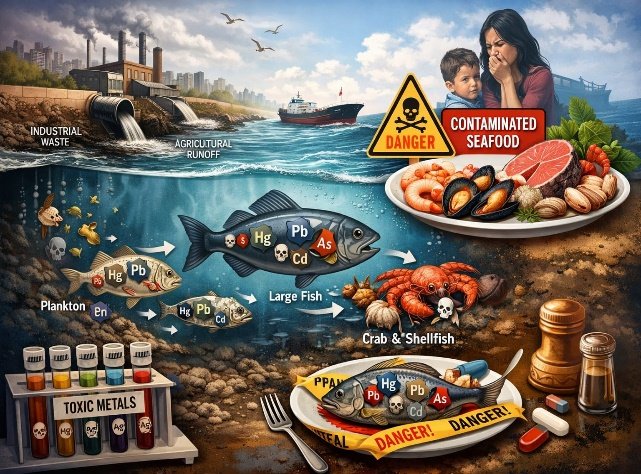
Heavy metals are rapidly threatening marine ecosystems and posing risks to human health. Seafood is an important source of protein and provides essential omega-3, omega-6, and omega-9 fatty acids. The main problem that is caused by this fish is that it does not have a bad odor, structure, taste, or occurrence; it simply looks like a normal consumable fish. Heavy metals are invisible, odorless, and tasteless. We can identify it through scientific testing like atomic absorption spectroscopy (AAS), or by measuring the light wavelength.
Heavy metals like mercury, lead, cadmium, arsenic, iron, copper, manganese, zinc, chromium, nickel, tin, zinc. Heavy metals enter the sea through human activities such as plastic disposal, industrial discharge, agricultural runoff, and other sources. When the heavy metals get into the water, they may dissolve or stick to water particles and sediments. Their actions are determined by the salinity, pH, temperature, and oxygenation of water. Methylmercury is so dangerous and can easily penetrate the human body through contamination of seafood. Plankton and algae absorb the heavy metals, which are then consumed by small fish and then by large fish. This leads to the distribution of the metals through the marine organisms and may be quite dangerous to human health in case of the consumption of contaminated seafood.
When these are consumed by human can cause cardiovascular disease. Mercury can cause brain damage and nervous system disorders, lead can cause kidney disorders and anemia, cadmium can cause weakness and kidney failure, arsenic can cause cancer and skin lesions, and chromium can cause respiratory and liver problems. These heavy metals are most vulnerable in children and pregnant women. Beyond these diseases, it can effect on environment and can cause environmental problems.
“In coastal waters, heavy metals do not vanish; they circulate, settle, transform, and ultimately return through the food chain to human consumers.”
The main challenge is sea food safety is that it has no damage or toxicity in appearance and odor, and is affected when consumed in the body. Its not only the environmental issue but also a part of human life; its toxicity can lead to human death. Protecting marine life means protecting human life because human life is linked to marine life through a source of food. The heavy metal do not degrade naturally they remain in water and can effect on fishes continuously, due to which day by day more and more marine life are affected and can cause severe disease. Even when plastic absorbs or releases heavy metals, they become more toxic. The heavy metal can be detected through AAS, and in many regions, instruments are not available, due to which we cannot perform regular monitoring. Also, in less educated area people do not have awareness about toxic heavy metals and their harmful impact. The problem of heavy metal contamination of seafood needs an environmental, regulatory, and consumer approach. The industries need to be stricter in their waste management activities. They should treat their effluents before being released into rivers and coastal waters. The introduction of metals in the marine ecosystems is also restricted by reducing agricultural runoff through sustainable farming methods.
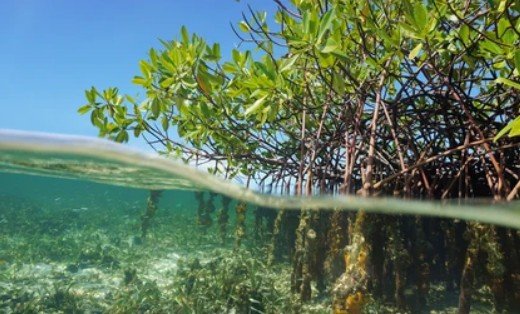
It is necessary to monitor seafood and coastal waters on a regular basis. Sophisticated laboratory tests would ensure that the production of contaminated products does not reach the consumers before the heavy metals are detected. Simultaneously, the attempts to rebuild the coastal ecosystems, including stabilizing contaminated sediments and covering natural buffers such as mangroves and seagrass, serve the purpose of capturing and limiting the diffusion of metals in the environment. Another risk factor is plastic pollution, which introduces a new dimension of danger because micro plastics have the potential to introduce heavy metals into the food chain.
This issue can be addressed by recycling efforts, prohibitions on single-use plastics and community clean-ups. It is also important that there is public awareness. Consumer education on safer seafood options, inducing responsibility of industries and sustainable fishery and aquaculture practices are sure to make seafood healthy and safe. Finally, defending the seafood against heavy metal contamination is not only a food safety issue but a step towards saving marine life and ensuring the well-being of the population in the future.
Mariam Ghulam Mustafa is a food scientist and researcher with expertise in food safety, nutrition, and emerging food technologies. Through her writing, she bridges science and public awareness, promoting safe, sustainable, and innovative practices in the food sector.
The views and opinions expressed in this article are solely those of the author and do not necessarily reflect the views of Maritime Current News.