Lloyd’s Register Advances Hybrid Nuclear Marine Power with Seatransport Partnership
Lloyd’s Register (LR) has announced Approval in Principle (AiP) for a hybrid nuclear-ready power concept developed in collaboration with Australian ship design group Seatransport Pty Ltd, marking a significant milestone in the evolution of low-emission maritime propulsion.
The innovative design enables nuclear Micro Modular Reactors (MMRs) to operate alongside conventional diesel-electric systems for 73-metre and 90-metre amphibious stern landing vessel (SLV) platforms. The AiP follows several years of close technical cooperation between LR and Seatransport aimed at ensuring regulatory compliance, operational safety and practical feasibility.
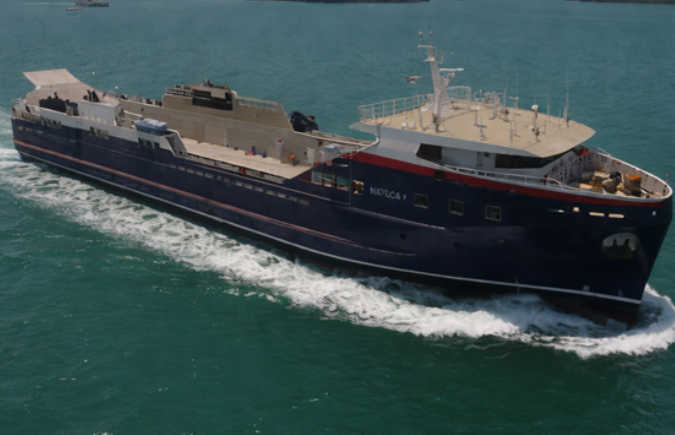
The concept demonstrates how licensable MMR technology can be safely integrated with established diesel-electric propulsion systems to create long-range vessels with substantially reduced fuel dependence and lower emissions. A recently launched 73-metre SLV served as the trial platform, with sea trials of the conventionally powered vessel validating the design assumptions applied to the nuclear-ready configuration.
Seatransport’s SLV platform has been operational for more than 25 years, supporting amphibious logistics and remote landing missions. By incorporating hybrid nuclear-ready capability, the vessels could achieve effectively unlimited operational range, extended endurance and reduced reliance on traditional fuels. The approach also enhances operational flexibility and enables reliable performance in demanding environments, including operations on unprepared or remote beaches.
The Micro Modular Reactors under consideration range from 1.2 MW to 2.6 MW and are currently undergoing comprehensive technical and regulatory assessments. LR is working closely with national authorities to ensure full compliance with safety, operational and environmental standards. Broader adoption of the technology is anticipated in the early 2030s.
Jez Sims, Technical Authority for Nuclear at Lloyd’s Register, described the AiP as an important step for both LR and the maritime sector, highlighting the organisation’s role in providing independent technical assurance grounded in decades of regulatory, design and nuclear safety expertise.
Stuart Ballantyne, CEO of Seatransport, said the approval represents a transformative moment in amphibious vessel design, integrating nuclear MMR capability into a proven SLV platform to deliver extended endurance, operational flexibility and low-emission performance. He noted that the advancement could represent a technological shift comparable to the historic transition from sail to steam.
Through this partnership, Lloyd’s Register continues to reinforce its leadership in nuclear marine propulsion, hybrid energy systems and next-generation vessel assurance, supporting the development of safer and cleaner maritime operations worldwide.