
Marine Biofuels Technical Seminar will Highlight Low-GHG Global Shipping Pathways
By Maritime Current News
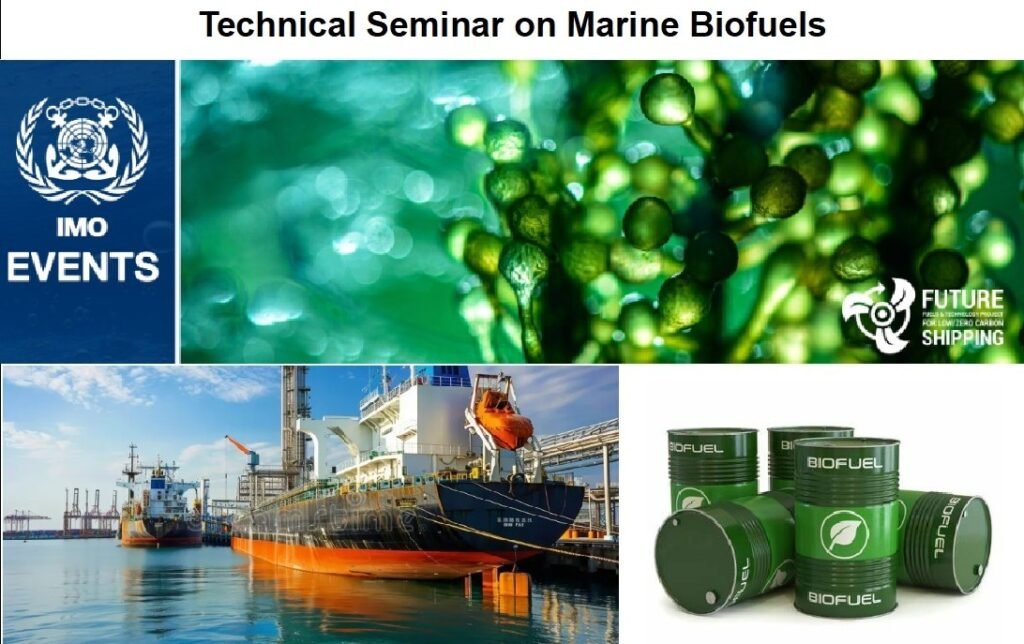
Marine biofuels are now being established as a bridge fuel through the maritime energy transition, which reduces short-term emissions but provides long-term zero-carbon solutions as they evolve. Against this backdrop, a high-level Technical Seminar on Marine Biofuels will bring together policymakers, industry experts, and researchers on 12 February 2026 at the International Maritime Organization (IMO) Headquarters in London. The seminar is to be organized under the Future Fuels and Technology (FFT) Project of IMO, which has been seeing increased traction on biofuels as a promising low-greenhouse-gas (GHG) alternative to international shipping.
The purpose of the seminar is to enhance technical knowledge and discuss the latest operational experiences associated with the use of marine biofuels that have become a scalable solution to the lifecycle emission reduction in the context of exploiting existing vessel and port infrastructure. As the regulatory pressure intensifies in major shipping areas, the event arrives at a pivotal moment among shipowners, fuel suppliers, and policymakers aiming to find viable decarbonization routes.
From Pilot Use to Market Reality
The programme will be divided into three technical sessions. Session 1 will determine the level of play in the marine biofuel use, pilot projects, performance of operations and what early adopters have learnt. The major points of discussion would be fuel compatibility, engine performance, safety concerns and reliability.
Session 2 will touch on production and certification of biofuels, which is the focus of the need of a credible environment and an adherent regulation of the environment. This session will discuss feedstock solutions, greenhouse gas accounting of lifecycle, and certification schemes which form the basis of sustainable utilization of biofuels in the maritime sector.
The last session, Session 3 will be centered on the market dynamics of biofuels, which will analyse the availability of supply, cost structure, demand indicators and the contribution of policy incentives to the market uptake. These dynamics are crucial to understand because shipping companies consider fuel strategies and changing regulations of carbon emissions.
Maritime Decarbonization Strategic Significance
Biofuels are now being considered as a drop-in-solution that can provide instantaneous results with reducing emissions without need of massive changes to current fleets. Although zero-emission fuels, including green ammonia, methanol, and hydrogen, will be at the heart of long-term decarbonization strategies, biofuels could be used as a complement in the transition phase.
The seminar will welcome both the physical and virtual participation thus allowing the global involvement of governments, industry actors, research centers, and technology suppliers. Registration of attendance is open until 5 February 2026.