Trump Warns US Might Target Iran’s Kharg Island Again ‘Just for Fun’
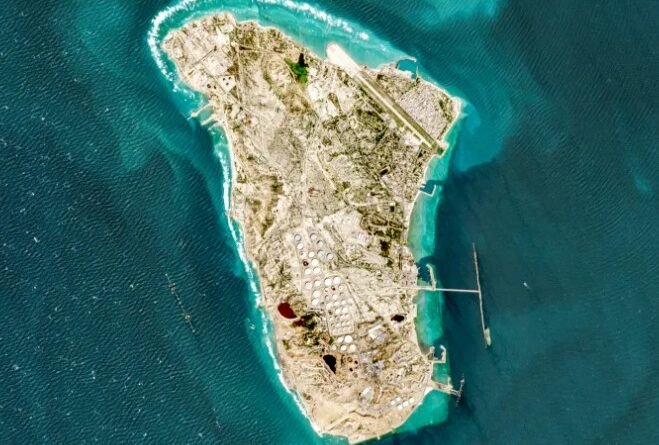
Global oil markets and maritime security concerns intensified after remarks by Donald Trump suggesting the United States could conduct additional strikes on Iran’s major oil export hub at Kharg Island, a key facility responsible for a large share of Iran’s crude shipments to international markets.
Speaking about the potential for further military action, Trump said the United States “may hit it a few more times just for fun,” signaling a possible escalation in tensions linked to energy infrastructure in the region. The comment represents a shift from earlier statements in which Trump indicated that U.S. operations were focused primarily on military targets located on Kharg Island rather than oil export facilities.
The remarks immediately drew a response from Abbas Araghchi, Iran’s foreign minister, who warned that Tehran would retaliate if its energy infrastructure were attacked again. Araghchi also claimed the United States carried out the previous strike from locations in the United Arab Emirates, including Ras Al-Khaimah and an area near Dubai. He described the situation as “dangerous,” while adding that Iran would attempt to avoid targeting populated areas in any potential response.
The United States Central Command, which oversees American military operations across the Middle East, declined to comment on the claims about the strike locations. Meanwhile, Anwar Gargash, diplomatic adviser to the UAE president, said on social media that the country maintains the right to defend itself but continues to prioritize restraint and diplomatic logic in handling regional tensions.
Regional security risks escalated further when the Islamic Revolutionary Guard Corps announced it had launched missile and drone strikes targeting sites in Israel and three U.S. military bases in the region. Iranian officials described the attacks as the first phase of retaliation after workers were killed in strikes on Iranian industrial areas.
One such incident occurred in the central Iranian city of Isfahan, where a missile strike on an industrial zone reportedly killed at least 15 people while workers were inside a factory, according to Iranian media reports.
Beyond the immediate military tensions, the crisis is also raising alarms across the global energy and shipping sectors due to the strategic importance of the Strait of Hormuz, one of the world’s most critical maritime oil transit chokepoints. Roughly one-fifth of the world’s seaborne crude oil shipments pass through the narrow waterway linking the Persian Gulf to international markets. Any disruption to tanker traffic in the strait could have major consequences for global oil supply chains and energy prices.
Trump also urged countries dependent on oil shipments through the Strait of Hormuz to work with the United States to ensure the passage remains open. In a social media post, he stated that nations receiving oil through the strait should “take care of that passage,” adding that the United States would coordinate with partners to keep global shipping routes operating smoothly.
The conflict between Iran and Israel, which Trump and Israeli Prime Minister Benjamin Netanyahu launched on February 28 according to official reports, has already resulted in more than 2,000 deaths, the majority reported in Iran by government and state media sources.
Analysts warn that continued attacks on energy infrastructure, oil export terminals, or shipping lanes in the Persian Gulf could further destabilize global energy markets, increase crude oil price volatility, and disrupt maritime trade routes that are critical for international energy security.