Unregulated Recreational Fishing is Fueling a Massacre of Our Marine Resources
By Muhammad Moazzam, WWF-Pakistan
Recreational or sport fishing is considered important for health, conservation efforts, community building, and economic benefits through tourism, promoting a vital connection to nature while fostering stewardship, supporting fisheries management, and providing relaxation and social interaction. In Pakistan, sport fishing in the inland water bodies and coastal waters is also considered important, as it is mainly aimed at relaxation and for the provision of high-quality and protein-rich food. In the inland waters, the recreational fisheries are undertaken along large rivers, canals, lakes, reservoirs, and other water bodies. In some cases, sport fishing in freshwater bodies is associated with commercial fishing, which is mutually beneficial for the professional fishermen and those who engage in this activity for recreation. In most cases, sport fishing is undertaken in small scale and does not result in mass-scale killing of the fisheries resources and damage to the ecosystem.
On the contrary, the situation is extremely painful in the coastal waters of Sindh and, to a lesser extent, in Balochistan. Recreational fishing along the coast is undertaken throughout the year. During the rough monsoon months, this activity remained at its ebb; however, still undertaken in the inner creeks of the Indus Delta, mainly targeting seabreams and snappers. Even before the cessation of monsoon, recreational fishing starts, on a limited scale, targeting Kingfish mainly around the entrance of Karachi Port, which continues till the beginning of October, by the time the monsoon subsides. Technically sport fishing season starts from October, as a large number of such enthusiasts throng known fishing grounds like Goth Mubarak and some of the creeks near Karachi. This starts the mass scale exploitation of the fish that are found in shallow coastal waters, such as seabreams, pompanos, trevallies, and groupers. During this period, the massacre of kingfish continues in coastal waters, which is mainly hunted using troll lines and handlines.
Major assault on the prime fishes starts by the middle of November when the turbidity in the coastal waters improves, which prompts snorkelers to plunder the fish that inhabit rocky, reef areas and ship and other wrecks along the coast of Pakistan. Armed with spearfish, the mass-scale killing of the precious resources results in serious damage to these critical habitats through the depletion of large-sized fish species. The main targets are usually groupers that prefer to live in crevices of the rocks and other structures. Hundreds, if not thousands, of groupers are annihilated every year using spearfish. In a series of photos posted on social media recently, more than 15 to 30 groupers were hunted by speargun fishermen from off the Goth Mubarak and Churna area. Although spearfishing is prohibited in the Churna and Astola Islands Marine Protected Area and its buffer areas, it is being used extensively by recreational fishermen in these areas. Groupers are a protogynous (fish that start as female and later transform into males). Most groupers mature in 5 to 7 years; therefore, most groupers targeted by spear fishermen are maturing females. Their uncontrolled killing in recreational fisheries is a major threat to the sex ratio and also the reproductive cycle of slow-growing and elusive groupers. Spearguns are also used to kill seabreams and other bottom dwelling fishes of the shallow coastal waters. An unfortunate victim of spear fishing is the parrotfish, which inhabits rocky outcrops and reef areas along the Karachi coast and Churna Island. Majestic parrotfish are considered “reef cleaners” and bioeroders because they control algal overgrowth, help recycle nutrients, and build tropical sand, making their protection essential for reef and rocky shore resilience. Parrotfish are not considered a preferred species in Pakistan and are consumed by only a few, these are targeted by sport fishermen. In some recent posts on social media, such fishermen were seen holding their prized catch of more than 10 parrotfish, which is a great loss.
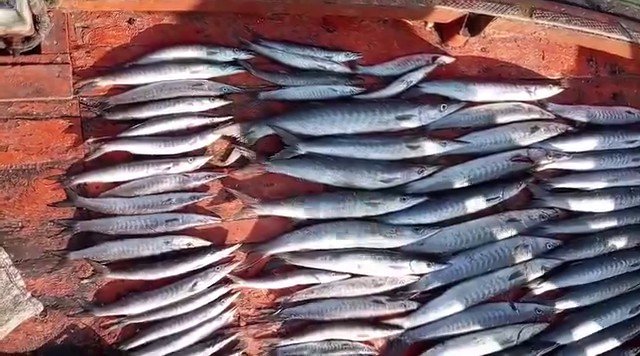
Barracudas, in large numbers, are generally hunted from shipwrecks and reef areas along the coast of Pakistan
Those sport fishermen operating in open waters between Karachi and Ormara continue to target kingfish during November and March. Dolphinfish is another species that is also targeted in large numbers in the offshore waters. Tuna, mainly yellowfin, are also caught by the sport fishermen using a troll in offshore waters. If lucky, billfish may also be entangled in offshore waters.
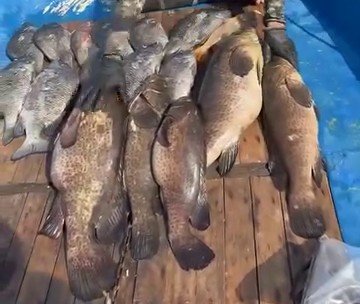
Groupers are mainly hunted in the areas with ship wrecks or rocky outcrops. Large groupers of such size may be 10- to 15-year-olds.
Sport fishing is considered a healthy recreational activity; however, when it leads to the killing of fish on a mass scale, it is not a good sign, but rather leads to the threat of overfishing. Need not mention that commercial fishing operations have already severely affected the stocks of most fish species in the coastal and offshore waters of Pakistan. Uncontrolled increase in the commercial fleet is further threatening the stocks of some prime species, which are also targeted by sport fishermen.
Sport fishing in coastal and inland waters falls under the purview of the Fisheries Departments of the Provincial Governments. In Sindh, where most of the sport fishermen operating in the coastal and offshore waters of Pakistan are based, the Government has promulgated Rules for obtaining licenses or permits for sport fishing under the provisions of the Sindh Fisheries Ordinance 1980, read with the Rules called Sindh Fisheries Rule, 1983, dated 31st July 1983. For seeking a license application can be applied as specified in Appendix No. 1.2 of these Rules. This Appendix also lists the conditions under which the license is issued. The salient conditions include:
Condition 2: The licensee can use two rods and lines at a time, provided that a daily license shall entitle its holder to fish with one rod and line only.
Condition 3: The licensee shall not employ or engage any person. Other than his own children under the age of 16 to help him with his rods and lines, unless the person so employed is also a license holder.
Condition 8: A daily license shall be valid for the date mentioned in the license, and fishing under all licenses shall start from half an hour before sunrise and be closed at half an hour after sunset.
Condition 9: A licensee shall not catch fish of the species Rohu, Mori, Thaila, and Mahseer exceeding five in number (bag limit for freshwater fish, but none for marine fish).
It is worth mentioning that the licensee is allowed to use a maximum of only two rods and lines. Condition 7 mentions only four freshwater species. There is no limit provided for the number or quantity of marine fish that can be caught by sport fishermen.
Interestingly, the Sindh Wildlife Protection, Preservation, Conservation and Management Act, 2020, and rules made thereunder as Sindh. Wildlife Protection, Preservation, Conservation, and Management Rules, 2022, have a comprehensive provision for Game Fishing. The Act, 2020, defines wildlife as including organic resources, animals, birds, fish, reptiles, vegetation, soil, and water. Provision 73 of the Rules 2022 deals with Game Fishing, which envisages:
(1)The permit for game fishing shall be granted under these rules on payment of the prescribed fees of rupees two thousand in Form-XVII.
(2)The permit shall be valid at game reserves, coastline, including prescribed limits of Sea within Pakistan’s economic zone, and as approved by the Council (Sindh Council for Conservation of Wildlife established under section 3 of the Act, 2020); on the proposal of Pakistan Game Fish Association.
(3)The license shall be subject to renewal every year.
(4)The record-keeping of such game fishing is mandatory for claiming any title/record. The certificate issued by the Pakistan Game Fish Association shall be valid for the purpose mentioned above.
(5)Game Fish sport-related association; registered for this purpose under these rules shall be the authorized body to conduct tournaments and record keeping of game fishing.
(6)All non-fish species shall be released back into the habitat immediately by the angler.
(7)No game fishing shall be allowed during the breeding season.
(8)The record keeping that t includes game fish taxidermy, electronic records jointly certified by Pakistan Game Fish Association and the Department shall be valid for contesting at international tournaments.
(9)The bag limit and size in game fishing vary with different game fish species as provided in Form-XVII, which shall be subject to any change or update, from time to time, with the approval of the Council.
Form XVII deals with Game Fishing Permit/License and also provides a list of Game Fishing Size and Bag Limit. It provides a list of 46 species of marine game fishes and 15 freshwater fishes, including their legal size (in cm and inches) and bag limits. It may be mentioned that the Sindh Wildlife Protection, Preservation, Conservation and Management Act, 2020, or Rules made thereunder, 2022, does not define Pakistan Game Fish Association nor provide any scientific or other basis for the legal size and bag limits.
There is no such legislation for sport fishing in the Balochistan Sea Fisheries Ordinance, 1971, and although elaborate legislations exist in Sindh, these are not being implemented at all. No permission for sport fishing is known to have been obtained from the Fisheries Department (Marine Fisheries) or the Wildlife Department. It may be mentioned that since the provisions for sport fishing in both fisheries and wildlife legislations are duplicated and contractor. Additionally, the role and level of involvement of the Pakistan Game Fish Association in sport fishermen under the Sindh Wildlife Protection, Preservation, Conservation and Management Act, 2020, or Rules made thereunder, 2022, is not understood.
Under the provisions of the Notification of the Churna Island Marine Protected Area dated 24 September 2024, there is a ban on fishing, hunting, shooting, trapping, killing, capturing with methods such as the use of explosives, electric current, poisons and chemicals, and the use of spear guns and SCUBA guns. Despite these provisions, spearguns are frequently used in the area of Churna MPA
Considering the uncontrolled game fishing, there is a need to control spear fishing. Dichotomy in the legislation involving licensing and issuing permits by the Department of Fisheries and the Department of Wildlife, Government of Sindh, may be streamlined, and only one agency may be allowed to issue such a license and permit for sport fishing. Need not mention, all other provinces, the Fisheries Department is entrusted with the responsibility of sport fishing under their respective legislation. There is also a need to determine bag limits for main species based on scientific data of their stocks. There should also be a ban on catch fish in large numbers on the pretext of sport fishing and selling them at fish markets and other outlets.
Sport fishing is considered a healthy recreational activity and is considered an integral part of ecotourism; however, mass-scale hunting of fish and their use for commercial purposes may not be allowed.
The views and opinions expressed in this article are solely those of the author and do not necessarily reflect the views of Maritime Current News.