World’s Largest Subsea Rock Installation Vessel “Windpiper” Arrives in Rotterdam for Offshore Wind Projects
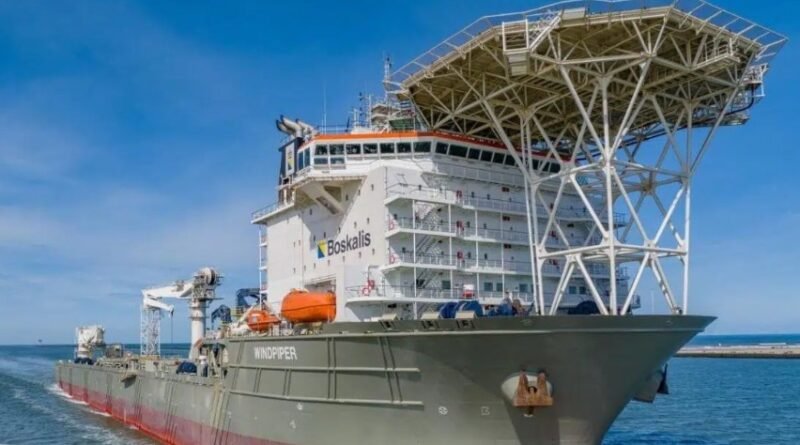
Global offshore energy and marine engineering sectors are witnessing a major milestone as the 45,500-tonne Windpiper, now recognized as the world’s largest subsea rock installation (SRI) vessel, has officially arrived in Rotterdam for final outfitting and commissioning.
The high-capacity offshore construction vessel reached Waalhaven in early April 2026, marking a critical step before it begins its first commercial deployment in the Baltic Sea later this year. The vessel is expected to play a pivotal role in offshore wind farm infrastructure and subsea protection projects, key segments in the rapidly expanding renewable energy market.
Developed by leading Dutch marine contractor Boskalis, Windpiper boasts an unmatched rock-carrying capacity of 45,500 tonnes. Measuring 227 meters in length and 40 meters in width, and powered by more than 31,000 kW, the vessel is designed to deliver high-efficiency offshore operations with reduced transit frequency—an important factor in lowering fuel consumption and operational costs.
Originally announced in January 2025 for a different operational role, Windpiper has undergone extensive conversion into a next-generation subsea rock installation vessel. The transformation includes the addition of two large rock holds and a state-of-the-art inclined fall pipe system. Integrated with the vessel’s moonpool, this system enables highly precise placement of rock material around offshore structures such as wind turbine foundations, critical for seabed stabilization and infrastructure protection.
Equipped with seven thrusters and advanced Dynamic Positioning Class 2 (DP2) technology, Windpiper can maintain its position and heading autonomously, even in harsh offshore conditions or system failure scenarios. This capability ensures operational safety and precision, particularly in complex subsea environments.
The vessel’s dual-hold configuration is strategically designed for long-distance offshore logistics, making it highly suitable for projects across the Baltic Sea, southern North Sea, and the North American east coast. By minimizing the number of voyages required, Windpiper supports both cost optimization and emissions reduction, aligning with global decarbonization goals in maritime and offshore energy sectors.
Onboard, the vessel offers over 100 single-occupancy cabins, ensuring комфорт and privacy for crew members and project personnel, an increasingly important factor in long-duration offshore assignments.
Boskalis highlighted that converting an existing vessel rather than building a new one significantly accelerated deployment timelines while extending the vessel’s operational lifecycle. This approach reflects a growing trend in sustainable ship retrofitting within the maritime industry.
Following completion of commissioning activities in Rotterdam, Windpiper is scheduled to mobilize to its first offshore assignment in the Baltic Sea in 2026, further strengthening Boskalis’ position in the global subsea rock installation and offshore wind support market.