Scientists Discover Globe-Trotting Marine ‘Sea Monsters’ that Lived 250 Million Years Ago after Mass Extinction
The arid plains of the Kimberley region in Western Australia may seem far removed from the sea today, but around 250 million years ago the landscape was submerged beneath a shallow bay teeming with early marine life. New research has uncovered evidence that this ancient ecosystem was home to diverse, globe-trotting marine amphibians that thrived shortly after Earth’s most devastating mass extinction event.

Paleontologists from the Swedish Museum of Natural History have reexamined fossil remains first discovered in the 1970s at Noonkanbah cattle station, east of Derby in the Kimberley. Their findings reveal that these early “sea-salamanders” were far more diverse ,and far more globally connected ,than previously believed.
When the 250-million-year-old fossils were initially described in 1972, they were attributed to a single marine amphibian species, Erythrobatrachus noonkanbahensis. However, a detailed 2024 reassessment using high-resolution 3D imaging and archival research has transformed that understanding.

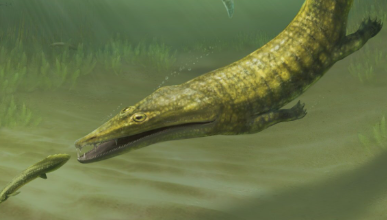
The long-overlooked fossil fragments were found to represent at least two distinct species. Alongside the original large, broad-headed apex predator Erythrobatrachus, researchers identified Aphaneramma, a long-snouted specialist adapted for catching small fish. Although both species inhabited the same coastal waters, they occupied different ecological niches, highlighting early ecosystem complexity during the dawn of the Mesozoic era.
The discovery sheds new light on life’s rapid recovery after the catastrophic end-Permian mass extinction , often referred to as the “Great Dying.” Within just two million years of the event, these crocodile-like trematosaurids ,distant relatives of modern frogs and salamanders , had diversified and spread widely.
While Erythrobatrachus appears to have been endemic to Australia, Aphaneramma demonstrates a remarkable global footprint. Fossils of this species have been uncovered in regions as distant as the Arctic, Russia, Pakistan, and Madagascar, indicating strong transoceanic connections even during a volatile post-extinction world.
The findings suggest that early Mesozoic marine tetrapods were not isolated populations struggling for survival, but adaptable species that rapidly colonized new habitats as interconnected coastal environments reshaped the planet around 252 million years ago , just as the Age of Dinosaurs began.
Until now, much of the scientific focus on early marine tetrapods centered on discoveries in the Northern Hemisphere. This Australian evidence confirms that these ancient marine predators were globally distributed, filling apex roles across the supercontinents of the time.
The long-lost Kimberley fossils are now being repatriated to Australia. The full study was published on February 22 in the Journal of Vertebrate Paleontology, providing new insight into how quickly complex marine ecosystems rebounded after Earth’s greatest extinction event.