Stranded Whale Rescue Germany: “Timmy” Humpback Whale Escapes Baltic Sandbank, Gets Trapped Again in Dramatic Maritime Rescue Effort
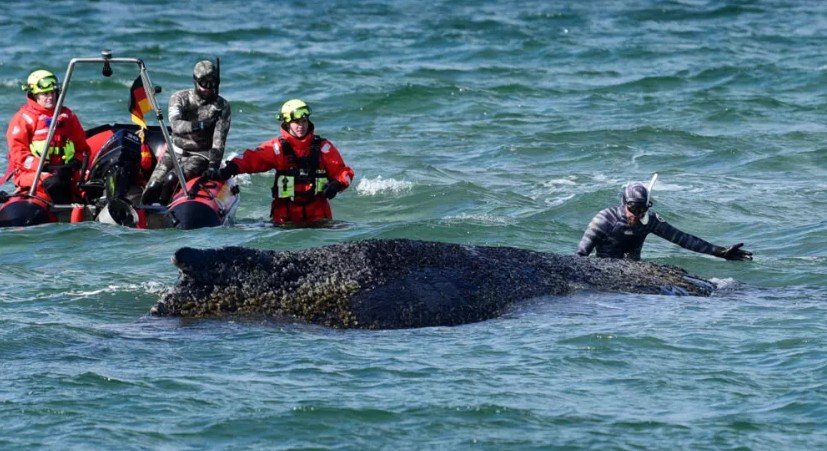
A complex stranded whale rescue operation in Germany has entered a critical scientific phase after a humpback whale, known locally as “Timmy,” briefly freed itself from a Baltic Sea sandbank, only to become stranded again shortly afterward. The case is now being closely studied as both a maritime rescue mission and a marine biology event.
The 13.5-metre humpback whale, stranded near Poel close to Wismar, has drawn attention not only from the public but also from marine scientists analyzing whale stranding behavior in shallow coastal ecosystems.
Scientific Aspects of Whale Stranding
Marine biologists explain that whale stranding events are often caused by a combination of environmental, navigational, and physiological factors, including:
- Humpback whales rely on echolocation, but shallow sandy coastlines can distort acoustic signals, leading to disorientation.
- Rapidly changing tides in coastal regions like the Baltic Sea can leave large whales unable to reverse course.
- Weak or sick whales may drift into shallow zones and lose swimming strength over time.
- Some researchers suggest that anomalies in Earth’s magnetic field may interfere with whale migration pathways.
- Once stranded, whales often experience repeated cycles of escape attempts followed by collapse due to fatigue.
Scientists also note that repeated stranding, as seen in this case, can indicate neurological stress, dehydration risk, and muscular exhaustion, making timely intervention critical.
Ongoing Maritime Rescue Efforts
Rescue teams had been preparing a highly technical recovery plan involving inflatable lifting cushions and pontoons designed to safely elevate the whale from the seabed. The goal is to transport it back toward the North Sea, with potential relocation into the Atlantic Ocean.
However, the whale unexpectedly swam free before becoming stranded again on a nearby sandbank. Authorities described the behavior as both encouraging and concerning, suggesting the animal still has partial mobility but lacks sustained navigational control.
German environment officials, including Till Backhaus, stated that the whale appears to be “resting” rather than fully stranded this time, though experts remain cautious given the unpredictable nature of marine mammal behavior in shallow waters.
Scientific and Conservation Significance
Marine researchers emphasize that such events provide valuable data on:
- Climate change impacts on marine migration routes
- Acoustic pollution effects from shipping lanes
- Sediment shifting patterns in coastal ecosystems
- Stress biomarkers in stranded whales during rescue attempts
The case of “Timmy” is now being monitored as a real-time example of how marine ecosystems, human intervention, and animal physiology intersect during stranding events.
Read: Stranded Humpback Whale Crisis in Baltic Sea Raises Marine Conservation Concerns in Germany
Rescue Operation Continues
The whale was first spotted on 23 March near Lübeck, and has since experienced multiple stranding and escape cycles. Authorities previously feared survival was unlikely, but renewed rescue efforts have been approved under a last-ditch intervention plan supported by private maritime engineers, including stakeholders linked to MediaMarkt.
Rescue teams are now preparing for another coordinated attempt, combining marine biology expertise, offshore engineering, and real-time behavioral monitoring to maximize the whale’s survival chances.