India-Vietnam Strategic Partnership Targets $25 Billion Trade by 2030, Boosts Maritime Security and Defence Cooperation
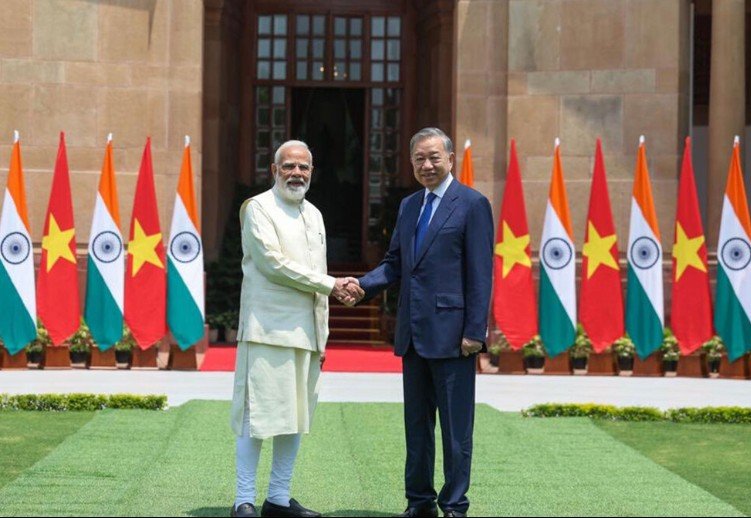
India and Vietnam have elevated their bilateral relationship to an “Enhanced Comprehensive Strategic Partnership,” marking a major step forward in Indo-Pacific cooperation, maritime security, defence manufacturing, digital payments, and critical mineral supply chains. The announcement came after high-level talks between Indian Prime Minister Narendra Modi and Vietnam’s General Secretary and President To Lam in New Delhi.
Under the new framework, both countries have set an ambitious target to increase bilateral trade to USD 25 billion by 2030, reflecting the growing economic and strategic alignment between two of Asia’s fastest-growing economies.
According to the Joint Statement issued after the meeting, India and Vietnam agreed to elevate ties “in the spirit of shared vision, strategic convergence, and substantive cooperation,” signaling deeper collaboration across defence, maritime affairs, advanced technology, logistics, renewable energy, and regional security.
The agreement is expected to strengthen India’s strategic footprint in the Indo-Pacific region while enhancing Vietnam’s role in regional maritime cooperation and supply chain diversification. The move also comes at a time when global shipping routes, maritime trade security, and rare earth supply chains are becoming increasingly important for regional stability and economic resilience.
Both countries agreed to expand investments in high-growth sectors including transport, smart agriculture, electric vehicles, renewable energy, information technology, healthcare, manufacturing, logistics, tourism, aquaculture, and agro-processing. The partnership is also expected to create new opportunities for maritime logistics, port connectivity, and digital trade integration across Asia.
India and Vietnam further agreed to improve market access for agricultural exports. Vietnam approved market access for Indian grapes, while India opened access for Vietnamese durians. Discussions are also underway to accelerate approvals for Indian pomegranates and Vietnamese pomelos, strengthening bilateral agri-trade.
A major highlight of the partnership is the growing defence and maritime collaboration between the two nations. The leaders agreed to expand cooperation in defence industrial production, joint research, co-development of advanced defence technologies, and defence procurement systems.
Maritime security emerged as a central pillar of the new partnership, with both sides reaffirming the importance of freedom of navigation, maritime domain awareness, and scientific cooperation in the Indo-Pacific. Vietnam welcomed India’s invitation to assign an International Liaison Officer at the Information Fusion Centre – Indian Ocean Region in Gurugram, a move aimed at enhancing regional maritime surveillance and information-sharing capabilities.
The strengthening of maritime cooperation is expected to reinforce regional naval coordination and support secure sea lanes in one of the world’s most strategically important shipping corridors.
India and Vietnam also announced plans to deepen cooperation in emerging technologies including artificial intelligence, Digital Public Infrastructure, 6G networks, biotechnology, marine sciences, pharmaceuticals, advanced materials, nuclear technology, and space research.
In a significant move for the fintech sector, the Reserve Bank of India and the State Bank of Vietnam signed a Memorandum of Understanding on financial innovation and digital payments. The agreement will promote QR code-based retail payment connectivity between the two countries, making cross-border tourism and business transactions easier.
Speaking after the talks, MEA Secretary (East) P Kumaran said the fintech partnership and cooperation in rare earth minerals underline the importance both countries place on supply chain resilience and economic diversification.
India and Vietnam also expanded cooperation in renewable energy, climate-resilient technologies, and critical minerals. A new agreement between IREL (India) Limited and Vietnam’s Institute for Technology of Radioactive and Rare Elements will focus on collaboration in rare earth exploration and processing, an increasingly strategic sector for global clean energy and technology industries.