India Expands Indo-Pacific Influence with Multinational IOS Sagar Naval Mission
India is steadily strengthening its maritime influence across the Indo-Pacific through the Indian Ocean Ship (IOS) Sagar initiative, a multinational naval deployment designed to deepen regional maritime security cooperation, interoperability, and trust among neighbouring nations.
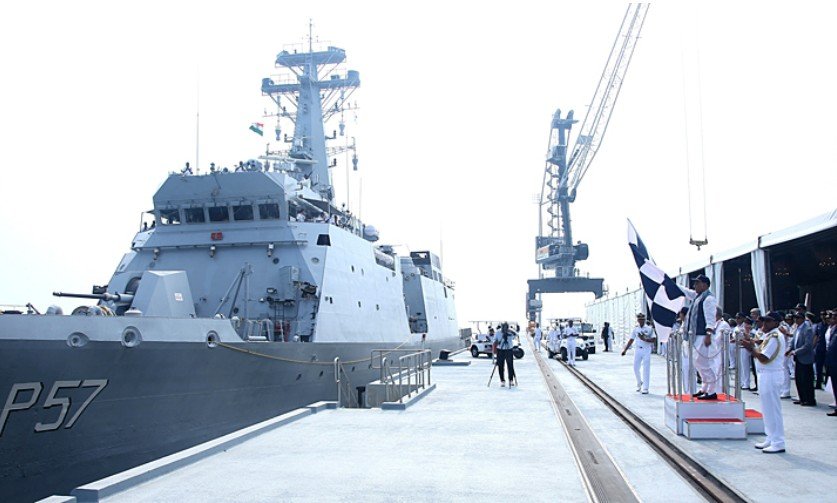
Last month, an Indian Navy warship departed from Mumbai carrying not only its Indian crew but also 38 naval personnel from 16 partner countries. The deployment covered key Indo-Pacific maritime routes and ports including the Maldives, Thailand, Indonesia, Singapore, Myanmar, Bangladesh, and Sri Lanka.
The latest voyage marked the second edition of IOS Sagar since its launch in 2025, with an expanded regional scope that highlights New Delhi’s growing ambition to position itself as a leading maritime security partner in the Indian Ocean Region (IOR).
Unlike traditional naval diplomacy missions that rely heavily on formal statements and symbolic port visits, IOS Sagar focuses on building operational trust at sea. Participating naval personnel trained together at Indian naval establishments under the Southern Naval Command in Kochi before deployment. The training included seamanship, maritime security operations, naval communication systems, safety protocols, and coordinated operational procedures.
By serving together aboard a single Indian naval platform, foreign naval personnel operated as an integrated multinational crew rather than mere observers. This approach allowed partner nations to gain practical operational exposure while improving interoperability among regional navies.
The initiative also enables mutual knowledge exchange. India benefits from learning advanced operational practices from partner countries, including Singapore’s highly automated naval systems and Sri Lanka’s expertise in Visit, Board, Search and Seizure (VBSS) operations.
India Strengthens Indo-Pacific Maritime Strategy
India’s expanding naval engagement with Southeast Asia reflects both rising geopolitical competition in the Indo-Pacific and New Delhi’s growing recognition of ASEAN’s strategic importance.
The designation of 2026 as the ASEAN-India Year of Maritime Cooperation underlines the increasing focus on regional maritime collaboration. At the same time, China continues to expand its naval footprint in the Indian Ocean through research vessel deployments, growing defence partnerships, and increased maritime activity across the region.
In response, India has intensified its naval diplomacy by increasing maritime presence, expanding bilateral and multilateral exercises, and enhancing operational cooperation with regional partners. Naval engagements now increasingly focus on anti-submarine warfare, maritime domain awareness, humanitarian assistance, disaster relief, counter-trafficking operations, and illegal fishing surveillance.
IOS Sagar also aligns with India’s broader MAHASAGAR initiative announced by Prime Minister Narendra Modi in Mauritius in March 2025, which seeks to deepen India’s outreach to the Global South and strengthen maritime partnerships across the Indian Ocean.
ASEAN Finds a Balanced Security Partner in India
ASEAN countries are increasingly viewing India as a reliable maritime security partner without the strategic pressures associated with the intensifying US-China rivalry.
India’s regional approach focuses on maritime capacity building, cooperative security, institutional engagement, and operational interoperability without imposing alliance obligations or ideological conditions. This positioning has strengthened India’s appeal among smaller Indian Ocean and Southeast Asian states seeking practical maritime cooperation while maintaining strategic autonomy.
The IOS Sagar initiative particularly addresses functional maritime challenges faced by regional states, including Exclusive Economic Zone (EEZ) monitoring, disaster response, illegal fishing, counter-smuggling, and maritime law enforcement.
Economic Challenges Remain for India’s Regional Ambitions
Despite growing naval engagement, analysts note that India still faces major economic challenges in competing with China’s broader regional influence.
Trade and investment gaps remain a significant weakness in India’s Southeast Asia strategy. While maritime cooperation enhances diplomatic and security ties, long-term regional influence will also depend on stronger economic integration and sustained commercial partnerships.
Another challenge lies in the diversity of IOS Sagar participants. The 16 participating nations do not form a unified strategic bloc. Many maintain strong economic and security ties with China, while others prioritise domestic development and maritime resource management over geopolitical competition.
Maintaining long-term participation in future IOS Sagar missions will therefore require India to remain flexible and responsive to the differing strategic interests of partner nations.
Future of IOS Sagar Depends on Shared Regional Ownership
The long-term success of IOS Sagar will depend not only on India’s continued commitment but also on whether the initiative evolves into a genuinely shared regional maritime platform.
Security analysts believe the credibility of the initiative could be significantly enhanced if India eventually introduces rotating co-leadership roles among participating navies. Such a move would reinforce the perception of IOS Sagar as a collaborative regional institution rather than solely an Indian strategic project.
As Indo-Pacific maritime competition intensifies, IOS Sagar is emerging as one of India’s most ambitious naval diplomacy initiatives ,combining maritime security cooperation, regional trust-building, and strategic outreach across the Indian Ocean and Southeast Asia.