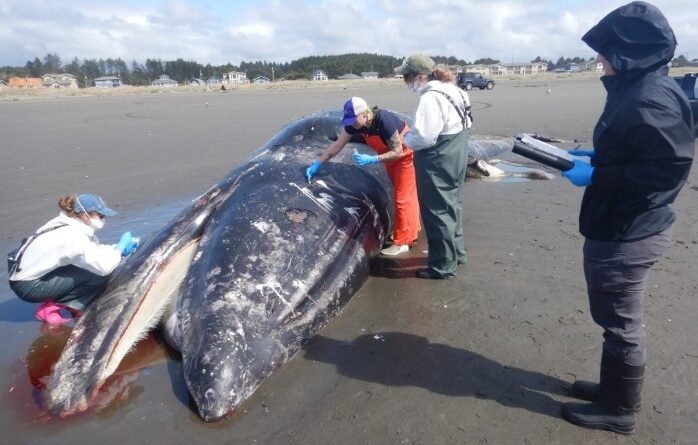
Malnourished Gray Whales in Eastern North Pacific Face Serious Decline as Strandings Surge on U.S. West Coast
Gray whale mortality along the U.S. Pacific coastline has surged in recent months, raising renewed concern among marine scientists about the long-term stability of the Eastern North Pacific population. In Washington state alone, 21 dead gray whales have washed ashore since March, many of them in visibly emaciated condition, according to research biologist John Calambokidis.
“I am alarmed,” said Calambokidis, founder of the Cascadia Research Collective, who has studied gray whales for decades.
Once considered a major conservation success story, the gray whale population has undergone a sharp and sustained decline over the past seven years, reversing years of recovery progress. Researchers report that many of the stranded whales show signs of severe malnutrition, weakness, and in some cases unusual behavior prior to death, including possible navigational disorientation likely linked to deteriorating physical condition.
Climate Change and Arctic Food Chain Disruption Driving Whale Mortality
Marine scientists say the crisis is strongly linked to climate-driven changes in Arctic ecosystems, particularly the loss and early melting of sea ice, which is disrupting the whales’ primary feeding grounds.
“We know it’s a food supply issue,” said Calambokidis. “We know the Arctic has gone through dramatic changes because of climate change.”
Gray whales depend heavily on Arctic feeding areas where they consume amphipods, tiny shrimp-like organisms,during their summer migration. However, researchers believe shifts in sea ice dynamics are altering the entire food chain.
According to Josh Stewart of Oregon State University’s Marine Mammal Institute, the Arctic ecosystem that once supported large whale populations is undergoing irreversible change. “They are very sensitive to these environmental conditions,” he said.
Collapse in Feeding Efficiency Leading to Starvation Risk
Scientists explain that traditional Arctic conditions allowed algae to grow under sea ice and later sink to the seafloor, enriching sediments and supporting amphipod populations. Gray whales would feed by scooping sediment from the ocean floor to consume these organisms.
Now, earlier sea ice melt is allowing sunlight to penetrate the water column sooner, shifting productivity toward phytoplankton in the upper layers and reducing nutrient transfer to the seabed. This change is believed to be reducing prey availability for gray whales at a critical feeding stage.
“For gray whales, the Arctic is their primary feeding zone,” Stewart noted, emphasizing that whales fast for much of the year outside the Arctic feeding window. This makes summer foraging success essential for survival during long migration periods.
Rising Strandings and Unusual Migration Behavior Observed
Since 2019, increased gray whale deaths have been classified by the National Oceanic and Atmospheric Administration (NOAA) as an “unusual mortality event.” Although a brief population rebound was observed in 2023, scientists say the overall trend has again turned downward.
Calambokidis noted that some whales have recently been observed in unusual locations, including one that entered Washington’s Willapa River before dying, possibly in search of food.
“As these animals become malnourished, they become more desperate,” he said, adding that weakened whales may also lose navigational ability.
Population Decline from Historic Recovery Levels
NOAA estimates indicate that the Eastern North Pacific gray whale population has declined from approximately 27,430 individuals a decade ago to about 12,950 last summer, though researchers caution that population models carry uncertainty.
Despite the decline, scientists do not currently believe the species is at risk of immediate extinction. However, they warn that the population is now significantly below levels recorded after its removal from the endangered species list in 1994.
Migration Patterns and Sub-Populations Show Varied Resilience
Most Eastern North Pacific gray whales migrate annually between Arctic feeding grounds and winter breeding lagoons in Mexico. However, smaller sub-groups show different behaviors and feeding strategies.
A small group known as “Sounders” feeds in northern Puget Sound and extends its range into the Bering and Chukchi Seas, while another group, the Pacific Feeding Group, comprising over 200 whales, feeds along coastal waters of the U.S. West Coast and southern Canada.
Researchers suggest these alternative feeding strategies may help certain sub-populations withstand environmental pressures more effectively.
Recovery Progress Reversing Under Environmental Stress
Historically, gray whales were heavily depleted by commercial whaling in the 19th and early 20th centuries, with populations falling to an estimated few hundred individuals. Following international protection measures and conservation laws, the species rebounded strongly and became one of the fastest-recovering whale populations globally.
However, scientists now warn that climate change-driven ecosystem disruption is reversing parts of that recovery.
“We’re significantly lower in abundance than when the species was delisted from the Endangered Species Act, so we are in uncharted territory from a recovery perspective,” Stewart said.