Op-Ed: Strong Marine Protected Areas: The Foundation of a Sustainable Blue Economy
By Aiman Haider
As the global ocean economy races toward $3 trillion, the science is unambiguous, only genuinely protected seas can sustain the prosperity we seek. Paper parks will not save us.
Civilisations have always been shaped by the seas they bordered, but never before has humanity faced so stark a reckoning with the ocean it depends upon. We are, in the same breath, the most ambitious exploiters and the most consequential destroyers of marine ecosystems in recorded history. Shipping lanes multiply, offshore wind arrays proliferate, deep-seabed mineral licences are auctioned, and industrial trawlers sweep corridors of ocean floor that took millennia to build, all in pursuit of a blue economy now valued at trillions of dollars. And yet the very biological engine powering that economy, the reef systems, the migratory fish populations, the kelp forests and the coastal nurseries, is being dismantled at a pace that should alarm every boardroom, legislature, and port authority on Earth. As we mark World Ocean Day 2026, the evidence is no longer ambiguous, nor is the prescription. Strong, properly enforced Marine Protected Areas (MPAs) are not a constraint on blue economy growth; they are its most indispensable precondition.
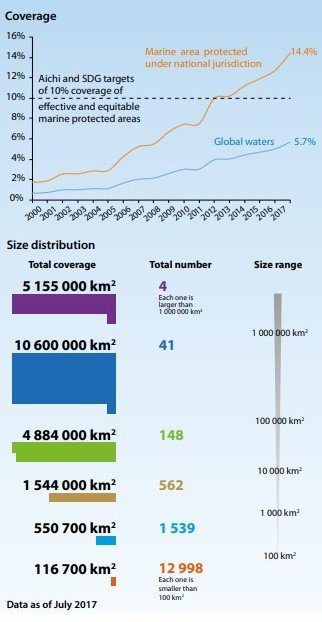
Global MPA Coverage Growth (2000-2017)
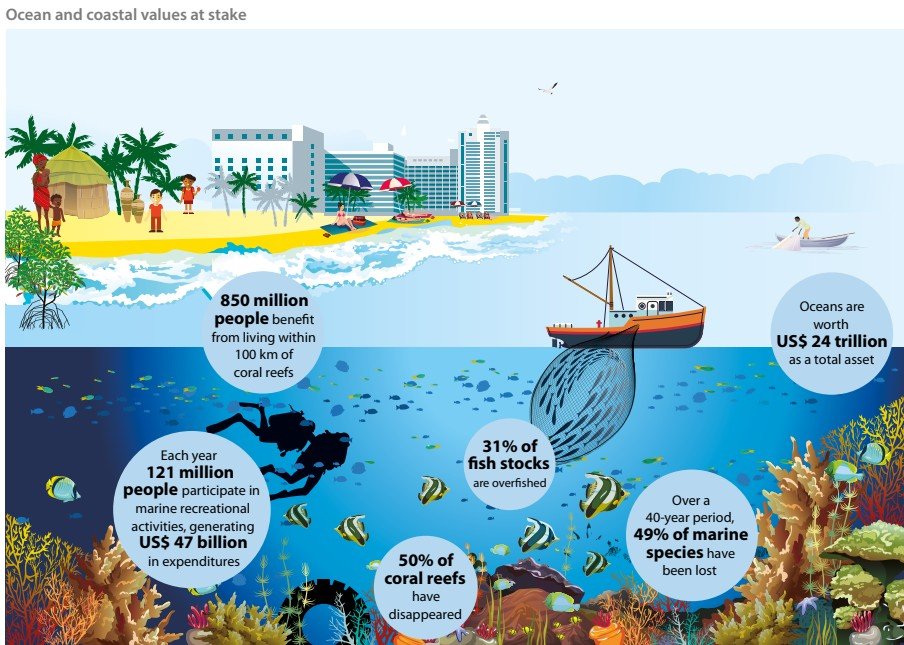
Ocean and Coastal Values at Stake
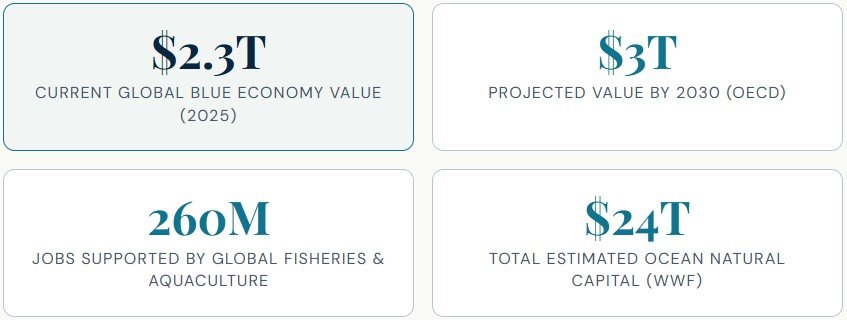
Today, the global ocean economy is valued at approximately $2.3 trillion and is projected to reach $3 trillion by 2030, according to OECD estimates cited by the World Bank and multiple United Nations bodies.1,2 Fisheries and aquaculture alone contribute $100 billion per year and support roughly 260 million jobs worldwide.3 These are staggering numbers. Yet they are numbers built on a crumbling biological foundation. Overfishing has impacted marine biodiversity and ecosystems both directly, through the removal of significant biomass, and indirectly, by severing the ecological linkages that make fisheries productive in the first place.4
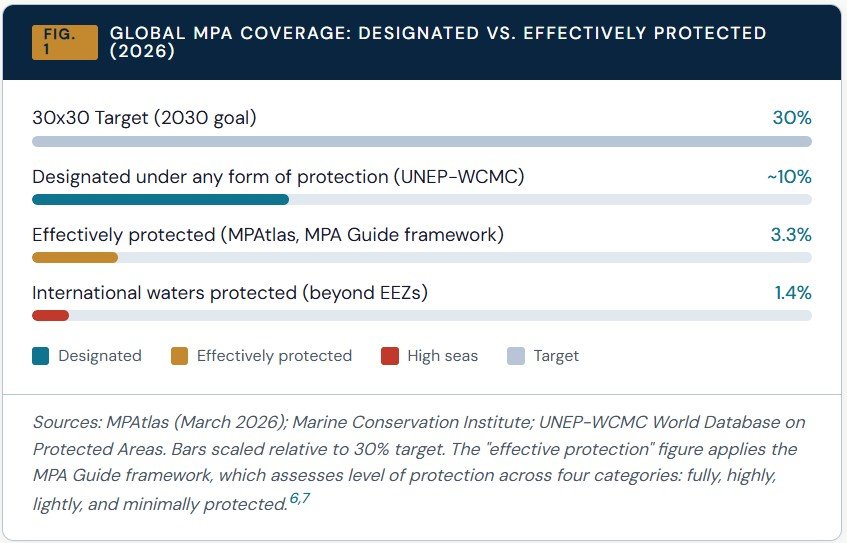
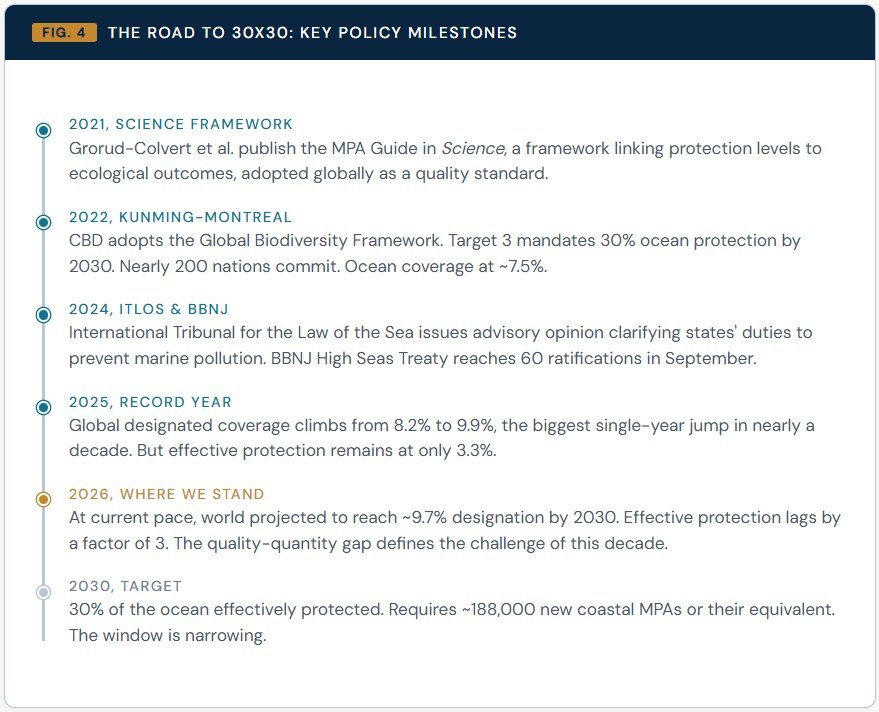
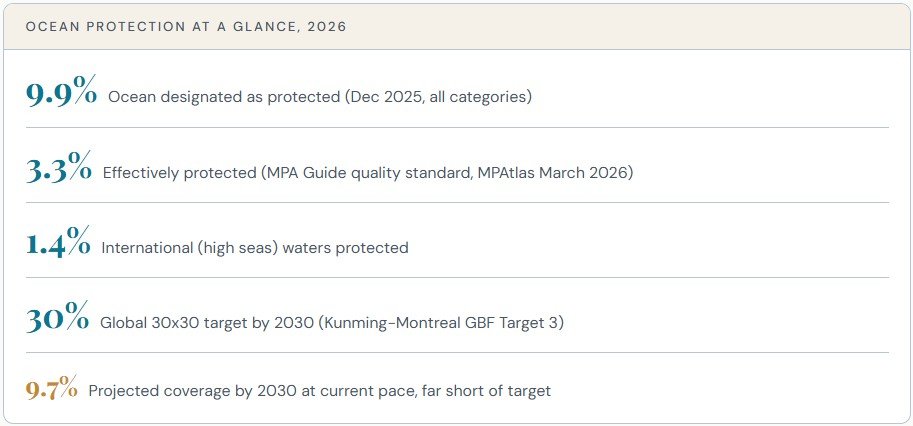
The solution is not complicated to articulate, even if it is formidably difficult to execute: we must translate international commitments into genuinely protective ocean governance. The Kunming-Montreal Global Biodiversity Framework, adopted in 2022, enshrined Target 3, to conserve 30% of the planet’s land, waters, and seas by 2030 (“30×30”). Yet as of March 2026, the Marine Protection Atlas reports that only 3.3% of the ocean is effectively protected, a figure that contrasts starkly with the 10% headline coverage reported by the UN Environment Programme.5,6 This gap between designation and genuine protection is not a technicality. It is the difference between ecosystems that recover and those that collapse.
The Science of Strength: Why Level of Protection Matters
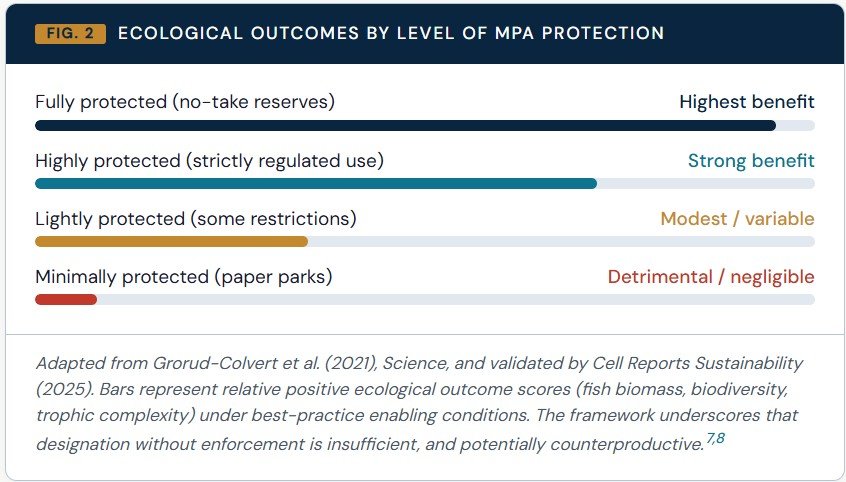
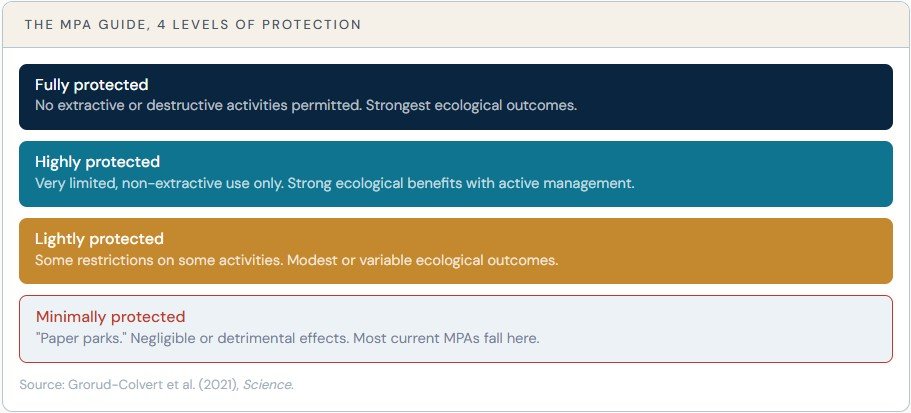
The marine science community has for decades been accumulating evidence on a question that should be central to any blue economy strategy: do all MPAs deliver the same results? The answer, unambiguously, is no. A landmark study published in Science by Grorud-Colvert et al. (2021) established the MPA Guide, a framework classifying marine protected areas into four levels of protection: fully, highly, lightly, and minimally protected, and systematically linked level of protection to ecological outcomes.7 The conclusion was decisive: strongly protected areas deliver substantially greater biodiversity and biomass benefits than lightly or minimally protected ones.
This was reinforced by a 2025 study in Cell Reports Sustainability, which used the MPA Guide framework across 123 MPAs and found that actively managed, highly protected areas showed significantly more positive ecological outcomes than those merely designated but not enforced.8 Minimally protected, implemented-only MPAs were found to produce detrimental outcomes for fish, suggesting that a poorly designed MPA can be worse than no MPA at all. The message for policymakers is unambiguous: count quality, not just quantity.
“Implemented MPAs that are minimally protected show detrimental outcomes for fish. Actively managed MPAs have positive outcomes, whereas those only implemented do not. “Cell Reports Sustainability, 2025 (MPA Guide framework study across 123 MPAs)8
The Spillover Dividend: Conservation as Investment
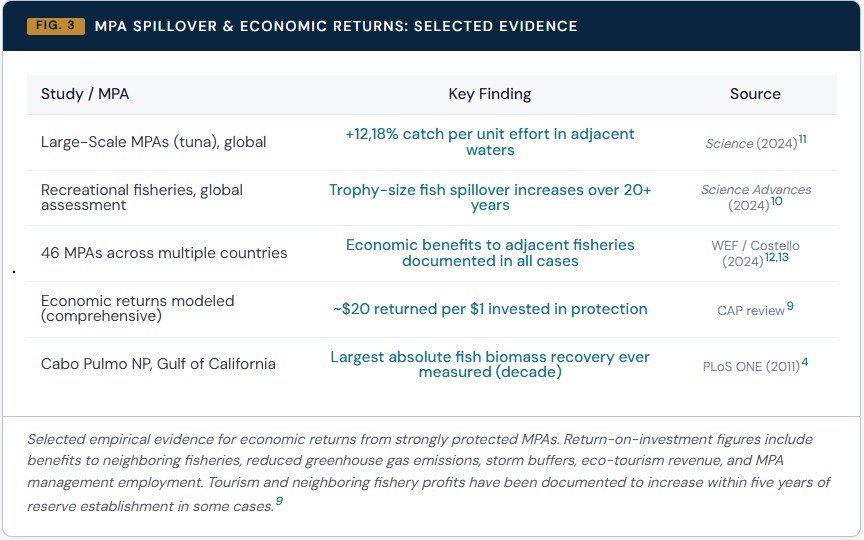
Perhaps the most commercially compelling argument for strong MPAs is the spillover effect, the movement of fish and larvae from protected areas into adjacent fisheries, replenishing stocks that would otherwise collapse. The metaphor deployed most effectively by economists is that of a savings account: the MPA protects the “principal,” while spillover delivers the “interest.”9 And the interest, it turns out, is substantial.
A study published in Science Advances (Franceschini et al., 2024) provided the first standardised global assessment of MPA spillover benefits to recreational fisheries, confirming that highly-protected ecosystems produce tangible, real-world, long-term benefits for fishers, with the strongest effects emerging after more than 20 years of protection.10 More dramatically, a December 2024 study published in Science examined large-scale MPAs including Mexico’s Revillagigedo and found spillover effects resulting in a 12-18% increase in catch-per-unit-effort in adjacent waters, with the strongest benefits for bigeye tuna.11 The nations that conserve, the researchers found, are the same nations that reap the greatest economic rewards.
Climate Shields: MPAs in the Age of Ocean Warming
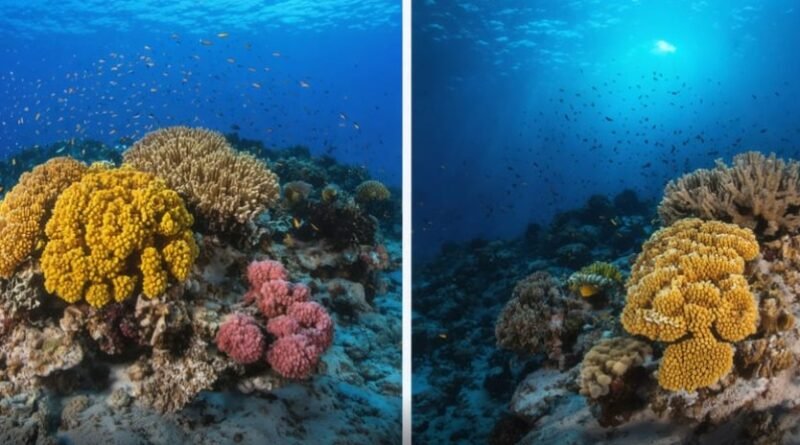
No argument for strong MPAs in 2026 can ignore the climate emergency bearing down on marine ecosystems. Marine heatwaves are intensifying in frequency and magnitude, and coral reefs, which harbor a third of all marine species in just 0.2% of the ocean’s area and provide services to over 450 million people within 100 kilometres of their shores, face catastrophic decline. A November 2025 study in Nature Communications simulated coral eco-evolutionary dynamics across 3,800 reefs of Australia’s Great Barrier Reef and projected rapid coral decline by mid-century under current emissions trajectories, with collapse possible by 2100 unless warming is held below 2 degrees C.14
Into this bleak prognosis, MPAs offer a critical, evidence-backed ray of possibility. A landmark 2024 study in Nature Communications (Benedetti-Cecchi et al.) examined 71,269 time-series of population abundances for 2,269 reef fish species at 357 protected versus 747 open sites worldwide. The findings were striking: protection mitigates the adverse effects of marine heatwaves on fish abundance, community stability, and functional richness. Protected networks maintained persistent fish communities in warming oceans by sustaining large populations and promoting asynchronous fluctuations that buffer against local extinctions.15
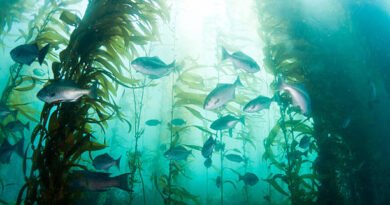
Separately, a 2025 study in the Journal of Applied Ecology demonstrated that California’s MPA network enhanced climate resilience for kelp forest ecosystems facing severe marine heatwaves, providing empirical evidence to help set “realistic expectations for MPA outcomes under climate impacts.”16 Kelp forests are ecologically and economically critical for coastal communities: they are nursery grounds, carbon sinks, and tourism magnets simultaneously.
“Protection mitigates adverse effects of marine heatwaves on fish abundance, community stability, asynchronous fluctuations and functional richness. “Benedetti-Cecchi et al., Nature Communications, 202415
The Quantity-Quality Trap: A Warning Against Bluewashing
Accelerating progress toward 30×30 is urgent, but acceleration without rigour is dangerous. A November 2025 analysis in npj Ocean Sustainability warned explicitly that conservation success depends on MPA quality, not merely area coverage. The study found that existing MPAs are disproportionately under-protected: over 80% of EU MPAs only marginally regulate human activities, according to a 2024 study in One Earth cited therein.17 The Bloomberg Ocean Fund’s 2025 report found that the global protected area network had grown by only 0.5 percentage points since 2022, to 8.3%, “still nearly 2% short of the 10% target that 30×30 replaced.”18
The mathematics of the deficit are sobering. A 2025 analysis in Marine Policy calculated that achieving 30% protection of territorial seas alone would require creating an additional 1.68 million km2 of MPAs, roughly 188,000 coastal MPAs at an average size of 10 km2, or protecting approximately 1,000 km2 of nearshore areas every single day for six years.19 At the current pace, the world is on track to reach only 9.7% by 2030.18
Governance, Equity, and the “Blue Justice” Imperative
Strong MPAs are not simply a matter of drawing lines on nautical charts. The emerging concept of “blue justice”, the fair distribution of marine benefits, has gained significant traction in scholarly literature, emphasising equity, accountability, and transparent decision-making as non-negotiable pillars of effective ocean governance.20 Conservation that dispossesses small-scale fishers to create exclusive tourist zones is not conservation, it is dispossession with scientific branding, and it will fail on both ecological and ethical grounds.
Research consistently shows that MPAs with genuine community engagement, adaptive management, and monitoring deliver better outcomes than top-down designations.8 The most celebrated example remains Cabo Pulmo National Park in Mexico’s Gulf of California: a no-take reserve driven by strong community leadership and social cohesion produced the largest absolute increase in fish biomass ever measured in a marine reserve worldwide within a single decade, a recovery that translated directly into economic benefits for local fishers.4 The lesson is not that exclusion works, but that genuine protection, with community buy-in and real enforcement, produces extraordinary outcomes.
At the international level, governance frameworks are catching up with the science. The 2025 European Ocean Pact committed EUR1 billion toward growing a competitive, sustainable blue economy by tightening links between marine planning, investment and open data.21 The High-Level Panel for a Sustainable Ocean Economy, representing 18 nations covering 50% of global coastlines, has committed to protecting 30% of the ocean by 2030 while sustainably managing 100% of national ocean areas.21 These are promising signals, but signals require conversion into enforceable, funded reality.
What Strong Protection Actually Means
The MPA Guide defines “strongly protected” as encompassing fully and highly protected areas, those that prohibit or strictly limit extractive and destructive activities.7 Fully protected no-take reserves deliver the strongest ecological benefits: a comprehensive meta-analysis confirms that fish biomass in fully protected areas is substantially higher than in partially protected or unprotected areas, and that trophic cascades, the recovery of apex predators, restore the ecological complexity that makes marine systems resilient.22
Critically, the application of genomic and environmental DNA (eDNA) tools, so-called “omics,” is providing new capacity to design, monitor, and evaluate MPA networks at scale, connecting the emerging blue economy strategy to the conservation of ecosystem services that underpin it.23 These tools can detect biodiversity changes invisible to traditional survey methods, enabling adaptive management at the speed that ecosystem pressures demand.
“Each $1 invested in strongly protected MPAs returns approximately $20 in benefits, including gains to neighboring fisheries, carbon capture, storm protection, eco-tourism, and scientific discovery.”Center for American Progress, synthesising multi-study economic analysis9
A Call to Action on World Ocean Day 2026
The science is not in dispute. Strong marine protected areas restore fish biomass, stabilise reef fish communities under climate warming, generate economic spillover benefits, and return roughly $20 for every $1 invested. The question is one of political will and institutional coherence, whether the nations that signed the Kunming-Montreal framework will translate a pledge into patrol vessels, enforcement budgets, community benefit-sharing mechanisms, and genuine no-take zones.
On this World Ocean Day, the maritime community, shipowners, port authorities, offshore energy developers, fishers, marine scientists, coastal communities, must coalesce around a single, evidence-grounded proposition: a sustainable blue economy is only possible on the foundation of a strongly protected ocean. The sea does not negotiate. It either recovers under genuine protection, or it does not recover at all.
The global community has coalesced around 30×30 as a planetary imperative. The decisions taken in 2026, on enforcement budgets, on MPA quality standards, on the BBNJ Treaty’s implementation, on equity frameworks for coastal communities, will shape the health of the ocean for decades. We are, as the Bloomberg Ocean Fund put it, at the halfway point of the Ocean Decade. The second half must be defined not by the area we designate on maps, but by the life we restore beneath the waves.
References
1.Grantham Research Institute on Climate Change and the Environment, LSE. “What is the blue economy?” LSE/Grantham Explainer. December 2024.
2.Earth.Org. “Blue Economy: Frameworks, Policies and Challenges.” April 2026.
3.United Nations, DESA. “Exploring the potential of the blue economy.” UNDESA Ocean Conference.
4.Aburto-Oropeza O, et al. “Large Recovery of Fish Biomass in a No-Take Marine Reserve.” PLoS ONE. 2011; 6(8): e23601.
5.Bloomberg Ocean Fund. “30×30 in the Ocean: Reflecting on 2025 Ocean Protection Progress.” December 2025.
6.Marine Conservation Institute. “10% Protected. 3% Effective. The Widening Gap We Can’t Ignore.” On the Tide. April 2026.
7.Grorud-Colvert K, et al. “The MPA Guide: A framework to achieve global goals for the ocean.” Science. 2021; 373(6560): eabf0861.
8.Cell Reports Sustainability. “Marine protected areas stage of establishment and level of protection are good predictors of their conservation outcomes.” 2025.
9.Center for American Progress. “How Marine Protected Areas Help Fisheries and Ocean Ecosystems.” March 2026.
10.Franceschini S, et al. “A Global Test of MPA Spillover Benefits to Recreational Fisheries.” Science Advances. 2024.
11.Lynham J, et al. “Spillover benefits from large marine protected areas.” Science. December 2024.
12.World Economic Forum. “How marine protected areas can drive economic growth.” April 2024.
13.Costello MJ. “Evidence of economic benefits from marine protected areas.” Scientia Marina. 2024; 88: 1,17.
14.Bozec Y-M, et al. “A rapidly closing window for coral persistence under global warming.” Nature Communications. 2025; 16: 9704.
15.Benedetti-Cecchi L, et al. “Marine protected areas promote stability of reef fish communities under climate warming.” Nature Communications. 2024; 15: 1427.
16.Ortiz-Villa M, et al. “Marine protected areas enhance climate resilience to severe marine heatwaves for kelp forests.” Journal of Applied Ecology. 2025.
17.npj Ocean Sustainability. “Quality of marine protected areas is critical to achieving global biodiversity targets.” November 2025.
18.Bloomberg Ocean Fund report. “Targets to save 30% of the ocean by 2030 aren’t being met.” June 2025.
19.Marine Policy. “A pathway to protect 30% of coastal waters by 2030.” May 2025.
20.Frontiers in Marine Science. “Governing the blue economy in arid coastal regions.” January 2026.
21.npj Ocean Sustainability. “Balancing the blue economy and multiple stressor management in marine spatial planning.” March 2026.
22.Nature Index, Marine Protected Areas and Biodiversity Conservation. Meta-analysis synthesis. (accessed June 2026)
23.Jeffery NW, et al. “Application of Omics Tools in Designing and Monitoring Marine Protected Areas For a Sustainable Blue Economy.” Frontiers in Genetics. 2022; 13: 886494.
Aiman Haider is associated with Blue Economy Research and Consulting (BERC) Pvt. Ltd. Her work focuses on blue economy development, marine sustainability, ocean governance, and coastal resource management. She is committed to advancing research and policy dialogue that support sustainable and inclusive growth in ocean-based sectors.