Russia Names Second Arctic LNG Carrier as Northern Sea Route Expansion Moves Forward
Russia has officially celebrated the naming of its second domestically supported Arctic LNG carrier, marking another milestone in the country’s ambitious strategy to expand Arctic energy exports and strengthen year-round shipping operations along the Northern Sea Route (NSR).
The naming ceremony took place on June 18 at the Zvezda Shipyard, where government officials highlighted the vessel’s importance to Russia’s transport, shipbuilding, and energy sectors. The new carrier forms part of a large-scale fleet development program designed to support the Arctic LNG 2 project and boost cargo transportation through Arctic waters despite ongoing challenges created by Western sanctions.
In a message delivered during the ceremony, Russian Prime Minister Mikhail Mishustin described the event as a significant achievement for the nation. He emphasized that the project supports Russia’s long-term objective of maintaining sustainable year-round navigation along the Northern Sea Route, a key maritime corridor connecting Arctic resource developments with global energy markets.
The Arctic LNG carrier program was launched before the conflict in Ukraine and originally called for the construction of 21 ice-class LNG vessels. Russian shipping giant Sovcomflot contracted the ships, with an initial plan involving partial construction in South Korea before final completion at the Zvezda Shipyard in Russia. Under the arrangement, Samsung Heavy Industries delivered five hulls before the project was disrupted, while Hanwha Ocean currently retains six vessels that remain undeliverable due to sanctions-related restrictions.
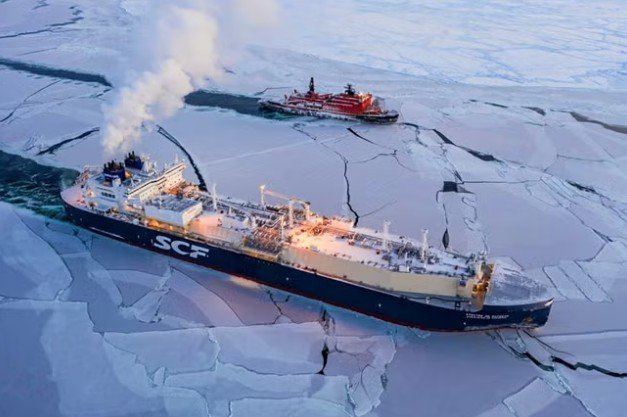
During the ceremony, Russian officials presented the newly named vessel as a major achievement for domestic shipbuilding and engineering capabilities. The LNG carriers are specifically designed for extreme Arctic conditions and are capable of independently navigating through ice up to 2.1 meters (6.9 feet) thick. Each vessel carries an ARC7 ice-class rating, making them among the most capable LNG carriers operating in polar regions.
The ships were constructed with financial backing from VEB.RF, Russia’s state development corporation, while technical supervision was carried out by the Russian Maritime Register of Shipping.
Russian Transport Minister Andrei Nikitin described the vessels as a critical element of the country’s Arctic shipping strategy. According to Nikitin, the fleet will play a central role in strengthening Russia’s maritime sovereignty and ensuring uninterrupted commercial operations along the Northern Sea Route throughout the year.
Sovcomflot highlighted the vessel’s advanced design and technical specifications. The LNG carrier features a cargo capacity of 172,600 cubic meters and incorporates optimized hull lines and highly efficient propulsion systems that enhance maneuverability in challenging ice conditions. The propulsion system generates 45 megawatts of power through three full-turn rudder propellers, each producing 15 megawatts. The vessel has a deadweight tonnage of approximately 81,000 dwt.
The newly named carrier, Konstantin Posyet, is the second ship in the series and honors the influential statesman recognized as a key figure behind the development of the Trans-Siberian Railway. The vessel will be homeported in St. Petersburg and operated by a crew of 29 Russian sailors.
According to Sovcomflot Chairman Sergey Frant, the delivery of the vessel represents an important step toward serial production of a new generation of Arctic transport ships. He noted that the design has already demonstrated strong performance during ice trials and commercial operations involving the lead vessel of the class, Alexey Kosygin, which entered service in December 2025.
Once operational, the Konstantin Posyet will serve under a long-term charter agreement with the Arctic LNG 2 project, supporting Russia’s growing LNG export ambitions and Arctic shipping infrastructure. Officials did not provide details regarding the delivery schedule for additional vessels in the series.
As Russia continues investing in Arctic LNG transportation, ice-class tanker technology, and Northern Sea Route infrastructure, the new carrier underscores the strategic importance of Arctic shipping in the country’s long-term maritime and energy development plans.