
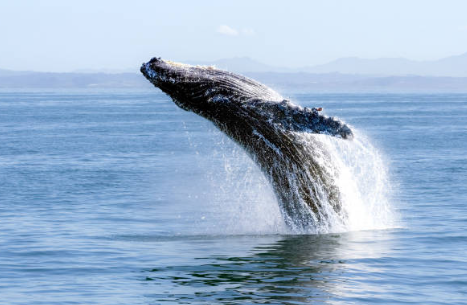
Endangered Arabian Sea Humpback Whale Completes Historic 4,350-Mile Journey across the Arabian Sea
Scientists record the first-ever direct evidence of an Arabian Sea humpback whale crossing the Arabian Sea, revealing critical insights for marine conservation, biodiversity protection, and ocean ecosystem management.
For the first time, marine biologists have documented an endangered Arabian Sea humpback whale making a remarkable long-distance journey across the Arabian Sea, marking a significant breakthrough in marine wildlife research and whale conservation.
The discovery, published in the scientific journal Frontiers in Marine Science, provides the first direct evidence that an Arabian Sea humpback whale (ASHW) can travel across the Arabian Sea, challenging previous assumptions about the movement patterns of one of the world’s most isolated whale populations.
Arabian Sea humpback whales are among the rarest marine mammals on Earth. Around 80 individuals are believed to survive off the coast of Oman, making them one of the most endangered whale populations globally. Unlike most humpback whales that undertake seasonal migrations between feeding and breeding grounds, Arabian Sea humpback whales are considered unique because they remain within the Arabian Sea throughout the year.
Researchers tracked 14 whales using satellite tags deployed in Hallaniyat Bay and the Gulf of Masirah in Oman. The tracking devices transmitted data for an average of 53 days, generating more than 1,800 location records and offering unprecedented insights into the daily movements of these elusive marine giants.
According to the study team, the Gulf of Masirah emerged as the most important habitat for the whales, accounting for approximately 57 percent of all recorded locations. Hallaniyat Bay represented another key area, contributing around 18 percent of tracked positions. Most whales remained within these productive waters or moved between Oman and northern Yemen, demonstrating strong habitat loyalty.
However, one whale delivered an extraordinary surprise.
A female whale named Luban, identified by a distinctive frankincense-shaped marking on her tail fluke, embarked on an unexpected eastward journey across the Arabian Sea. Satellite tracking revealed that Luban traveled as far as the western coast of India’s Goa region before eventually returning to Oman.
In total, Luban covered approximately 4,350 miles during her round-trip voyage.
While previous studies had detected similarities in humpback whale songs between Oman and India, Luban’s journey represents the first direct evidence of an Arabian Sea humpback whale physically crossing the Arabian Sea.
Scientists observed that Luban spent nearly a month in highly productive waters off southern India, an area known for abundant marine food resources. Researchers believe that both feeding opportunities and reproductive behavior may have influenced her long-distance movement, similar to migration drivers observed in humpback whale populations in the Atlantic and Pacific Oceans.
The study also sheds light on the unique ecological history of Arabian Sea humpback whales. Earlier research suggests that this population diverged from Southern Hemisphere humpback whales roughly 70,000 years ago, developing distinct behaviors and adapting to the Arabian Sea’s unusual environmental conditions.
The western Arabian Sea is enriched by seasonal monsoon-driven upwelling, which brings nutrient-rich waters to the surface and supports abundant marine life throughout the year. Researchers believe the whales primarily follow prey species such as sardines along the continental shelf, while deeper dives may be linked to searching for krill and other offshore food sources.
Scientists recently re-sighted Luban in the Gulf of Masirah, providing reassurance that the whale safely completed her historic journey.
The findings arrive at a critical time for marine conservation. Arabian Sea humpback whales face growing threats from climate change, warming ocean temperatures, fishing activities, vessel traffic, and habitat disturbance. Researchers note that parts of the Arabian Sea are warming approximately 1.5 times faster than the global ocean average, raising concerns about future impacts on marine biodiversity and whale habitats.
Conservation experts believe the new tracking data will help improve marine spatial planning and reduce interactions between whales and fishing operations. The information could prove valuable in protecting critical habitats and ensuring the long-term survival of this endangered population.
Read: Humpback Whale ‘Timmy’ Brought Ashore in Denmark after Months-Long Baltic Sea Rescue Effort
Researchers emphasize that additional vessel surveys and monitoring programs will be necessary to better understand how Arabian Sea humpback whales use their habitat and adapt to changing ocean conditions.
The study highlights both the resilience and vulnerability of one of the world’s most extraordinary whale populations, while providing fresh hope that improved scientific knowledge can support stronger conservation efforts across the Arabian Sea and the wider Indian Ocean region.