Canada’s $39 Billion Submarine Deal Enters Final Stage as South Korea and Germany Compete for Major Naval Contract
Canada is approaching a critical decision in its multibillion-dollar naval modernization program, with South Korea and Germany locked in a high-stakes competition for a submarine contract valued at approximately $39 billion (60 trillion won).
Under the Canadian Patrol Submarine Project (CPSP), the Royal Canadian Navy plans to replace its aging fleet of four Victoria-class submarines with 12 advanced 3,000-ton diesel-electric submarines, alongside decades of maintenance, repair, and overhaul (MRO) support.
With Ottawa expected to identify a preferred bidder by the end of the month, South Korea has intensified diplomatic and industrial efforts to secure what could become one of the largest submarine procurement deals in modern naval history.
South Korea Pushes Proven KSS-III Submarine Design
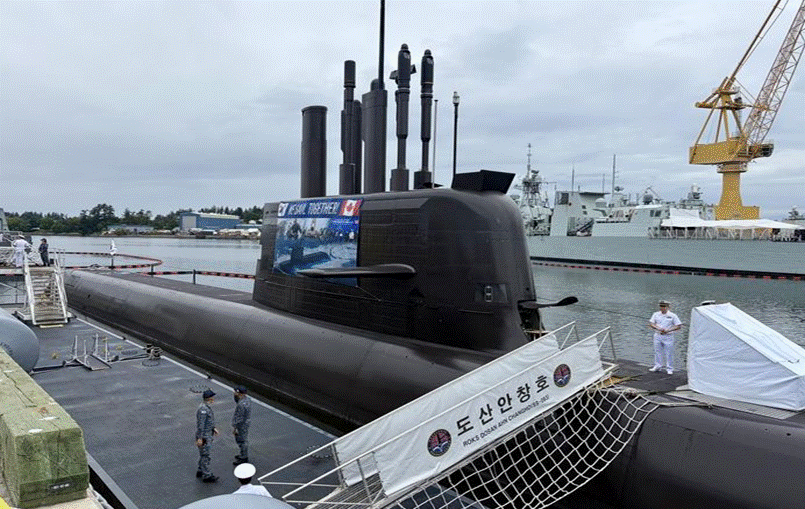
South Korea’s bid is led by Hanwha Ocean, which is offering the Dosan Ahn Chang-ho-class (KSS-III) submarine. The vessel is already operational with the Republic of Korea Navy, giving Seoul a significant advantage in demonstrating real-world performance and combat capability.
Hanwha Ocean has proposed delivering the first four submarines by 2035, with the full fleet of 12 vessels completed by 2043.
Industry analysts note that the KSS-III’s operational record could strengthen South Korea’s position against Germany’s Thyssenkrupp Marine Systems (TKMS) proposal, which is based on a design that has yet to enter active service.
According to naval experts, submarine performance represents only a portion of Canada’s evaluation criteria, while long-term support capabilities, industrial cooperation, and economic partnerships carry even greater weight.
High-Level Diplomacy Supports Korean Bid
The Korean government has elevated the competition to the highest diplomatic level. During a recent bilateral meeting with Canadian Prime Minister Mark Carney on the sidelines of the G7 Summit in France, President Lee Jae Myung highlighted South Korea’s readiness to contribute to Canada’s future defense requirements.
Seoul’s strategy extends far beyond submarine construction. The Korean consortium has signed roughly 75 memorandums of understanding (MOUs) with Canadian companies across sectors including energy, aerospace, liquefied natural gas (LNG), hydrogen technology, and crude oil development.
Hydrogen Investment Could Boost Canada’s Economy
One of the most notable elements of the Korean proposal is Hyundai Motor Group’s “Project Beaver,” a potential investment worth around 4 trillion won.
If South Korea secures the submarine contract, Hyundai plans to establish a comprehensive hydrogen mobility ecosystem in Canada, including hydrogen liquefaction facilities, refueling infrastructure, and a hydrogen-powered truck manufacturing plant.
The proposal aligns with Canada’s growing interest in clean energy development and could generate long-term industrial and employment benefits beyond the defense sector.
NATO Ties Remain Germany’s Key Advantage
Despite South Korea’s technological strengths, analysts caution that Germany maintains an important strategic advantage through its longstanding defense relationship with Canada under the NATO framework.
Germany and Canada already cooperate extensively on Arctic and North Atlantic security issues, areas that are becoming increasingly important as geopolitical competition intensifies in northern waters.
Defense researchers argue that Canada’s decision may ultimately depend not only on submarine capabilities but also on broader considerations such as Arctic interoperability, naval cooperation, and long-term strategic alignment.
Arctic Security and Naval Modernization at the Center of Decision
As Canada seeks to strengthen its naval presence in the Arctic and modernize its underwater warfare capabilities, the outcome of the submarine competition will have implications far beyond shipbuilding.
The winning bidder will gain a central role in shaping the future of Canadian maritime security, Arctic defense operations, and next-generation naval technology for decades to come.
With billions of dollars, thousands of jobs, and strategic military partnerships at stake, the Canada submarine project has become one of the most closely watched defense procurement competitions in the global maritime industry.