Yemen Unveils Roadmap for National Maritime Information Sharing Centre to Boost Red Sea Maritime Security
Yemen has taken a significant step toward strengthening maritime security by developing a comprehensive roadmap for its proposed National Maritime Information Sharing Centre (NMISC), a move designed to improve maritime domain awareness, enhance inter-agency coordination, and reinforce regional cooperation across the Red Sea and the Western Indian Ocean.
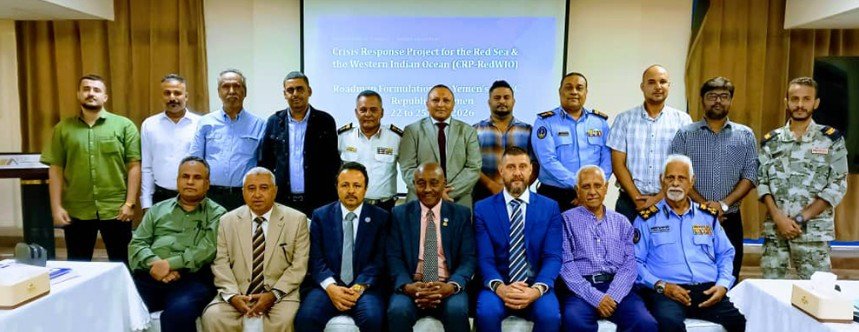
The roadmap was finalized during a four-day national workshop held from 22 to 25 June 2026 under the European Union-funded Crisis Response Project for the Red Sea and the Western Indian Ocean (CRP-RedWIO). The workshop was hosted by Yemen’s Ministry of Transport and facilitated by the International Maritime Organization (IMO).
The event brought together 23 representatives from Yemen’s leading maritime and security institutions to discuss practical measures for strengthening Maritime Domain Awareness (MDA) and improving the country’s integration into the regional information-sharing network established under the Djibouti Code of Conduct and Jeddah Amendment (DCoC/JA).
During the workshop, participants examined governance structures, operational concepts, staffing requirements, infrastructure needs, systems integration, and Standard Operating Procedures (SOPs) necessary to establish the NMISC. Through structured planning sessions, they assessed existing institutional capacities, identified operational and resource gaps, and agreed on a phased implementation strategy.
Under the approved roadmap, the NMISC will initially operate on a daytime watch schedule for its first two years, allowing Yemen to gradually expand its operational capabilities while building institutional capacity.
The workshop also confirmed that the multi-agency National Maritime Information Sharing Centre will be hosted at the Yemen Coast Guard Headquarters in Aden. In addition to serving as the national information-sharing hub, the centre will function as Yemen’s National Maritime Domain Awareness Centre, consolidating information from multiple government agencies into a unified maritime picture to support faster decision-making and coordinated responses to maritime security threats.
Meanwhile, the Regional Maritime Information Sharing Centre (ReMISC) will continue to operate under the Yemen Maritime Affairs Authority (YMAA), ensuring close coordination between Yemen’s national and regional maritime information-sharing responsibilities.
As part of broader governance reforms, Yemen’s Ministry of Transport committed to formally establishing the National Maritime Security Committee (NMSC) through a Government Decree. The committee will provide the legal framework needed to coordinate national maritime security policies and oversee the implementation of the NMISC.
Speaking during the workshop, Faheem Saif, Executive Chairman of the Maritime Affairs Authority, emphasized the committee’s strategic importance.
“A strong and empowered NMSC will provide the strategic direction and institutional coordination necessary not only for the successful establishment of the National Maritime Information Sharing Centre, but also for the effective implementation of Yemen’s broader National Maritime Security Strategy.”
Kiruja Micheni, IMO Project Manager, also commended Yemen for its leadership as Chair of the DCoC Working Group 1 on Information Sharing, recognizing the country’s continued role in strengthening regional maritime cooperation and advancing the DCoC Information Sharing Network.
Participants agreed that the NMISC should initially include seven permanently represented core agencies: the Yemen Coast Guard, Yemen Maritime Affairs Authority, Customs Authority, Yemen Ports Authority, Yemen Navy, National Security, and the Ministry of Fish Wealth. Additional government organizations will participate as operational requirements evolve.
The workshop also identified several critical infrastructure priorities, including dedicated workstations, resilient communication systems, reliable internet connectivity, backup power supplies, and integration with existing national and regional maritime information platforms.
To ensure effective cooperation with regional partners, attendees endorsed the DCoC/JA Information Sharing Standard Operating Procedures (2023) as the foundation for Yemen’s national SOPs, while recommending their translation into Arabic to encourage broader national implementation.
Read:Op-Ed: Inside the Life of Seafarers Navigating War Zones :Risk at Sea in 2026
Recognizing that information-sharing systems must be supported by effective operational capabilities, participants highlighted the importance of continued investment in the readiness of the Yemen Coast Guard and Yemen Navy, including personnel development, patrol vessels, operational assets, and logistical support.
Officials concluded that strengthening both the National Maritime Information Sharing Centre (NMISC) and the Regional Maritime Information Sharing Centre (ReMISC) will significantly improve Yemen’s ability to contribute to regional maritime security cooperation and enhance collective responses to maritime threats across the Red Sea and the Western Indian Ocean.