
Op-Ed: Inside the Life of Seafarers Navigating War Zones :Risk at Sea in 2026
Risk at Sea in 2026: A Structural Analysis
From the merchant mariners torched by U-boats in 1942 to the crews abandoning burning hulls in the Red Sea today, to the 20,000 seafarers now stranded in the Persian Gulf as Iran closes the Strait of Hormuz, the seafarer has always been history’s most forgotten combatant, a civilian who carries the world’s commerce through corridors of geopolitical fire, without armour, without recognition, and without adequate protection.
There is a particular cruelty embedded in the economics of maritime war risk. When a Houthi missile finds a container vessel in the Gulf of Aden, the insurance market recalibrates within hours, new war-risk surcharges flow immediately into the freight invoices of importers from Rotterdam to Karachi, and the shipping company’s stock ticks accordingly. What is not traded, not priced, not widely reported, is the terror inside the bridge.
The year 2026 finds the world’s 1.89 million seafarers1 confronting a trifecta of maritime war zones not seen simultaneously since the Second World War: the Red Sea and Gulf of Aden, the Black Sea, and the Baltic approaches. Three distinct geopolitical conflagrations have converged to make the global sea lanes, which carry approximately 90 per cent of world trade,2 into a dispersed battlefield.
To understand what this means for the men and women at sea, one must first resist the abstraction of maritime risk metrics. War-risk insurance premiums, freight rate indices, and Suez Canal tonnage figures are the instruments through which the shore-side world measures crisis. But behind each data point is a human being standing a night watch, perhaps a 27-year-old deck officer from Cebu, perhaps a chief engineer from Odessa, who has been told, implicitly if not explicitly, that the geopolitical calculations of states and non-state actors are now their problem to navigate.
I. The Historical Ledger: Precedents of Peril
The vulnerability of the civilian seafarer in wartime is not a novel condition. It is a recurring tragedy whose patterns have repeated themselves with grim fidelity across the centuries. The most instructive parallel is the Battle of the Atlantic (1939 to 1945), during which German U-boat wolfpacks prosecuted a sustained campaign against Allied merchant shipping that remains the deadliest sustained maritime campaign in modern history.3
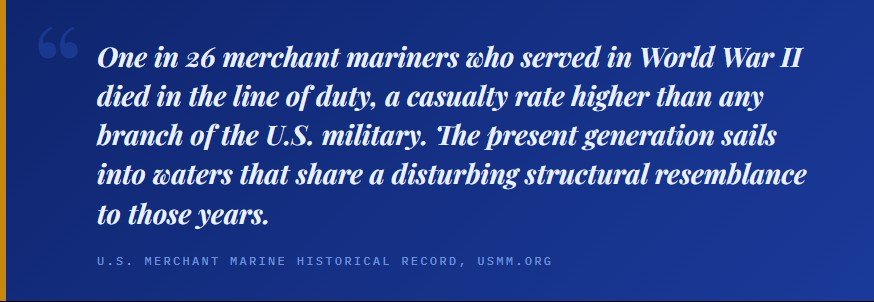
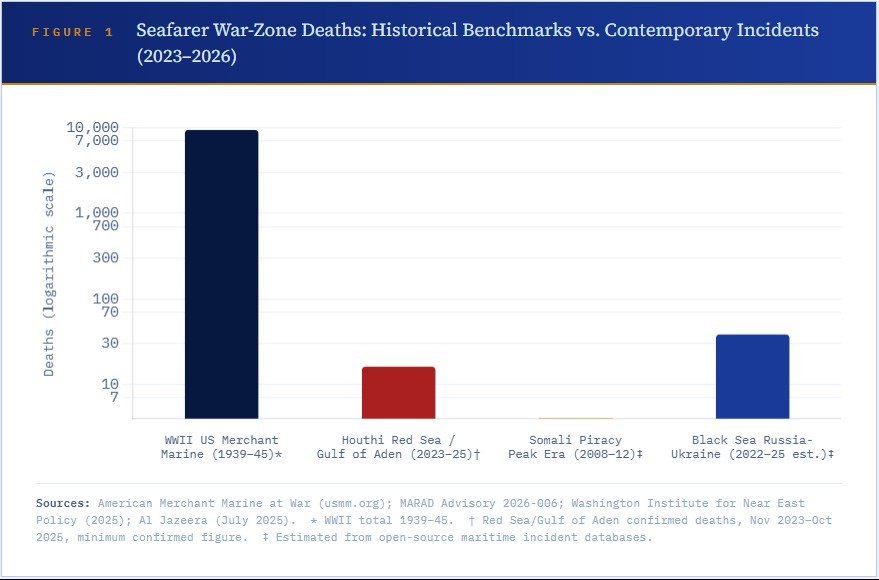
The arithmetic is staggering even at this remove. Approximately 8,300 American merchant mariners were killed at sea during the Second World War, with a further 12,000 wounded, of whom at least 1,100 subsequently died from their injuries.4 More than 1,500 ships were sunk. Statistically, the mortality rate of the U.S. Merchant Marine, one death for every 26 men who served, exceeded that of every branch of the conventional armed forces.5 These men were civilians. They received no veterans’ benefits for decades. There was, as one survivor recalled, never a parade.
The year 1942 was particularly savage. In March of that year alone, 27 ships from six Allied nations were sunk in American coastal waters, as U-boats ranged freely along the eastern seaboard. The experience of being torpedoed became so commonplace that the president of the Boston Seaman’s Club established a “40-Fathom Club” for those who had survived it, a grim index of just how routine catastrophe had become.6
What the historical record establishes, and what policymakers of the present age would do well to internalise, is that civilian seafarers have always absorbed a disproportionate share of the physical consequences of maritime warfare, while receiving a disproportionately small share of the political recognition and legal protection afforded to uniformed combatants.
II. The Present Constellation of Risk
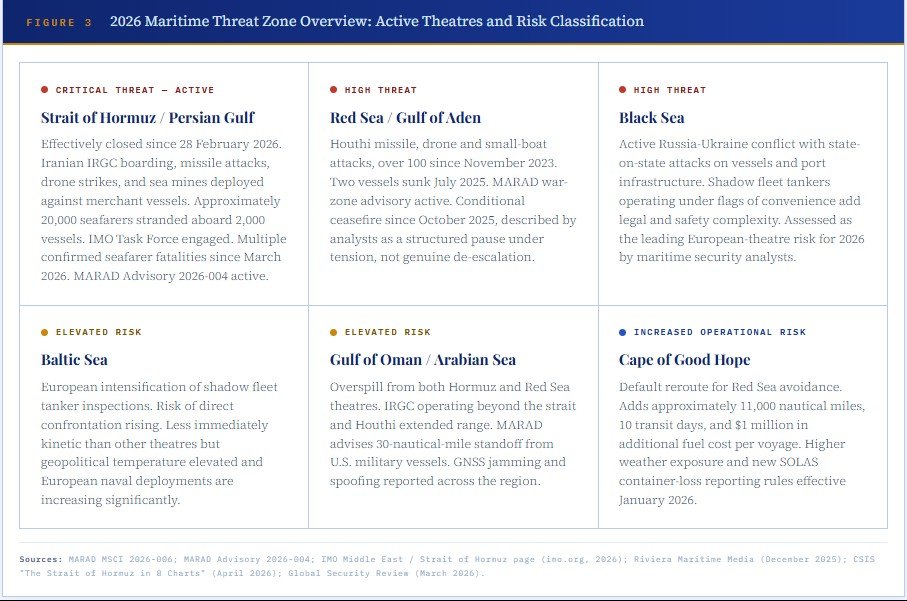
Four distinct theatres of maritime threat now converge to create an environment of cumulative danger unprecedented in the post-Cold War era, with the Strait of Hormuz crisis of 2026 representing the most acute rupture to global maritime order since the Second World War.
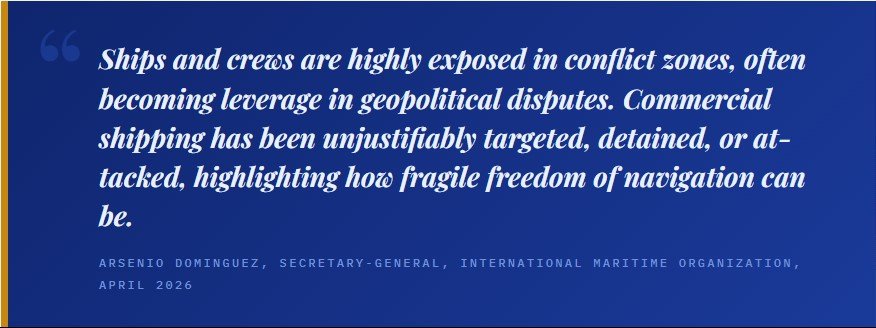
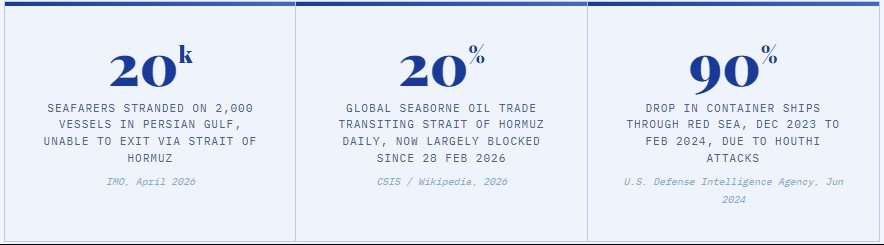
The Strait of Hormuz, at just 34 kilometres wide at its narrowest point, has been effectively closed to normal commercial traffic since 28 February 2026, when the United States and Israel launched military operations against Iran and Iran retaliated by deploying the Islamic Revolutionary Guard Corps Navy to board, attack, and mine merchant shipping in the Persian Gulf.7 The consequences are staggering in their scale. Approximately 20,000 seafarers, stranded aboard some 2,000 vessels unable to exit the Persian Gulf safely, have become, in the words of IMO Secretary-General Arsenio Dominguez, “leverage in geopolitical disputes.”8 Prior to the crisis, the strait facilitated the transit of approximately 20 million barrels of oil per day, representing roughly 20 per cent of global seaborne oil trade and 20 per cent of the world’s liquefied natural gas.7
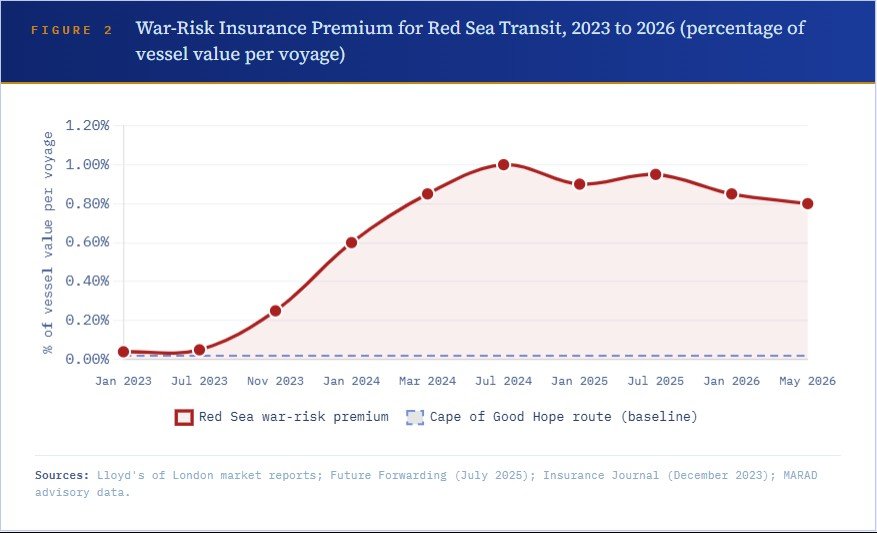
The human toll within the strait has been direct and documented. The IMO has recorded multiple fatal incidents since late February 2026, including four seafarer fatalities aboard the MUSSAFAH 2 on 6 March, one fatality on MKD VYOM on 1 March, three fatalities aboard MAYUREE NAREE on 11 March, one fatality on SAFESEA VISHNU on 11 March, and eight seafarers injured when the CMA CGM San Antonio was struck by a cruise missile on 5 May.9 War-risk insurance premiums for the strait surged from 0.125 per cent before the conflict to between 0.2 and 0.4 per cent per transit within days, representing an additional quarter of a million dollars per voyage for very large oil tankers.10
The Red Sea and Gulf of Aden constitute the second active theatre. Beginning in November 2023, the Houthi movement in Yemen launched a sustained campaign of drone, missile, and small-boat attacks against commercial vessels transiting the Bab el-Mandeb Strait, through which approximately 12 per cent of global container traffic historically passed.11 By late 2025, the Houthis had launched more than 100 attacks on commercial vessels, sinking two ships and killing a confirmed minimum of four seafarers, with the sinking of the Eternity C in July 2025, in which four more seafarers were killed and 15 went missing, extending the toll further.12
The third theatre is the Black Sea, where Russia’s invasion of Ukraine has persisted into its fourth year. Maritime analysts at the Global Salvage and Wreck Forum projected in December 2025 that the Black Sea would remain the most intense theatre for state-on-state maritime violence outside the Gulf region, with Russia and Ukraine continuing to exchange attacks on vessels and port infrastructure.13
The fourth arena is the Baltic Sea, where European states have intensified inspections of suspected shadow fleet tankers, raising the possibility of direct confrontation between inspecting vessels and their subjects.13
III. The Insurance Apparatus and Its Moral Gaps
The financial architecture of maritime risk has responded to the crisis with characteristic efficiency. War-risk insurance premiums for Red Sea transit, which stood at approximately 0.05 per cent of a vessel’s insured value per voyage before November 2023, surged to near 1 per cent of vessel value by mid-2024.14 In the Strait of Hormuz, premiums jumped from 0.125 per cent before the February 2026 conflict to between 0.2 and 0.4 per cent per transit within days, representing an additional quarter of a million dollars per very large oil tanker voyage.10 Taken together, these figures represent a repricing of the world’s two most critical energy chokepoints simultaneously, a development without modern precedent.
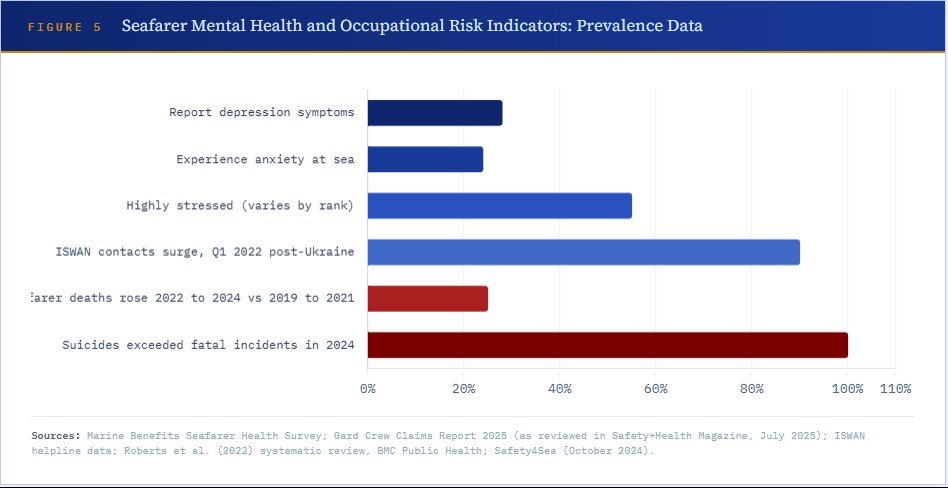
What the insurance actuarial tables do not and cannot capture is the psychological cost borne by crews. Mental health contacts to the International Seafarers’ Welfare and Assistance Network (ISWAN) increased by 126 per cent quarter-on-quarter when the Covid-19 crew-change crisis struck in 2020, and surged again by 90.3 per cent in the first quarter of 2022 in the wake of Russia’s invasion of Ukraine.15
A 2025 systematic review in peer-reviewed literature identified the following as primary risk factors for poor mental health among seafarers: feeling unsafe, high job demands, long working hours, poor sleep, poor social support, and scheduling uncertainties.16 Every one of these factors is acutely present for crews currently transiting active threat zones, and for the 20,000 who are not transiting at all but are simply waiting, trapped, in the Persian Gulf.
IV. The Anatomy of Abandonment
The attack sequence of July 6 to 9, 2025 on the Eternity C provides a clinical illustration of what war-zone seafaring looks like at the human level. According to the Washington Institute for Near East Policy, Houthi gunboats directed fire specifically at the ship’s bridge, the location of the watch officer, the navigator, and the most experienced personnel aboard.17 The vessel subsequently sank and surviving crew members were taken hostage.
The Washington Institute’s analysis was unsparing: the only entities able to intervene were private maritime security firms, which have limited capabilities.17 The world’s most sophisticated naval alliance, NATO, could not or did not provide protection to a civilian crew in imminent mortal danger. This is not a critique of individual naval commanders. It is a structural indictment of the international community’s failure to translate its stated commitment to freedom of navigation into practical protection for the people who actually navigate.
The United Nations Security Council adopted Resolution 2722 in January 2024, condemning the Houthi attacks and affirming freedom of navigation.18 Four seafarers were confirmed dead in the Red Sea within six months of that resolution. The gap between declaratory policy and operational protection is, in this case, measurable in human lives.

V. The Psychology of the Perpetual Threat
Clinical psychology offers a relevant framework for understanding what sustained exposure to uncertain mortal threat, threat that may or may not materialise on any given watch, does to the human nervous system. The risk factors identified in the peer-reviewed literature on seafarer mental health do not operate in isolation. They interact multiplicatively with the additional stressor of what clinicians term hypervigilance, the sustained alertness that characterises response to an environment of unpredictable danger.
The 2025 Gard Crew Claims Report, based on review of approximately 3,000 cases involving more than 6,000 seafarers, found that seafarer deaths rose 25 per cent between 2022 and 2024 compared with the previous three-year period, and that suicides among crew in 2024 exceeded the number of fatal workplace incidents.19 Study data from the Marine Benefits health survey found that 28 per cent of seafarers experience depression and 24 per cent experience anxiety, with between half and two-thirds reporting high levels of stress depending on rank.15 These are pre-crisis baseline figures, collected before the current multi-theatre emergency, now encompassing four simultaneous war zones, matured into its present form.
to
1945
German U-boat wolfpacks prosecute the deadliest sustained campaign against civilian maritime personnel in modern history. Approximately 9,300 American merchant mariners are killed at sea, with a further 12,000 wounded, of whom at least 1,100 subsequently die. More than 1,500 Allied ships are sunk.
The mortality rate of the U.S. Merchant Marine, one death for every 26 men who served, exceeds that of every branch of the U.S. armed forces. Casualty figures are classified throughout the war to maintain morale and conceal losses from the enemy. There is, as one survivor later recalled, never a parade.
and
2006
The United Nations Convention on the Law of the Sea (UNCLOS, 1982) codifies freedom of navigation as a foundational principle of international law. The Maritime Labour Convention 2006, entering force in 2013, establishes the first comprehensive framework of seafarer labour rights, including minimum wages, rest hours, and repatriation entitlements.
Neither instrument comprehensively addresses the rights or protections of civilian seafarers transiting active war zones, or their right to refuse such transit without punitive consequences to their employment. This gap remains unresolved in 2026.
to
2016
Somalia-based piracy reaches its peak, with over 40 vessels held simultaneously at the height of the crisis. Seafarers endure extended captivity, threats of violence, and psychological trauma. The international response, including the multinational naval task force CTF-151 and the EU’s Operation Atalanta, provides a partial precedent for coordinated maritime security operations.
However, the deterrence model effective against piracy, naval presence, vessel hardening, and armed escorts, proves structurally insufficient against the ballistic missiles and precision drones deployed in later conflict theatres.
2022
Russia’s full-scale invasion of Ukraine transforms the Black Sea into an active conflict zone. Ukrainian and Russian ports are effectively closed to normal commercial traffic for extended periods. Merchant vessels transiting the region face risk of missile attack and naval interdiction.
The psychological consequences manifest rapidly. ISWAN helpline contacts from seafarers surge 90.3 per cent quarter-on-quarter in Q1 2022, one of the sharpest recorded spikes in maritime welfare data. The shadow fleet of sanctions-evading tankers grows, adding legal and safety complexity to the region’s navigational environment.
2023
The Houthi movement in Yemen launches a sustained campaign of drone, missile, and small-boat attacks against commercial vessels transiting the Bab el-Mandeb Strait. More than 100 attacks follow over the next two years. By February 2024, 40 vessels have been struck and container traffic through the Red Sea falls 90 per cent. Two vessels are sunk, one is seized. The first fatal attack occurs in March 2024, killing three seafarers aboard MV True Confidence in the Gulf of Aden, including two Filipino nationals.
The sinking of the Eternity C in July 2025 kills four further seafarers and leaves 15 missing. A Dutch-flagged cargo ship is struck by a Houthi missile on 9 July 2025, killing one mariner. UN Security Council Resolution 2722, adopted January 2024, condemns the attacks but fails to halt them.
2026
U.S. and Israeli military strikes on Iran trigger the most severe disruption to global maritime commerce since the Second World War. Iran’s Islamic Revolutionary Guard Corps Navy responds by deploying missile attacks, armed drones, sea mines, and boarding operations against merchant shipping in the Persian Gulf and Strait of Hormuz. The strait, carrying approximately 20 per cent of global seaborne oil trade and 20 per cent of global LNG, is effectively closed to commercial transit.
Approximately 20,000 seafarers are stranded aboard some 2,000 vessels unable to exit the Persian Gulf safely. IMO Secretary-General Arsenio Dominguez describes crews as “leverage in geopolitical disputes.” Confirmed fatalities include: four aboard MUSSAFAH 2 (6 March), one aboard MKD VYOM (1 March), three aboard MAYUREE NAREE (11 March), one aboard SAFESEA VISHNU (11 March). Eight seafarers are injured when CMA CGM San Antonio is struck by a cruise missile on 5 May 2026. A UN-led Task Force on the Strait of Hormuz is established. War-risk insurance premiums surge from 0.125 to 0.4 per cent per transit within days.
On 17 April, Iran announces reopening of the strait. On 18 April, the IRGC reverses and reimposed restrictions. On 4 May, the U.S. launches Operation Project Freedom to escort merchant vessels. On 6 May, it is paused pending diplomacy.
2026
For the first time since the Second World War, commercial seafarers face concurrent, active war-zone threats across four geographically distinct maritime theatres: the Strait of Hormuz and Persian Gulf, the Red Sea and Gulf of Aden, the Black Sea, and the Baltic Sea. The IMO Council calls for the establishment of a safe maritime framework as an urgent provisional measure to facilitate the safe evacuation of merchant ships confined within the Persian Gulf region.
Thirty-six nations issue a joint statement condemning Iranian closure of the Strait of Hormuz. U.S. Navy Operation Project Freedom, tasked with escorting merchant vessels out of the Gulf, is paused on 6 May 2026 pending diplomacy. Negotiations remain ongoing. The global seafarer workforce of 1.89 million people confronts a threat environment without modern precedent.
VI. A Structural Verdict
The philosopher of law Lon Fuller once wrote that a legal system must, at minimum, be possible to obey, and that a law commanding the impossible is no law at all. One might adapt this principle to the ethics of seafarer deployment: a duty of care that asks workers to sail through active war zones, while providing them with manifestly inadequate legal protection, naval coverage, or post-incident psychological support, is not a duty of care in any meaningful sense.
The International Sustainable Development Observatory noted in February 2026 that the Red Sea and Suez Canal no longer function as the seamless, neutral, and assumed-reliable corridors they once were, and that the crisis has transitioned from acute disruption to structural disruption.20 The Strait of Hormuz crisis, erupting just days later, proved the point with devastating finality. What structural disruption requires is structural response. The International Transport Workers’ Federation has long argued for enhanced rights for seafarers to refuse to enter war-risk zones without punitive consequences to their employment. The current framework permits this in theory, but in practice the power asymmetry between shipowners and crew makes exercise of this right economically catastrophic for the individual seafarer and their family.
The world’s supply chains depend on the willingness of seafarers to sail into danger. That willingness cannot be assumed indefinitely, and it should not be exploited. The measure of a civilised maritime order is not the speed with which insurance markets recalibrate premiums after a missile strike. It is the seriousness with which that order considers the wellbeing of the 1.89 million people who deliver the world’s goods, in silence, in danger, and largely without acknowledgement, through seas that states have made into war zones, but that seafarers must still sail.
References
- BIMCO/ICS. (2021). Manpower Report 2021: The global supply and demand for seafarers. International Chamber of Shipping. As cited in: Ugurlu, O., Yildirim, U., and Basar, E. (2024). Understanding seafarers’ physical and mental health. Journal of International Maritime Safety, Environmental Affairs, and Shipping, 8(4).https://doi.org/10.1080/25725084.2024.2421708
- International Maritime Organization. (2024). Shipping and world trade: Driving prosperity. IMO. See also: Maritime Education. (n.d.). Navigating mental health at sea: Fostering wellbeing in the maritime industry.https://maritimeducation.com/navigating-mental-health-at-sea
- National WWII Museum. (2022, February 6). Supplying victory: The history of merchant marine in World War II. The National WWII Museum, New Orleans.https://www.nationalww2museum.org/war/articles/merchant-marine-world-war-ii
- American Merchant Marine at War. (n.d.). American Merchant Marine in World War 2: Service and sacrifice.http://www.usmm.org/ww2.html
- Shearer, B. (2020, April 7). Remembering the U.S. Merchant Marine’s sacrifice in a time of crisis. Maritime Executive.https://maritime-executive.com/editorials/remembering-the-u-s-merchant-marine-s-sacrifice
- Smithsonian Magazine. (2016, May 27). The Merchant Marine were the unsung heroes of World War II. Smithsonian Institution.https://www.smithsonianmag.com/history/merchant-marine-were-unsung-heroes-world-war-ii
- Wikipedia contributors. (2026, May). 2026 Strait of Hormuz crisis. Wikipedia, The Free Encyclopedia.https://en.wikipedia.org/wiki/2026_Strait_of_Hormuz_crisisUsed for aggregate statistical summary only. Primary sources cited therein.
- International Maritime Organization. (2026, April 24). Middle East: Information related to shipping and seafarers, Strait of Hormuz. IMO Media Centre.https://www.imo.org/en/mediacentre/hottopics/pages/middle-east-strait-of-hormuz.aspx
- United Nations News. (2026, April). Chokepoints and conflict: How the Hormuz crisis is exposing global shipping vulnerabilities. UN News.https://news.un.org/en/story/2026/04/1167383
- Congressional Research Service. (2026, March 11). Iran conflict and the Strait of Hormuz: Impacts on oil, gas, and other commodities. Library of Congress, Congress.gov.https://www.congress.gov/crs-product/R45281
- Wikipedia contributors. (2026, May). Red Sea crisis. Wikipedia, The Free Encyclopedia.https://en.wikipedia.org/wiki/Red_Sea_crisisUsed for aggregate statistical summary only. Primary sources cited therein.
- Al Jazeera. (2025, July 9). Six rescued and 15 missing after Houthi attack on cargo ship in Red Sea. Al Jazeera English.https://www.aljazeera.com/news/2025/7/9/five-rescued-after-suspected-attack-by-yemens-houthis
- Riviera Maritime Media. (2025, December 31). 2026 maritime threats: Three seas predominant for incidents and salvage potential. Riviera.https://www.rivieramm.com/news-content-hub/2026-maritime-threats-87142
- Future Forwarding. (2025, July 18). Red Sea attacks disrupt global shipping and increase risk for importers and exporters.https://www.futureforwarding.com/red-sea-attacks-disrupt-global-shipping
- Safety4Sea. (2024, October 2). Seafarers’ physical and mental health must come first. Safety4Sea Maritime Intelligence Portal.https://safety4sea.com/seafarers-physical-and-mental-health-must-come-first
- Roberts, S. E., Nielsen, D., Jaremin, B., and Luczak, J. (2022). Mental health and psychological wellbeing of maritime personnel: A systematic review. BMC Public Health, 22(1), Article 1077.https://pmc.ncbi.nlm.nih.gov/articles/PMC9150387/DOI 10.1186/s12889-022-13445-w
- Washington Institute for Near East Policy. (2025, July 16). Lethal attacks show strengthened Houthi control over Red Sea transit. Policy Analysis.https://www.washingtoninstitute.org/policy-analysis/lethal-attacks-show-strengthened-houthi-control
- United Nations Security Council. (2024, January 10). Resolution 2722 (2024): Condemning Houthi attacks on commercial shipping and affirming freedom of navigation. United Nations.https://www.un.org/securitycouncil/content/resolution-2722
- Safety + Health Magazine. (2025, July 23). Report examines seafarers’ mental health and well-being [Review of Gard Crew Claims Report 2025]. Safety+Health Magazine, National Safety Council.https://www.safetyandhealthmagazine.com/articles/27092
- International Sustainable Development Observatory. (2026, February 3). Analysis of maritime geopolitics in early 2026: The Red Sea factor. ISDO Policy Brief.https://isdo.ch/analysis-of-maritime-geopolitics-on-early-2026-the-red-sea-factor
- Sivri, F., Ugurlu, O., Blanco-Davis, E., Senbursa, N., and Wang, J. (2025). Mapping mental health of seafarers post-COVID-19: A Gaussian graphical model of depression, anxiety, and maritime working conditions. INQUIRY: The Journal of Health Care Organization, Provision, and Financing, 62.https://doi.org/10.1177/00469580251371386DOI 10.1177/00469580251371386
- Maritime Administration (MARAD). (2026, March 13). Advisory 2026-004: Persian Gulf, Strait of Hormuz, and Gulf of Oman, Iranian attacks on commercial vessels. U.S. Department of Transportation.https://www.maritime.dot.gov/msci/2026-004
- Center for Strategic and International Studies (CSIS). (2026, April). The Strait of Hormuz in 8 charts. CSIS Analysis.https://www.csis.org/analysis/strait-hormuz-8-charts
- Security Council Report. (2026, April 1). Maritime security, April 2026 monthly forecast. Security Council Report.https://www.securitycouncilreport.org/monthly-forecast/2026-04/maritime-security-4.php