Nigeria and Ghana Sign Maritime Cooperation Deal to Boost Blue Economy, Maritime Security and Regional Shipping Growth
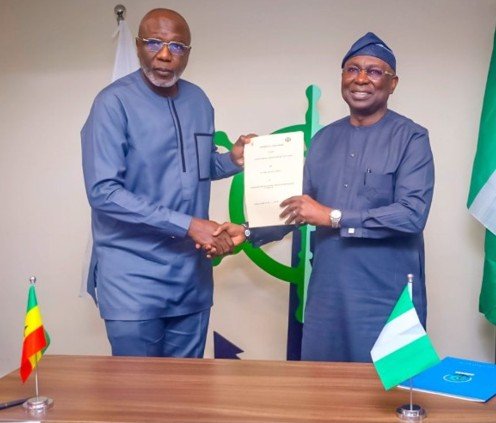
The Nigerian Maritime Administration and Safety Agency (NIMASA) and the Ghana Maritime Authority (GMA) have signed a new Memorandum of Understanding (MoU) aimed at strengthening maritime cooperation, improving regional maritime governance, and accelerating sustainable Blue Economy development across West Africa.
The agreement marks another step toward deeper collaboration between two of West Africa’s leading maritime nations, focusing on safer shipping, stronger regulatory frameworks, and greater economic opportunities within the region’s growing maritime sector.
Speaking during the signing ceremony in Lagos, NIMASA Director General Dr. Dayo Mobereola thanked Ghana for supporting Nigeria’s successful re-election to the International Maritime Organization (IMO) Category C Council, describing the continued partnership as a key driver of maritime progress in West Africa.
According to Mobereola, the newly signed agreement establishes a practical framework for cooperation in several strategic areas, including maritime safety and security, mutual recognition of Certificates of Competency (CoC), institutional capacity building, knowledge exchange, comparative research, joint enforcement operations, and coordinated participation at international maritime forums.
He emphasized that the success of the partnership will depend on measurable implementation rather than commitments on paper alone.
“We will continue to work together to grow our economies and make the maritime sector safer. This Memorandum of Understanding is a commitment to do better. NIMASA will fully play its part in implementing the agreement, while both institutions must establish annual implementation agendas to monitor progress and deliver tangible results,” Mobereola said.
He added that Nigeria and Ghana share a responsibility to help shape the future of maritime development across West and Central Africa. By strengthening cooperation beyond their national borders, both countries aim to unlock the significant economic potential offered by the Blue Economy while encouraging wider regional collaboration.
As part of the agreement, both maritime authorities will establish a Joint Consultative Team (JCT) responsible for preparing implementation plans, coordinating agreed programmes, and monitoring progress through designated focal points. The committee will meet twice each year, with Nigeria and Ghana alternating hosting responsibilities to review achievements and strengthen bilateral cooperation.
The MoU is expected to improve maritime governance, strengthen institutional capacity, encourage evidence-based policymaking through comparative research, and enhance regulatory effectiveness. It also reinforces joint efforts to tackle piracy, armed robbery at sea, and maritime terrorism, particularly within the strategically important Gulf of Guinea.
Speaking at the ceremony, Ghana Maritime Authority Director General Dr. Kamal-Deen Ali described the agreement as an important milestone in the longstanding relationship between both maritime administrations.
He acknowledged Nigeria’s leadership within the regional maritime sector, noting that Ghana has benefited from studying several Nigerian initiatives, including the country’s Cabotage regime, ship registry, and maritime regulatory systems.
“This Memorandum of Understanding consolidates an already mutually beneficial relationship. Ghana remains fully committed to implementing every aspect of the agreement as we continue to learn from one another and work together to strengthen maritime administration across the region,” Ali said.
The agreement reflects the shared commitment of Nigeria and Ghana to strengthen regional integration, enhance maritime safety and security, improve shipping governance, and support sustainable economic growth through closer institutional cooperation across West Africa’s maritime industry.