Ancient Greek Shipwreck with 650 Amphorae Found off Andros
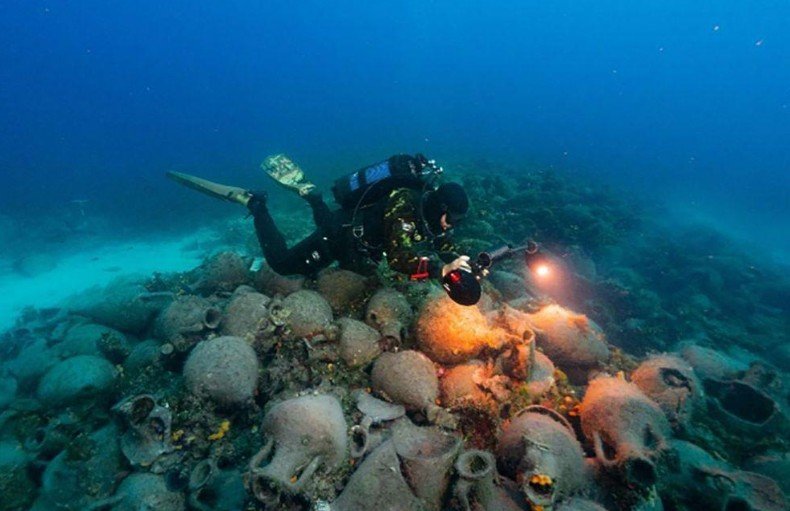
A significant underwater archaeological discovery off the coast of Andros, Greece, has revealed one of the richest Late Classical shipwrecks found in the Aegean Sea in recent years, providing new insights into ancient maritime trade routes, commercial shipping, and Mediterranean logistics. According to Greece’s Ministry of Culture, underwater archaeologists from the Ephorate of Underwater Antiquities uncovered the remains of a 5th-century BC merchant vessel resting at a depth of approximately 39 to 44 meters. The shipwreck contains an estimated 600 to 650 commercial transport amphorae, making it one of the most important ancient cargo ship discoveries for maritime archaeology and underwater cultural heritage research. The investigation was launched following information provided by a private citizen, and the official discovery was announced on 31 July 2026.
Archaeologists identified three distinct amphora types within the cargo, including vessels originating from Mende, Peparethos (modern-day Skopelos), and the Solokha 2 type. Mende and Peparethos were renowned wine-exporting centers in the northern Aegean during the Classical period, while the exact production center of the Solokha 2 amphorae remains debated, with researchers suggesting either the northern Aegean or the Black Sea region. One representative amphora from each category has been recovered for conservation and laboratory analysis to determine manufacturing techniques, clay composition, workshop origin, and potentially the commodities once transported. These ceramic containers served as the primary cargo units of ancient merchant shipping, and their distinctive forms and production characteristics enable researchers to reconstruct historic shipping networks, trade patterns, and commercial connections across the Mediterranean.
The extensive cargo suggests the merchant vessel likely collected goods from multiple ports rather than transporting products from a single producer. Although researchers consider a trading voyage beginning in the northern Aegean, passing Peparethos, navigating through Andros, and potentially heading toward Athens, Piraeus, or another southern Aegean commercial center to be plausible, no definitive destination has yet been established. The exact trading route will depend on further archaeological investigation, cargo distribution analysis, and detailed mapping of the wreck site.
Read: Archaeologists Discover Centuries-Old Shipwrecks in Bay of Gibraltar
From a maritime history perspective, the discovery highlights the sophistication of ancient Greek maritime logistics and demonstrates how diversified cargo shipments supported regional economic integration more than two millennia ago. The presence of multiple amphora types aboard a single merchant vessel reflects an interconnected commercial system where ships functioned as mobile distribution platforms linking producers, ports, and urban markets across the Aegean and beyond. Continued archaeological research on the Andros shipwreck is expected to improve understanding of ancient shipping economics, cargo management practices, and the evolution of Mediterranean maritime trade, offering valuable historical context for modern maritime supply chain studies and the long-term development of commercial sea transport.