Leonhardt & Blumberg Installs Econowind VentoFoils on First Newbuild
(By Econowind)
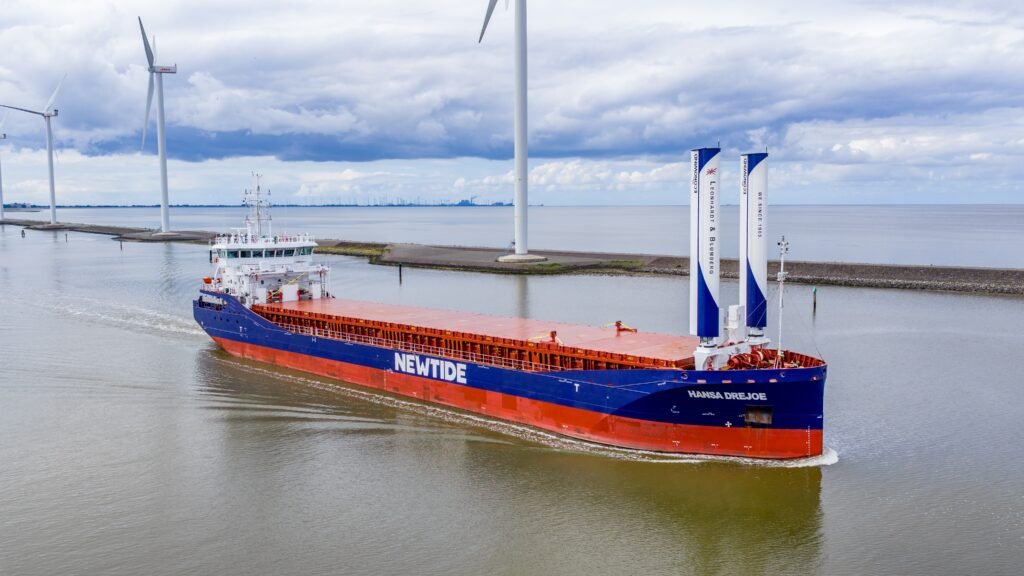
German shipowner Leonhardt & Blumberg has equipped HANSA DREJOE with Econowind VentoFoils, making it the first of four general cargo newbuilds to receive the wind-assisted propulsion technology. The installation reflects the company’s approach to reducing fuel consumption and CO₂ emissions while gaining practical operational experience with wind-assisted ship propulsion.
The first installation was completed aboard HANSA DREJOE at Royal Niestern Sander Shipyard in early August, while HANSA CHRISTIANSOE is currently at the yard. According to Econowind’s calculations, the VentoFoils are expected to deliver around 10% additional thrust, which can contribute to lower fuel consumption and CO₂ emissions. The assessment is based on the vessels’ actual trading routes throughout the year.
Importantly, the 10% figure refers to additional thrust and should not be interpreted as a guaranteed 10% reduction in fuel consumption or CO₂ emissions. Actual savings can vary depending on operating conditions, wind availability and trading routes.
“We see wind-assisted ship propulsion as a logical next step in our journey toward greener operations,” said Christoph Meier, Naval Architect at Leonhardt & Blumberg. “Of course, the business case is important, but we also feel a responsibility to move the industry forward. Econowind’s practical and well-developed technology allows us to do both, while gaining real operational experience along the way.”
Wind-Assisted Propulsion Integrated into Newbuild Design
The four vessels were designed by Groot Ship Design. Two were delivered in the first half of 2025, while the other two are currently under construction in China.
The GROOT XL-type vessels were designed to facilitate the integration of wind-assisted ship propulsion, allowing for appropriate positioning and installation of the VentoFoil systems. The two vessels under construction in China are expected to arrive in Europe in the first half of 2027 for final outfitting and commissioning.
The HANSA DREJOE and HANSA CHRISTIANSOE are 2025-built multipurpose vessels in Leonhardt & Blumberg’s fleet. The shipowner lists both vessels at approximately 5,900 DWT.
Econowind Targets Measurable Fuel Savings
“Our goal with VentoFoils is simple: to deliver measurable fuel savings with a clear business case,” said Stijn Engelage, Sales Manager at Econowind. “Leonhardt & Blumberg’s choice reflects their focus on proven technology and tangible results at sea. The systems will make a visible and immediate contribution to efficiency.”
By combining conventional propulsion with wind propulsion technology, Leonhardt & Blumberg is continuing its longer-term strategy of improving efficiency across its fleet. The VentoFoil installation forms part of a broader program to explore complementary technologies capable of delivering measurable operational and environmental benefits.
How Econowind VentoFoils Work
VentoFoils are compact, autonomous wing systems that can be tilted within seconds. The units use boundary-layer suction to generate additional thrust and improve aerodynamic efficiency.
The technology is designed to work alongside conventional marine propulsion rather than replace the ship’s main propulsion system. This allows wind energy to provide supplementary thrust when operating conditions are suitable.
Royal Niestern Sander has also confirmed that HANSA DREJOE arrived at its facility in Delfzijl for VentoFoil installation and described the technology as supporting the vessel’s main engine while helping reduce fuel consumption and CO₂ emissions.
Econowind’s technology has been deployed across several vessel types, including general cargo ships, tankers, heavy-lift vessels and multipurpose ships.
The installation on HANSA DREJOE represents another step in the adoption of wind-assisted ship propulsion, as shipowners evaluate technologies aimed at improving marine fuel efficiency, reducing shipping emissions and supporting maritime decarbonization.
Read: DNV Approval Clears the Way for Faster Deployment of Econowind VentoFoils on Global Fleet
U.S. Coast Guard Suspends Search for Nine Missing Boaters in Federated States of Micronesia