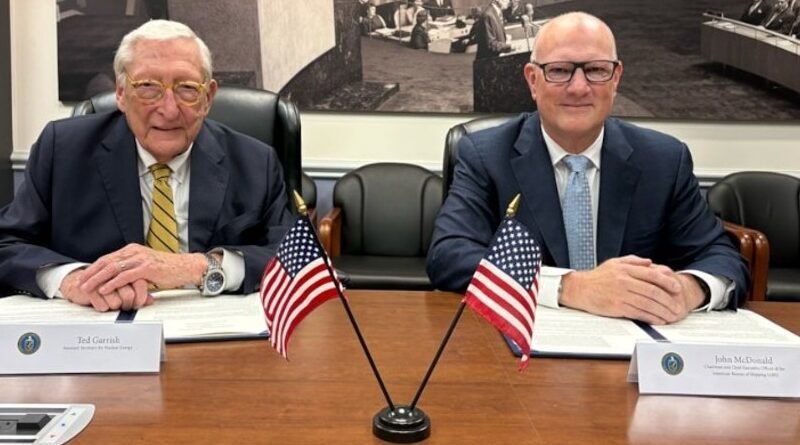
ABS and US DOE Sign MoU to Advance Maritime Nuclear Power
The American classification society ABS and the US Department of Energy (DOE) have signed a memorandum of understanding (MoU) to advance commercial maritime nuclear power, focusing on floating nuclear energy systems, nuclear-powered vessels and the infrastructure required to support their deployment. Announced on October 12, the agreement aims to assess the feasibility of nuclear-powered maritime applications while strengthening the United States’ shipbuilding capabilities and developing pathways for the safe adoption of advanced nuclear technology.

The partnership comes as the maritime industry explores advanced nuclear energy, small modular reactors (SMRs) and alternative marine propulsion systems to expand power-generation options and support future shipping requirements. Through technical, regulatory, economic and policy studies, ABS and DOE will examine the commercial potential of floating nuclear power plants, nuclear transportation corridors and the industrial infrastructure needed to construct and maintain nuclear-powered maritime assets. These assessments could help clarify the investment requirements, regulatory considerations and operational conditions associated with integrating nuclear technology into commercial shipping.
Under the MoU, ABS will jointly manage the Maritime Nuclear Applications Group (MNAG), which brings together specialists from the maritime and nuclear industries to conduct research and identify legal and regulatory challenges. ABS will also support studies covering technical feasibility, economic considerations and policy development.
Related activities will be coordinated through the US Maritime Administration’s (MARAD) US Center for Maritime Innovation (USCMI), where ABS serves as Secretariat. The classification society will also work with DOE to strengthen coordination across federal agencies involved in maritime nuclear development. DOE leads US federal efforts concerning the application of nuclear technology in the maritime sector.
ABS Chairman and Chief Executive Officer John McDonald said advanced nuclear technology was moving from concept towards practical application, making preparedness within the maritime industry increasingly important. He described the agreement as a framework for expanding work already underway and advancing commercial maritime nuclear applications.
Assistant Secretary for Nuclear Energy Ted Garrish said advanced nuclear technology could transform commercial shipping and create new opportunities for American innovation. He highlighted the partnership’s role in examining how established nuclear expertise could support the safe introduction of next-generation technologies into the maritime sector.
The agreement builds on a series of US government initiatives exploring small modular reactors for commercial shipping. On May 7, MARAD launched an initiative seeking industry input on a US-built, scalable, repeatable and commercially viable SMR system for marine transportation. The consultation covered reactor design, safety, shipbuilding, workforce development, regulatory readiness, liability, insurance, inspection and port access. MARAD said it was collaborating with the US Coast Guard, the Nuclear Regulatory Commission (NRC) and DOE on the initiative.
In June, the Port of Long Beach agreed to establish a site for trials involving nuclear-powered vessels under the initiative. In August, MARAD and the Port of Corpus Christi reached a separate agreement to explore the integration of small modular reactors, port microgrids, shoreside power and workforce development.
Regulatory arrangements are also evolving. The NRC has stated that existing regulations provide a basis for licensing maritime reactors. It is pursuing rulemaking focused on microreactors and comparable reactor technologies while developing a white paper on applying current licensing frameworks to nuclear power plants installed on floating facilities and to nuclear propulsion systems.
Internationally, the International Atomic Energy Agency (IAEA) is advancing its Atomic Technologies Licensed for Applications at Sea (ATLAS) initiative, which aims to develop a framework addressing floating nuclear power plants and vessels using civil nuclear propulsion. These efforts reflect the importance of establishing clear safety, licensing and regulatory arrangements as maritime nuclear technologies progress towards commercial applications.
The Maritime Nuclear Applications Group was originally established with support from DOE’s National Reactor Innovation Center (NRIC). Its work connects maritime and nuclear specialists, supports technical studies and identifies legal and regulatory barriers to the deployment of nuclear technology at sea.
ABS has already developed classification rules for nuclear power plants installed on floating platforms. In 2024, it published a study with Herbert Engineering Corporation modelling the installation of a high-temperature gas-cooled reactor on a liquefied natural gas (LNG) carrier with a capacity of 145,000 cubic metres. The study examined a potential pathway for integrating nuclear power into large commercial vessels.
Industry interest is also extending to vehicle transportation. Earlier in October, South Korea’s Hyundai Glovis and US operator Liberty Global Logistics agreed to assess the feasibility of a nuclear-powered car carrier service between South Korea and the United States.
Taken together, these developments indicate growing interest in the commercial potential of nuclear energy for maritime transport, floating power generation and port infrastructure. However, practical deployment will depend on the outcomes of feasibility studies, reactor safety assessments, licensing requirements, insurance arrangements, infrastructure investment and the development of a suitably trained workforce. The ABS–DOE agreement establishes a framework for examining these considerations as the United States evaluates the role of advanced nuclear technology in its future maritime industry.