Danish Start-Up Converts Surplus Shore Crabs into Marine Protein for Aquaculture
Danish start-up Decameal is developing a way to convert surplus shore crabs into marine protein ingredients for aquaculture feed and pet food. The company, founded by biologists Leander Hessner and Happylan Natkunarajah in 2022, uses mechanical and thermal separation to process the entire crab without chemicals.
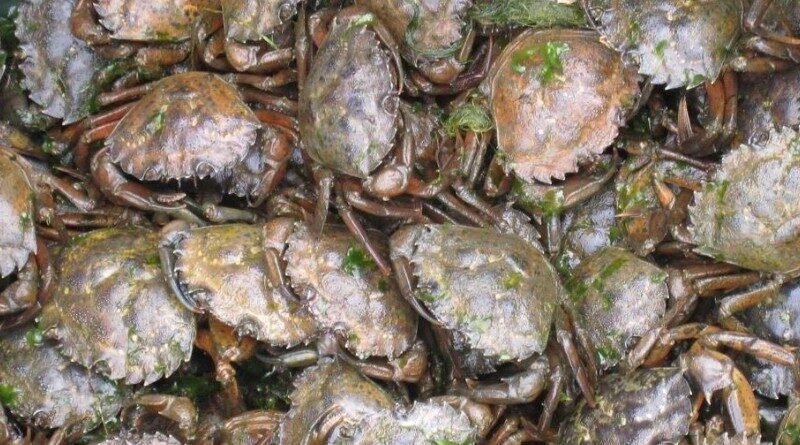
The initiative addresses a problem facing Danish coastal ecosystems, where declining numbers of natural predators have contributed to an increase in shore crab populations. The crabs prey on commercially valuable fish and mussels, while their limited market value means they are often caught as by-catch and discarded. Decameal’s approach links fisheries management with the potential commercial use of discarded marine resources.

Crab Population Growth Puts Pressure on Coastal Fisheries
According to the information provided by the company, overfishing has reduced shore crabs’ natural predators by 90% in Denmark. The resulting population growth has disrupted coastal ecosystems and affected fisheries through predation on fish and mussels.
Decameal initially tested its processing approach in a laboratory built inside a shipping container, using crab by-catch supplied by Danish fishermen. The company subsequently developed a pilot plant with a processing capacity of two tonnes per day and is producing its first larger-scale order for an aquaculture feed customer.
Processing Technology Targets Multiple Crab Components
Conventional crab processing can reduce the nutritional value of the raw material. Decameal instead uses mechanical and thermal separation to recover different components of the crab.
The resulting products include protein ingredients for aquaculture feed and pet food, as well as chitosan derived from crab shells. Chitosan has applications in agriculture, including uses that can help plants withstand disease.
The company says the technology could also be applied to large volumes of discarded crustaceans. Its wider commercial potential will depend on processing costs, the availability of suitable raw materials and demand for the resulting ingredients.
Funding Plans Point to a Larger Processing Facility
Decameal received the Ocean Bioresources category award at BlueInvest Day 2026, an achievement that expanded its visibility among investors, corporations and other blue economy stakeholders.
The company has raised approximately €3 million in grants and equity financing from business angels, venture capital funds and corporate investors. It plans to launch a seed funding round at the end of 2027 to finance a facility designed to process up to 40,000 tonnes of crabs annually.
The proposed facility would represent a substantial increase over the pilot plant’s current daily capacity. Reaching that scale, however, will require additional capital, dependable supplies of crab biomass and sufficient demand for the finished products.
Decameal is seeking investors prepared to support capital-intensive industrial development. The company is also considering longer-term applications for shell-derived chitosan in pharmaceuticals and human nutrition.
Commercial Viability Will Depend on Industrial Scale
The project illustrates one approach to increasing the value of marine by-catch through processing rather than disposal. For fisheries and feed manufacturers, the model could provide an additional use for a resource that currently has limited commercial value.
However, the environmental and economic benefits will depend on how the process performs at industrial scale. Processing capacity alone does not establish commercial viability; production costs, product quality, market demand and the consistency of raw-material supplies will also influence the outcome.
For the founders, the project remains rooted in biological research. Hessner said: “We run a business now, but we started out as biologists, and we still are.” He added that sustainability and ethics continue to guide the company’s decisions.
Read: SSA Urges NOAA to Protect Traditional Fishing Grounds as NOAA Plans Next Offshore Aquaculture Areas