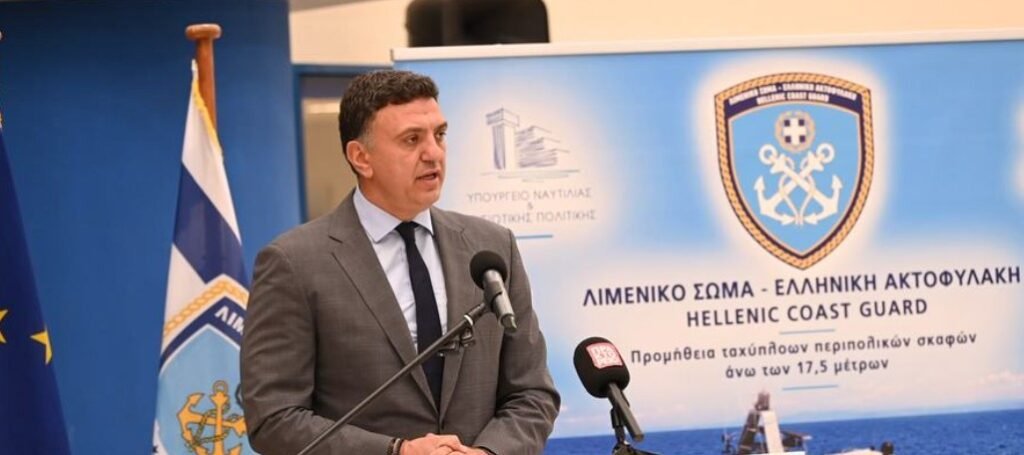
Greece Awards €23.8 Million Contract for Seven High-Speed Coast Guard Patrol Boats
Greece has signed a €23.8 million maritime security contract for seven new high-speed patrol boats for the Hellenic Coast Guard, strengthening its capabilities in maritime border protection, coastal surveillance and search-and-rescue operations. Shipping and Island Policy Minister Vassilis Kikilias signed the agreement at a ceremony held at the Ministry of Maritime Affairs and Island Policy.
The Coast Guard fleet modernisation programme combines enhanced operational capabilities with investment in Greece’s domestic shipbuilding industry. The seven MAGNAR 1950-class vessels will be manufactured in Greece by VIKING LIFE-SAVING EQUIPMENT HELLAS. The contract also includes an option to procure up to seven additional boats, offering scope for future fleet expansion without constituting a confirmed order for those additional vessels.

MAGNAR 1950 Patrol Boats: Specifications and Capabilities
Each of the seven high-speed patrol boats will measure 21.29 metres and be equipped for maritime surveillance, fishing activity inspections, action against illegal activities and search-and-rescue missions in Greek waters.
According to the published specifications, the vessels will be capable of reaching speeds of at least 50 knots and covering distances of at least 320 nautical miles. Each boat will accommodate a six-member crew and have a total carrying capacity of at least 30 people. The vessels will also feature modern navigation and communications systems, together with equipment designed to support search-and-rescue operations.
Kikilias said the acquisition would help the Hellenic Coast Guard respond to growing operational demands amid geopolitical instability. He called on the parties involved to adhere to the agreed timetable, with deliveries scheduled successively over a period of six to 12 months following the contract signing.
Greek Shipbuilding Industry Gains New Government Contract
Building the vessels domestically is a central feature of the procurement. The project supports Greece’s stated objective of strengthening national shipbuilding capacity and improving its ability to manufacture maritime equipment.
Kikilias said that maintaining strong shipyards and a competitive shipbuilding industry was essential to strengthening operational capabilities and working towards greater self-sufficiency. He also noted that Greek shipyards and companies in the sector were becoming stronger.
Ioannis Georgiadis, representing VIKING, described the agreement as a strategically important project for Greece, its shipbuilding industry and the Hellenic Coast Guard.
He confirmed that all seven vessels would be built at the company’s facilities in Thebes, Greece. According to Georgiadis, the programme represents an investment in Greek industrial production, technical expertise and workers, with expected benefits including job creation and skills development.
Read:Taiwan Acquires US Drone Boats to Expand Maritime Surveillance
VIKING aims to combine its international experience and quality standards with Greek manufacturing and innovation. Georgiadis said the company was committed to delivering vessels that meet the operational requirements of the Coast Guard.
Greece Advances Maritime Surveillance and Security Technology
The patrol boat procurement forms part of a broader government programme to modernise the Hellenic Coast Guard through upgraded operational equipment and maritime surveillance technology.
Kikilias highlighted several initiatives being pursued alongside the vessel acquisition, including artificial intelligence procurement procedures, a new Operations and Communications Centre (KEPICH), the National Integrated Maritime Surveillance System (ESOTHE), a Vessel Traffic Monitoring System (VTMS), drones and sensors.
These initiatives are intended to support maritime monitoring, operational coordination and the Coast Guard’s ability to respond to contemporary security challenges. The minister stressed that effective maritime border enforcement requires personnel to have appropriate equipment and the ability to put announced policies into practice.
He also emphasised that protecting human life at sea remains the foremost priority, alongside safeguarding Greece’s maritime borders.
Operational Readiness and Search-and-Rescue Operations
The new patrol boats are intended to strengthen the Coast Guard’s capacity to respond to maritime emergencies while carrying out routine surveillance and border protection duties. Their stated speed, range, navigation systems and communications equipment will support the operational requirements outlined in the procurement announcement.
Kikilias praised Coast Guard personnel for their professionalism and dedication, drawing on his experience visiting Greek islands and travelling aboard different Coast Guard vessels. He urged personnel to carry out their responsibilities confidently while respecting the public, island communities and the maritime environment.
The minister reiterated that personnel readiness, effective organisation and the protection of human life must remain central to Coast Guard operations.
Contract Funding and Engine Warranty
The €23.8 million maritime procurement will be funded through the Public Investment Development Programme under the co-funded Fisheries, Aquaculture and the Sea Programme 2021–2027.
The contract also provides for a four-year warranty or 6,000 operating hours for the main engines, whichever comes first. Maintenance and repair work covered by the warranty will be carried out without additional cost to the Hellenic Coast Guard.
The warranty provision establishes a defined period of support for the main engines, while the agreed delivery schedule sets the timeframe for introducing the new vessels into service.
What the Contract Means for Greece’s Maritime Sector
The procurement links three priorities: Coast Guard fleet modernisation, maritime border security and domestic shipbuilding. The seven vessels will add to the service’s planned operational resources, while the option for seven additional boats provides a potential route for future expansion.
The programme also directs public investment towards domestic vessel construction, supporting the Greek shipbuilding sector and the development of industrial skills. Alongside the planned investment in maritime surveillance systems, artificial intelligence, drones and sensors, the procurement forms part of Greece’s wider approach to equipping its maritime security services.
The programme’s practical impact will depend on delivery according to schedule, the vessels’ integration into Coast Guard operations and continued maintenance. With successive deliveries scheduled over six to 12 months from the signing date, the contract sets out a defined timetable for strengthening Greece’s high-speed patrol boat fleet.