Taiwan Acquires US Drone Boats to Expand Maritime Surveillance
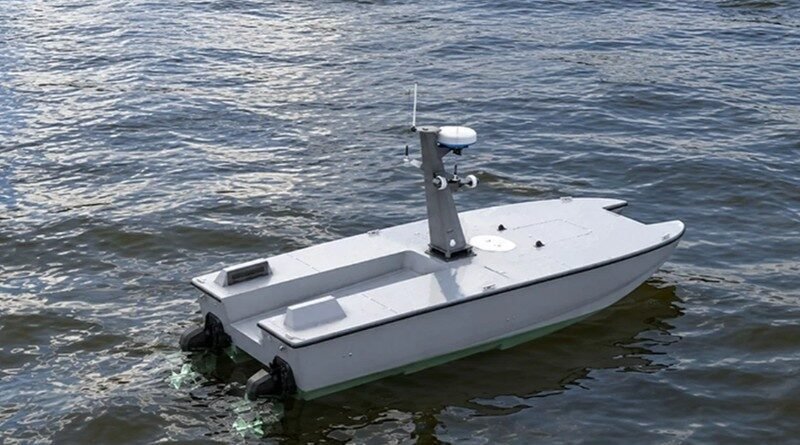
Taiwan’s coastguard is acquiring US-made autonomous drone boats to strengthen maritime surveillance, monitor increasing mainland Chinese vessel activity and extend its coastal security capabilities. Florida-based Maritime Tactical Systems (MARTAC) announced on October 13 that the agreement covers an undisclosed number of Devil Ray T24 uncrewed surface vessels (USVs), with production planned in the United States and Taiwan.
The procurement introduces a dedicated uncrewed maritime surveillance programme for Taiwan’s coastguard, combining autonomous vessel technology with existing maritime monitoring operations. The systems are intended primarily for long-range reconnaissance, investigations and remote rescue, while their effectiveness will depend on operational integration with crewed vessels, aerial drones and command networks.

US-Taiwan Partnership Advances Drone Boat Production
The agreement builds on a memorandum of understanding signed by MARTAC, Taiwanese technology company Confucian and the National Chung-Shan Institute of Science and Technology (NCSIST) during the 2025 Taipei Aerospace & Defense Technology Exhibition.
Under the co-production arrangement, some vessels will be manufactured at a partner facility in Edgewater, Florida, while the remaining boats will be built by Confucian in Taiwan. The partnership is intended to combine US autonomous vessel technology with Taiwanese manufacturing capacity.
James Lee, chief executive of Confucian, described the acquisition as the Taiwan Coast Guard Administration’s first unmanned surface vessel programme. The agreement also forms part of a broader initiative reported by Taiwanese media to acquire 25 uncrewed surface vessels; that figure should not be confused with the undisclosed quantity covered by the newly announced purchase.
Devil Ray T24 Specifications and Capabilities
The Devil Ray T24 autonomous surface vessel measures 8.4 metres (27.5 feet) and can achieve burst speeds exceeding 50 knots, according to MARTAC. Its modular design supports different equipment configurations for maritime surveillance and other missions.
The platform can support applications including electronic warfare, mine countermeasures and anti-submarine reconnaissance. During trials in Sweden in December 2024, the T24 also launched an exercise torpedo in tests backed by the US Navy.
Taiwan has not confirmed whether the coastguard’s vessels will carry weapons or incorporate all the capabilities associated with the wider technology partnership.
Coastguard Plans Integrated Maritime Monitoring
Coastguard director general Chang Chung-lung said the T24 vessels and aerial drones would primarily undertake long-range search and reconnaissance, investigations and remote rescue.
The agency intends to operate the unmanned systems alongside its existing cutters, supporting coordinated intelligence, surveillance and reconnaissance (ISR). This approach could extend operational coverage without requiring personnel to be physically present on every surveillance platform.
The acquisition follows increased mainland Chinese maritime activity around Taiwan. Taiwanese defence ministry figures analysed in reporting published on October 14 indicated record sightings of Chinese coastguard, research and other government vessels in June, July and August.
Beijing has also maintained regular coastguard patrols east of Taiwan since June, describing the operations as routine law enforcement.
Civilian Coastguard and Defence Preparedness
Taiwan’s coastguard is a civilian agency during peacetime, but its legal framework allows the government to incorporate it into the military order of battle during a conflict.
The agency’s Anping-class cutters illustrate this dual-purpose role. Designed to accommodate Hsiung Feng II and Hsiung Feng III anti-ship missiles during wartime mobilisation, vessels in the class have participated in missile-firing exercises since 2022.
In September, the Qijin launched a Hsiung Feng III supersonic anti-ship missile during an exercise. The role of the newly acquired T24 vessels, however, remains focused on the coastguard missions publicly outlined by Taiwan, with any future armed configuration unconfirmed.
Autonomous Vessels in Maritime Security
The acquisition highlights the expanding role of autonomous maritime technology in coastal monitoring and maritime domain awareness. Uncrewed vessels can provide additional surveillance coverage, support evidence gathering and reduce the exposure of crews during certain operations.
However, purchasing advanced hardware alone does not guarantee improved operational performance. Reliable communications, data sharing, personnel training and integration with existing surveillance systems will determine how effectively the vessels contribute to coastguard operations.
For maritime agencies considering similar investments, Taiwan’s programme illustrates the importance of matching autonomous vessel capabilities to defined operational requirements, particularly surveillance, search and rescue, and coordinated maritime monitoring.
Taiwan governs itself, while Beijing claims the island as part of China and has not ruled out the use of force. The United States opposes attempts to take Taiwan by force and has committed to supplying the island with weapons, although most countries, including the United States, do not formally recognise Taiwan as an independent state.