
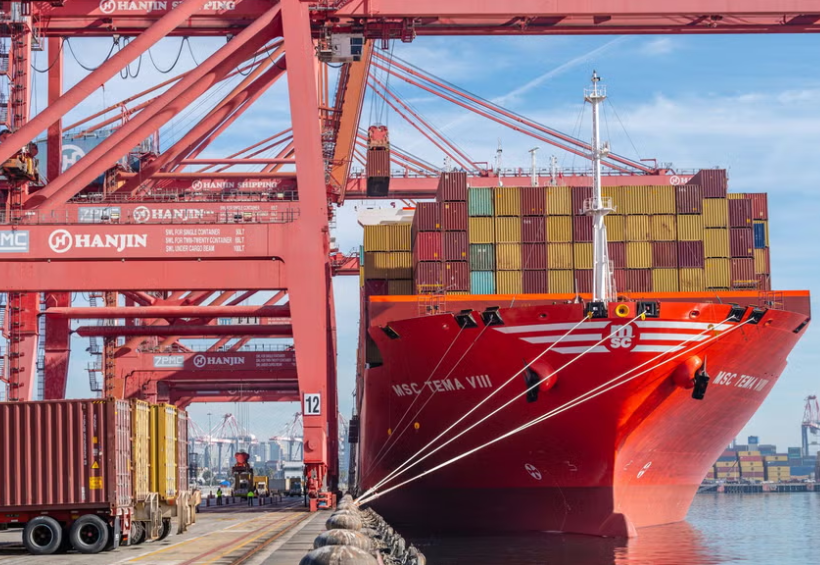
Container Shipping Rates Surge to Near Two-Year High as Tariff Uncertainty Drives Global Freight Market
Global container shipping markets are witnessing an unexpected surge in freight rates, with ocean freight prices climbing to levels not seen in nearly two years. What was initially expected to be a relatively quiet year for the container shipping industry has instead evolved into a period of strong demand, tariff-driven cargo movements, and tightening vessel capacity.
According to the latest Drewry World Container Index, average container freight rates have climbed close to US$4,200 per forty-foot equivalent unit (FEU), marking a 40 percent increase compared to the same period last year. The Shanghai Containerized Freight Index (SCFI) has also more than doubled from 2025 levels, highlighting the strength of the current shipping market.
Industry analysts attribute the sharp rise in freight rates to a combination of accelerating U.S. import demand, robust export bookings from China, limited shipping capacity, and supply chain disruptions linked to the recent U.S.-Iran conflict. Importers are also rushing to move cargo before potential changes in U.S. trade policy take effect later this summer.
Earlier this year, the U.S. Supreme Court invalidated the White House’s tariff measures imposed under the International Emergency Economic Powers Act (IEEPA). In response, the administration introduced a temporary 15 percent blanket import tariff under Section 122, covering imports from all trading partners. Those tariffs are scheduled to expire at the end of July, creating significant uncertainty across global supply chains.
President Donald Trump is widely expected to announce a new package of trade measures to replace the expiring Section 122 tariffs. On Friday, he further escalated trade tensions by threatening 100 percent import duties on countries that impose digital services taxes targeting the overseas revenues of American technology companies, particularly those being considered by several European nations.
Freight market analyst Lars Jensen noted that while the Section 122 tariffs are due to expire on July 24, the shipping industry still does not know which tariff framework, potentially emerging from ongoing Section 301 investigations, will replace them.
With uncertainty growing over future import duties, many retailers, freight forwarders, and beneficial cargo owners (BCOs) are accelerating shipments for the year-end holiday season while current tariff rates remain comparatively favorable. This surge in early cargo bookings has intensified pressure on available vessel capacity and pushed freight rates even higher.
The impact is particularly visible on Trans-Pacific routes. Drewry reported that Shanghai-to-Los Angeles container freight rates increased by 12 percent in just one week, reaching approximately US$5,750 per forty-foot container. Freight rates from Southeast Asia to the U.S. West Coast have also risen sharply, providing much-needed revenue relief for ocean carriers after months of softer market conditions.
Despite the current rally, shipping experts caution that the market’s strength may prove temporary. Lars Jensen pointed out that container spot-rate futures tracked through the NYFI index indicate investors expect freight prices to retreat significantly within the next month, coinciding with the anticipated introduction of new U.S. tariff measures.
For now, however, the global container shipping industry remains supported by strong cargo demand, front-loaded imports, and ongoing geopolitical uncertainty, factors that continue to reshape international maritime trade and global supply chain dynamics.