Drone Explosion near Romania’s Constanta Port Raises Maritime Security Concerns in Black Sea Region
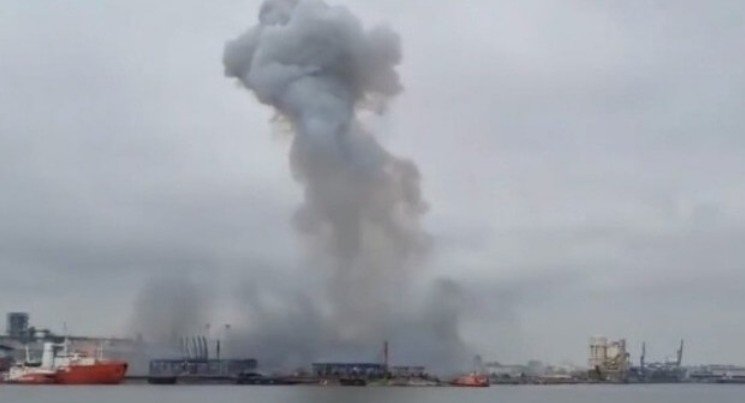
A sea drone exploded near an oil terminal at Romania’s largest Black Sea port, Constanța, on Friday after reportedly drifting off course due to Russian electronic warfare interference, according to Ukrainian and Romanian officials. No casualties were reported.
The incident has heightened concerns over maritime security and the growing spillover risks from the ongoing Russia-Ukraine war into NATO territory. It marks the second major security incident in a populated area of Romania, a NATO member state, within a week.
Ukraine’s Navy stated that one of its sea drones lost control in the Black Sea after being subjected to Russian electronic warfare and signal jamming. Ukrainian authorities subsequently notified Romania to prevent casualties and facilitate emergency response measures.
Romanian Defence Minister Radu Miruță said the warning enabled authorities to conduct a timely evacuation of affected areas before the drone detonated.
Romanian President Nicușor Dan directly linked the incident to Russia’s military actions in Ukraine, stating that three other Ukrainian drones that had similarly gone out of control also exploded offshore and no longer posed a threat.
“The entry of this drone into Romanian sovereign space is a direct consequence of the war waged by Russia against Ukraine,” President Dan said in a statement posted on social media.
The explosion occurred one week after Romanian authorities reported that a Russian drone crashed into an apartment building in the southeastern city of Galați, near the Ukrainian border. Two people were injured in that incident, marking the first time during the conflict that a drone struck a densely populated area within a NATO member state.
Black Sea Shipping Corridor Faces Growing Security Risks
The Black Sea remains a strategically vital maritime corridor for global shipments of grain, crude oil, refined petroleum products, and other commodities. The waterway is shared by Bulgaria, Romania, Georgia, Turkey, Ukraine, and Russia, making regional stability critical for international shipping and trade.
Constanța Port serves as Romania’s largest seaport and one of the most important logistics hubs in the Black Sea region. The port features 156 berths and approximately 32 kilometers of quay infrastructure. Since the outbreak of the Russia-Ukraine war, Ukraine has increasingly relied on Constanța as an alternative export route for grain shipments and as an entry point for fuel imports.
Romania’s Ministry of Defence reported that the drone exploded at approximately 10:30 a.m. local time (0730 GMT), nearly four hours after authorities were alerted to its presence. Officials said the device detonated about 500 meters from an oil terminal.
As a precautionary measure, port operations and surrounding areas were evacuated. More than 1,000 people were removed from Black Sea beaches and nearby areas of the Danube Delta. Romanian authorities also deployed ships and two helicopters to monitor the area and search for additional threats.
Deputy Interior Minister Raed Arafat confirmed that restrictions were lifted later in the day after security forces determined there were no further risks.
NATO and EU Officials Warn of Expanding Regional Threat
Romania shares a 650-kilometer border with Ukraine and has repeatedly experienced security incidents linked to the conflict since Russia launched its full-scale invasion four years ago. These incidents have included Russian drones entering Romanian airspace and naval mines drifting across critical maritime trade and energy routes in the Black Sea.
Earlier this week, the Romanian Navy successfully neutralized a Russian YaRM-type anti-landing mine that had washed ashore.
The latest drone explosion has drawn attention from European leaders. European Commission President Ursula von der Leyen stated that Russia’s war is increasingly becoming a direct threat to countries located on the European Union’s eastern frontier.
Ukraine’s Foreign Ministry echoed those concerns, stating that the incident demonstrates how Russia’s ongoing military aggression poses risks not only to Ukraine but also to the wider Black Sea region and neighboring European states.
The event underscores growing challenges for maritime safety, port security, shipping operations, and critical energy infrastructure in one of the world’s most strategically important trade corridors.