EU Force Boards Russian Shadow Fleet Tanker in Mediterranean Sea During Operation IRINI
The Italian Navy led a joint European Union force in boarding a sanctioned Russian shadow fleet tanker in the Mediterranean Sea on 2 August, according to Italy’s Ministry of Defence. The operation was conducted under Operation IRINI, the EU mission responsible for monitoring arms and oil trafficking in the Mediterranean.
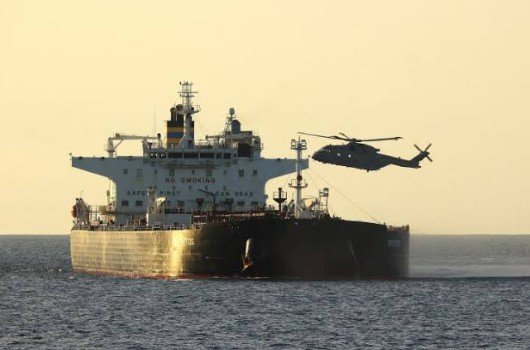
The Italian Navy vessel Thaon di Revel boarded the tanker Toa Payoh, a Russian shadow fleet vessel subject to EU sanctions. The vessel was intercepted in international waters west of Pantelleria, between Sicily and Tunisia, while sailing under a Cameroonian flag. The inspection was carried out to verify the ship’s nationality.
According to Italy’s Ministry of Defence, the tanker’s captain initially did not cooperate with Italian officers when requested to provide the ship’s documentation. As a result, Thaon di Revel proceeded with the boarding operation, supported by a Greek naval vessel and a Polish maritime patrol aircraft.
Italian Defence Minister Guido Crosetto said, “I wish to commend the crew of the Thaon di Revel and all military personnel involved in the operation for the professionalism, preparedness, and resolve they demonstrated. This activity serves as further concrete evidence of Italy’s contribution to security in the Mediterranean and to the European Union’s efforts.”
The Ministry of Defence reported that the two-hour operation was completed smoothly and safely, and verification of the vessel’s documentation is currently underway. The ministry did not indicate whether the tanker has been officially detained.
Launched in 2020, Operation IRINI was originally established to enforce the United Nations arms embargo on Libya. The mission’s mandate has since expanded, and several Russian shadow fleet vessels operating in the Mediterranean have been inspected as part of its activities. Individual European countries, including France, Sweden, Belgium and the United Kingdom, have also boarded suspected shadow fleet vessels after they entered their territorial waters.
Following Operation IRINI’s successful boarding of its fourth Russian vessel in the Mediterranean on 20 July, EU High Representative for Foreign Affairs and Security Policy Kaja Kallas announced that the bloc had agreed to allow a joint naval mission in the Indian Ocean to also intercept suspected shadow fleet tankers.
Russia’s shadow fleet consists of thousands of ageing, often uninsured vessels that the Kremlin uses to transport oil and evade international sanctions. According to the European Union, profits from these oil exports help finance Russia’s war in Ukraine, while some vessels are also used to supply fuel to occupied Ukrainian territories.
The European Union’s 21st sanctions package includes a provision allowing member states to sell crude oil, grain and other commodities seized from shadow fleet vessels. Under the sanctions, proceeds from such sales cannot be transferred to any Russian individuals or entities.
The latest boarding operation highlights the European Union’s growing emphasis on enforcing maritime sanctions through coordinated naval missions. As inspections of Russian shadow fleet vessels become more frequent, shipping companies, flag administrations, insurers and port authorities are expected to strengthen compliance with international sanctions, vessel documentation requirements and due diligence procedures. The operation also demonstrates the increasing role of multinational naval cooperation in protecting maritime security and maintaining the integrity of global shipping and energy trade.