Op-Ed: Impact of Wars on the Blue Economy and Bilateral Trade: Disruptions, Adaptations, and Geopolitical Realignment
As kinetic conflict migrates into maritime chokepoints, the institutions and norms governing the world’s commercial seaways are quietly disintegrating, and the costs will be borne least by those who bear arms.
By Syed Abdul Wajid ,(PNEC) NUST Karachi
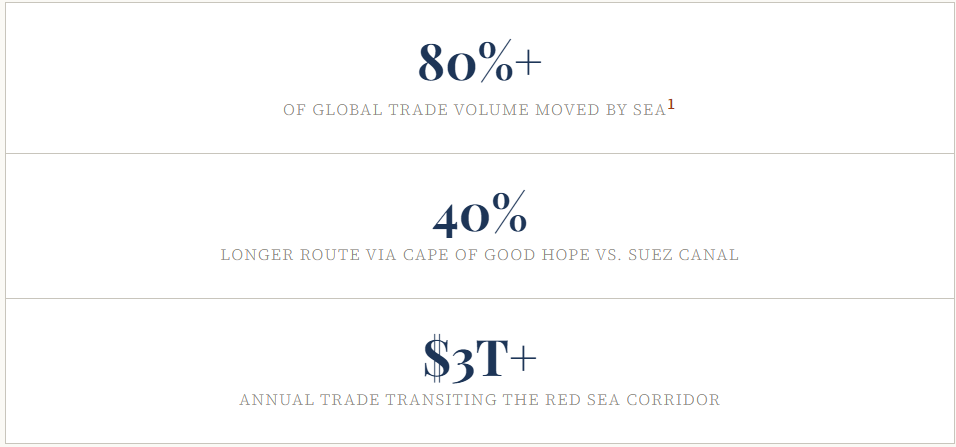
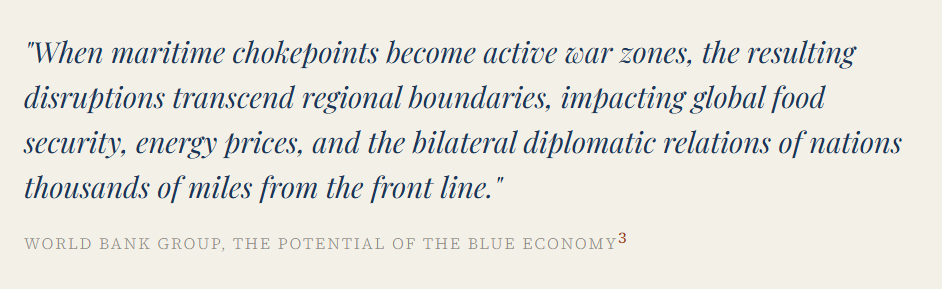
The ocean has never been neutral. From the Carthaginian grain fleets to the East India Company’s armed merchantmen, maritime commerce and military power have always been entwined. What has changed, dramatically, in the years since Russia’s full-scale invasion of Ukraine and the Houthi campaign in the Red Sea, is the speed and systemic scale with which regional conflicts can now convulse the entire architecture of global seaborne trade. More than 80 per cent of international trade by volume moves by sea.1 When the ocean becomes a theatre of war, the consequences are not merely strategic. They are inflationary, ecological, and fundamentally political.
The “Blue Economy,” a term encompassing marine resource extraction, offshore energy, fisheries, coastal tourism, shipping logistics, and subsea digital infrastructure, was, until recently, largely conceived within a framework of sustainable development and cooperative governance.3 That framework now strains under the weight of events it was never designed to absorb. Naval mines drifting in the Black Sea do not distinguish between warships and wheat carriers. Houthi missiles do not select their targets by cargo manifest. And the invisible thread of undersea data cables, carrying trillions of dollars in financial transactions daily, passes through the same contested waters as the container ships.
I. Infrastructure, Mines, and the Invisible Network
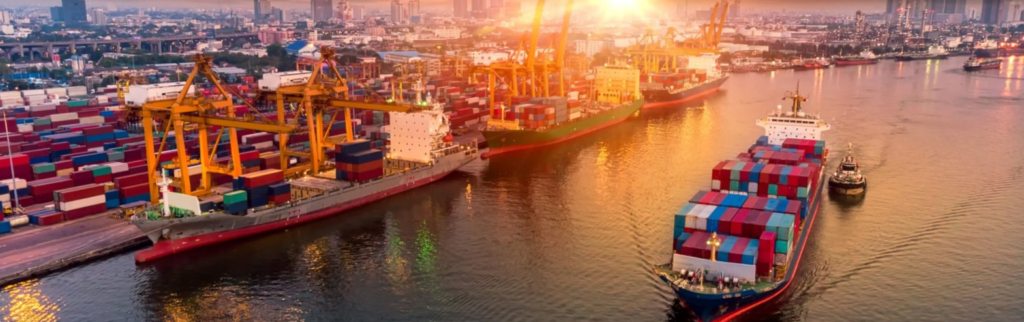
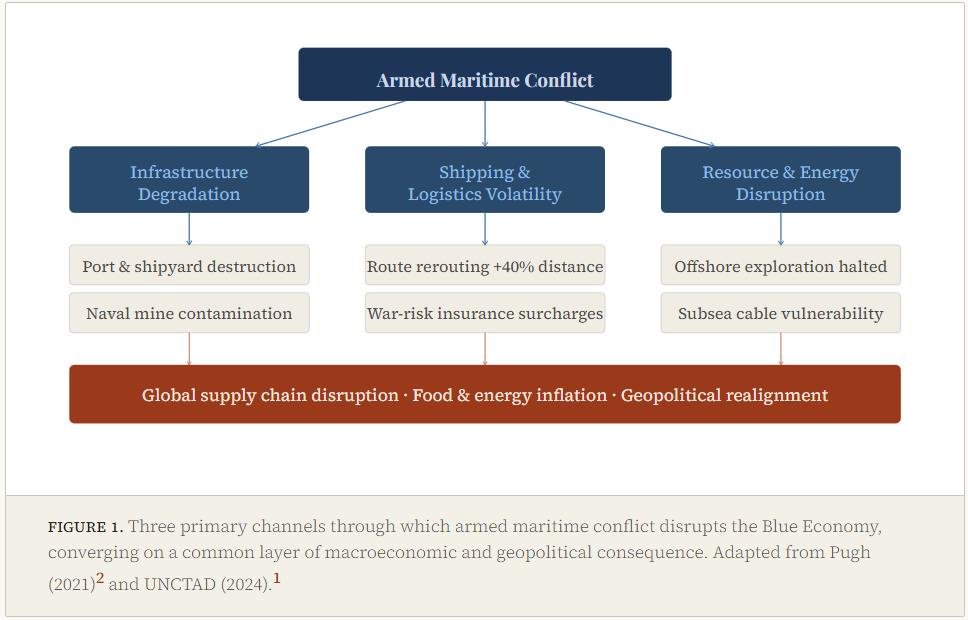
The most visible damage war inflicts on the maritime economy is also the most literal: the physical destruction of port infrastructure, grain terminals, and naval facilities. Ukraine’s Black Sea terminals, once the arteries of a global wheat supply, have been systematically targeted since 2022, reducing export capacity precisely when food-importing nations in North Africa and the Middle East were most vulnerable.1 But physical destruction is only the first layer of harm. Naval mines, deployed by both sides in the Black Sea, persist long after ceasefires; they transform once-navigable commercial lanes into actuarial nightmares, raising insurance premiums and suppressing maritime biodiversity simultaneously.
Less discussed, but potentially more consequential in the long run, is the threat to subsea data infrastructure. The same cables that carry international financial settlements, cloud computing traffic, and telecommunications pass through shallow, poorly monitored stretches of contested ocean.4 Severing a single cable node can re-route terabytes of traffic across fallback paths not designed for such load. Several incidents since 2023, in the Baltic and Red Seas, have renewed calls for treating subsea cable corridors as critical infrastructure deserving explicit protection under international law, calls that have, thus far, gone largely unheeded.
II. Rerouting, Risk, and the Cost of Distance
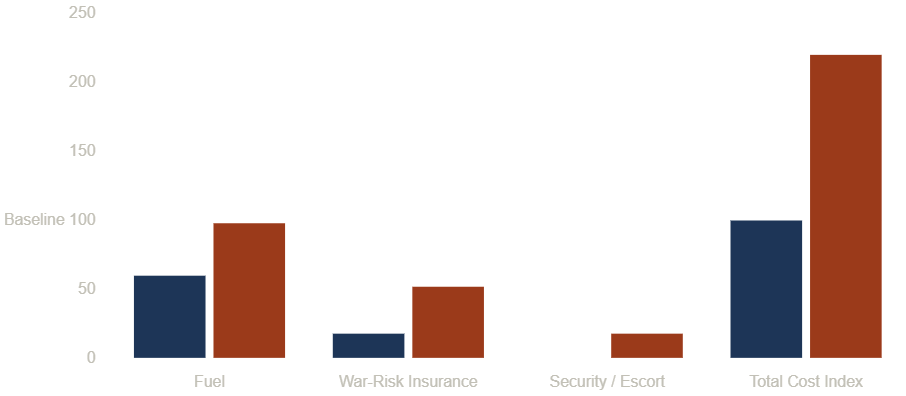
When the Houthi campaign against Red Sea shipping began in earnest in late 2023, the global container industry faced a stark calculation: continue transiting the Bab el-Mandeb Strait under missile threat, or reroute around the Cape of Good Hope, adding roughly 10 to 14 days and thousands of nautical miles to Asia-Europe voyages. Most chose the Cape. The consequences were immediate and cascading.1
The economics of this rerouting can be formalised in what this paper terms the Disruption Cost Function. For any given vessel diverting from a conflict-affected route, the total cost increase C is the sum of three components:
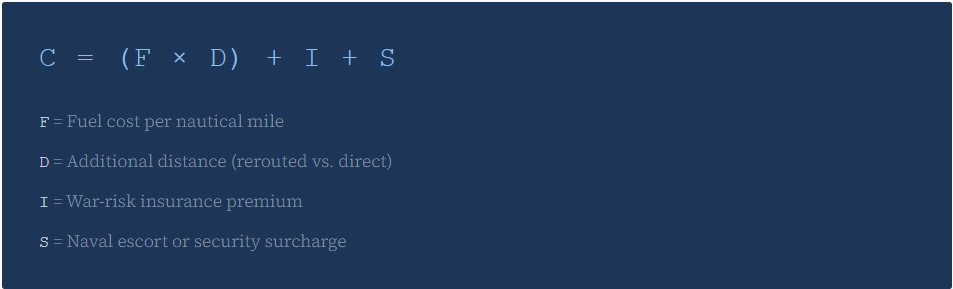
What this formulation captures, and what aggregate trade statistics often obscure, is the compounding nature of these costs. War-risk insurance premiums are not static; they are dynamically priced by Lloyd’s of London and specialist marine underwriters in near-real-time, spiking with each incident and receding only slowly after periods of calm.2 For major carriers with the financial depth to absorb surcharges, this is painful but manageable. For smaller shipping nations, and for the importers of the Global South who bear costs passed downstream, the arithmetic can be existential.
III. Friend-Shoring and the Fragmentation of Maritime Trade
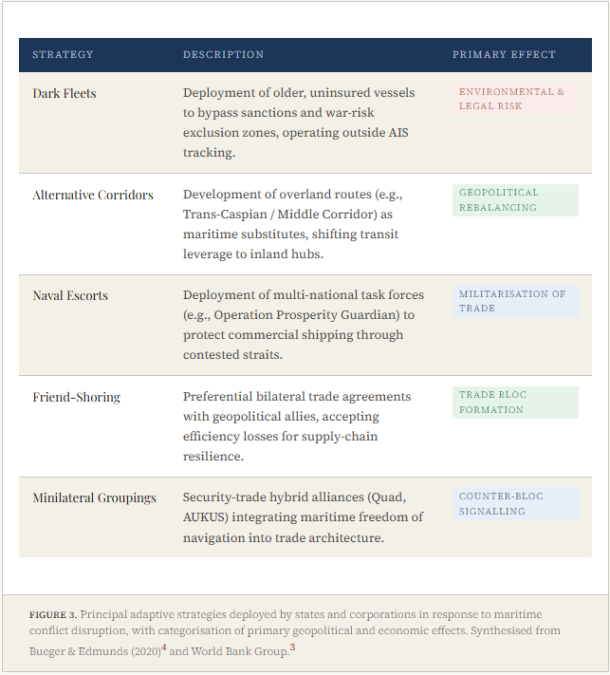
Beyond the immediate arithmetic of rerouting lies a deeper structural transformation. Conflict, and the threat of conflict, is rewiring the political economy of who trades with whom. The sanctions imposed on Russian maritime exports following the 2022 invasion of Ukraine forced not merely a rerouting of vessels, but a wholesale reshuffling of bilateral trade relationships: Russian crude found new buyers in India and China; European importers scrambled for Norwegian LNG and American liquefied natural gas delivered by sea.1 The efficiency costs of these substitutions were substantial. The geopolitical logic was, from each party’s perspective, compelling.
This phenomenon, the deliberate prioritisation of trade with geopolitical allies over economically optimal partners ,has acquired the label “friend-shoring,” a term coined in Washington but increasingly operative as a principle of maritime trade policy worldwide.3 It represents, in essence, a voluntary reduction in the comparative advantage gains from free maritime trade in exchange for supply-chain resilience. Whether this trade is worthwhile depends entirely on one’s assessment of the probability and cost of future supply-chain disruptions, an assessment that, given the events of recent years, has shifted dramatically toward caution.
IV. The Security-Trade Paradox
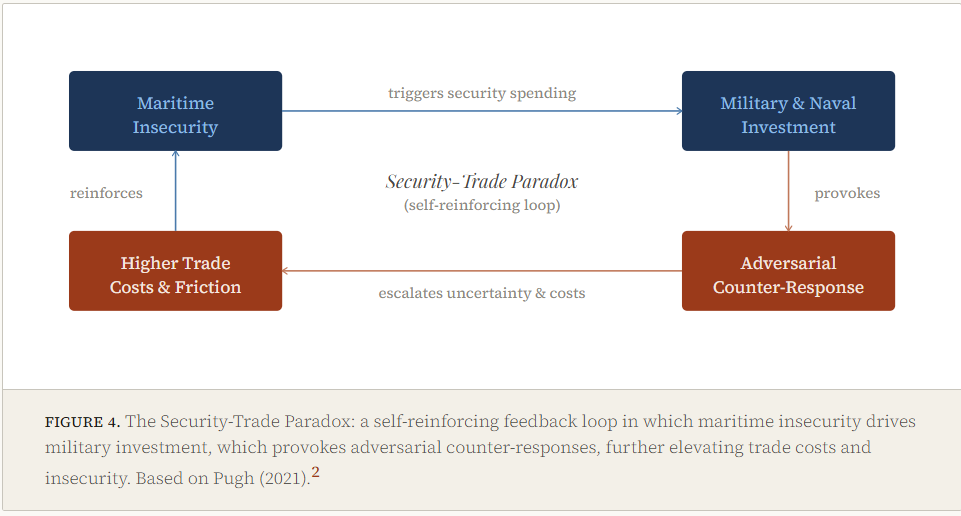
There is a deep structural irony at the heart of the international response to maritime insecurity. The more nations invest in naval escorts, maritime surveillance, and military-backed trade alliances to protect their commercial shipping, the more they signal to potential adversaries that the ocean is a theatre of military competition, thereby increasing the likelihood of the very disruptions they are trying to prevent. This is the Security-Trade Paradox, and it operates as a classic security dilemma at maritime scale.2
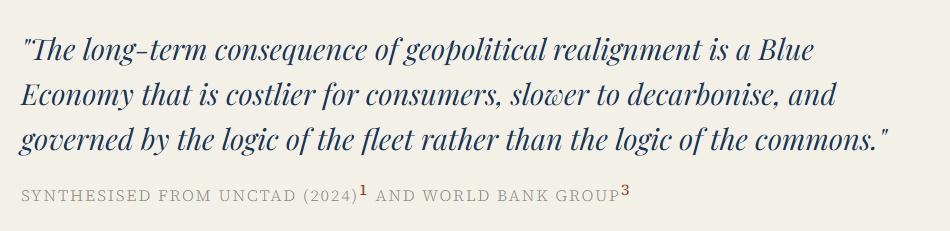
The rise of “minilateral” security groupings in the Indo-Pacific, the Quad, AUKUS, and various bilateral basing arrangements under the banner of “free and open seas,” illustrates this paradox in action. Each of these arrangements is presented, by its architects, as purely defensive and stabilising. Each is read, by Beijing, as an encirclement strategy. The resulting arms race in submarine technology, anti-ship missiles, and maritime domain awareness infrastructure is, as Bueger and Edmunds observe, “the transformation of the ocean from a commons into a contested space.”4 The costs of that transformation, in insurance premiums, rerouting surcharges, diverted investment, and slowed decarbonisation, are diffuse, cumulative, and ultimately borne by consumers and communities far from the naval exercise zones.
V. Towards a Law of the Weaponized Sea
The existing architecture of international maritime law, rooted in UNCLOS, the International Maritime Organisation conventions, and the 1856 Declaration of Paris, was not designed for an era in which non-state actors launch cruise missiles at container ships, or in which state actors deliberately contaminate commercial lanes with naval mines to coerce grain exporters. The legal framework treats freedom of navigation as a near-absolute principle; it has no adequate mechanism for protecting that freedom when the threat comes not from the act of navigation itself, but from the battlefield surrounding it.4
Three reforms deserve serious consideration by the international community. First, the designation of explicitly protected commercial corridors, analogous to humanitarian corridors in land warfare, within which attacks on civilian shipping would constitute a per se violation of international humanitarian law, with corresponding criminal accountability. Second, the establishment of a multilateral rapid-response mechanism, housed within the IMO, to assess and compensate disruption costs imposed on third-party shipping nations by bilateral conflicts. Third, the extension of the critical infrastructure protection norms being developed for cyberspace explicitly to subsea cable infrastructure, with monitoring, attribution, and deterrence mechanisms proportionate to the asset’s global economic significance.
None of these reforms will be easy to achieve. The very nations most likely to block them are those that have demonstrated the greatest willingness to weaponize the ocean for strategic ends. But the alternative, a continued drift toward a permanently fragmented Blue Economy governed by naval power rather than international law, carries costs that will be felt most acutely not in the admiralties and defence ministries of the great powers, but in the port cities, fishing communities, and food-importing nations that never asked to be caught in the crossfire.
The ocean was never neutral. But it was, for several decades of the post-Cold War order, governed by rules that made commercial neutrality possible. Recovering something like that order, in a world of resurgent great-power competition and emboldened non-state maritime actors, will require not just naval investment, but the patient, unglamorous work of international legal reform. The alternative, as the Black Sea grain lanes and the Red Sea shipping corridors have already demonstrated, is a world in which every merchant ship is a potential casualty of wars it has no part in fighting.
References
- UNCTAD (2024). Review of Maritime Transport: Navigating Stormy Waters. United Nations Conference on Trade and Development, Geneva.
- Pugh, M. (2021). The Blue Economy and Maritime Security: Realizing the Synergy. Maritime Policy & Management, 48(4), 512–527.
- World Bank Group. The Potential of the Blue Economy: Structural Transformations and Geopolitical Risks. Washington D.C.: World Bank Publications.
- Bueger, C., & Edmunds, T. (2020). Blue Crime: The Transformation of Maritime Security. Global Policy, 11(5), 693–703.

Mr. Syed Abdul Wajid is an Assistant Professor at Pakistan Navy Engineering College (PNEC), NUST Karachi, with over 23 years of experience in teaching and research. His expertise spans Economics, Finance, Management Sciences, international trade, and economic policy. He specializes in analyzing geopolitical developments, maritime trade, supply chain resilience, and the Blue Economy, contributing to research that supports sustainable economic growth and regional cooperation.
The views and opinions expressed in this article are solely those of the author and do not necessarily reflect the views of Maritime Current News.