Japan Secures ClassNK Approval for Standard Low-Pressure LCO₂ Carrier to Support CCS
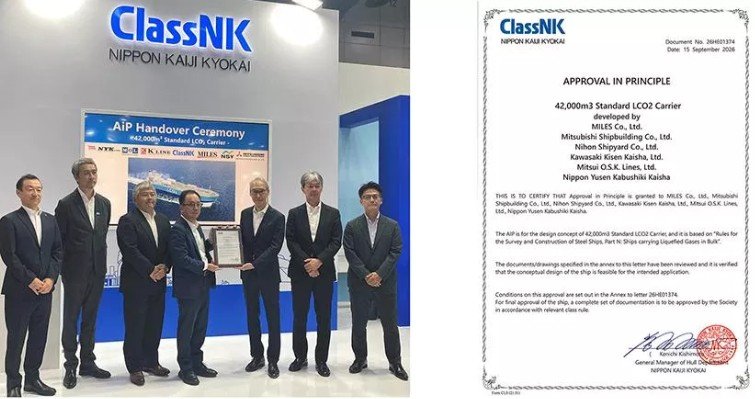
Japan has taken a significant step toward developing its carbon capture and storage (CCS) value chain after six companies acquired Approval in Principle (AiP) from the Japanese classification society Nippon Kaiji Kyokai (ClassNK) for a standard low-pressure liquefied CO₂ (LCO₂) carrier.
The approval strengthens efforts to develop LCO₂ shipping in Japan as demand for CO₂ transportation is expected to increase with the launch of a series of CCS projects. The proposed carrier will transport captured carbon dioxide from Japan to designated storage sites, supporting the development of a domestic CCS business and maritime transportation infrastructure.
The AiP was awarded on September 15, 2026, at Gastech 2026 in Bangkok, Thailand. It represents the first concrete achievement under a standard design framework utilizing MILES, a joint venture among related companies involved in the design of LCO₂ carriers and low-carbon-fueled ships.
The six companies involved are Mitsubishi Shipbuilding Co., Ltd., part of the Mitsubishi Heavy Industries (MHI) Group; Kawasaki Kisen Kaisha, Ltd. (“K” LINE); Mitsui O.S.K. Lines, Ltd. (MOL); Nippon Yusen Kabushiki Kaisha (NYK Line); Nihon Shipyard Co., Ltd. (NSY); and MILES Co., Ltd. NSY is a ship design and sales joint venture between Imabari Shipbuilding Co., Ltd. and Japan Marine United Corporation.
The companies have been working under a Memorandum of Understanding announced on December 1, 2025. Their standard design framework is intended to support the stable domestic construction and supply of LCO₂ carriers, promote vessel standardization, improve economic efficiency and contribute to the establishment of a CCS value chain in Japan.
For the AiP, the companies completed a Hazard Identification Study (HAZID) covering CO₂ handling operations on a standardized 42,000m³-class low-pressure LCO₂ carrier. The assessment considered risks specific to low-pressure LCO₂ operations and drew on the extensive experience of K LINE, MOL and NYK Line in low-pressure gas carrier operations.
Following the risk assessment, the companies established a safety-focused design policy that resulted in the ClassNK approval. The policy will be incorporated into the standard design of LCO₂ carriers and is expected to provide an important foundation for future CCS business development in Japan.
The use of a common design platform is also expected to reduce workloads and improve efficiency in vessel design and construction. Standardization could help strengthen Japan’s construction capabilities while supporting the future supply of LCO₂ carriers required for the emerging CCS market.
The initiative is part of MHI Group’s strategic measures to strengthen its energy transition business. Mitsubishi Shipbuilding is playing a key role in the project and aims to contribute to the development of the maritime industry in Japan and overseas through maritime engineering technology based on shipbuilding, in addition to its conventional shipbuilding activities.
Through collaboration with related companies in Japan and internationally, MHI Group will continue to support the development of LCO₂ carriers and the establishment of the CCS value chain.