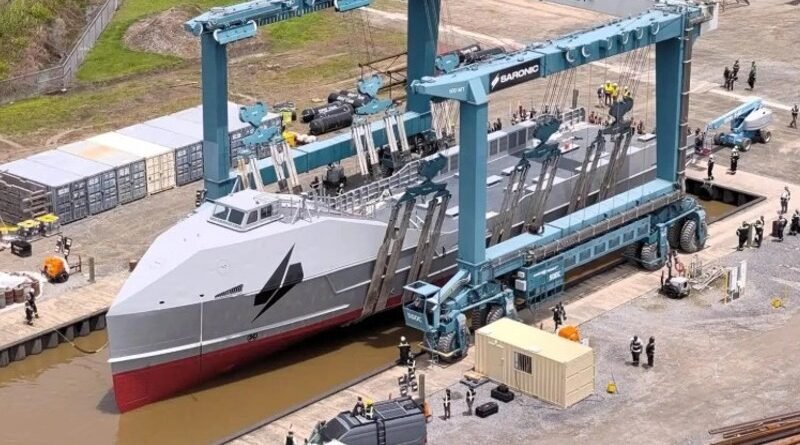
U.S. Navy Awards $1.2B MUSV Program to Three Louisiana Shipyards
Three Louisiana shipyards will build 30 unmanned surface vessels (MUSVs) for the U.S. Navy following successful at-sea testing, expanding the service’s focus on autonomous ships and maritime technology. Saronic, HII and Galliano Marine Service will each build 10 medium unmanned surface vessels at an average cost of about $40 million per vessel.
Based on the Navy’s average cost estimate, the 30-vessel program represents approximately $1.2 billion in vessel value, although the Navy did not disclose the individual amounts awarded to the three companies. Production will begin immediately, with deliveries expected to start as early as the fourth quarter of Fiscal Year 2027.

Louisiana Shipyards Begin MUSV Production
The three production sites are located in Loreauville, Houma and Franklin, Louisiana.
HII is working with Breaux Brothers and Halimar Shipyard to build its Romulus MUSVs. Breaux Brothers is based in Loreauville, while Halimar Shipyard is located in Morgan City.
Galliano Marine Service, which also does business as Edison Chouest, is based in Houma. Saronic is building its vessels in Franklin at the former Gulf Craft yard, which has undergone a major expansion.
Read:BMT Launches Maritime Autonomous Systems E-Learning Course as IMO MASS Code Takes Effect
The Navy selected the companies based on a combination of autonomy performance, vessel design, production schedule and cost.
Navy Sets Long-Range Requirements for Autonomous Vessels
The Phase I requirements called for an autonomous vessel capable of traveling 2,500 nautical miles at 25 knots in Sea State 4.
The vessels must also be capable of transporting payloads of up to 25 metric tons across at least two 40-foot shipping containers.
The production awards follow several weeks of at-sea testing designed to demonstrate the vessels’ ability to operate for extended periods with limited input from a command-and-control station.
The Navy said the testing required vessels to operate for approximately 26 hours over more than 360 nautical miles while receiving only a single input from the command-and-control station.
The demonstrations showed the ability of the vessels to operate for more than 24 hours over extended distances with minimal operator intervention.
Six Companies Complete MUSV Testing
Seven companies participated in the at-sea testing after reaching the prototype stage in May.
Six companies successfully met the testing requirements and will each receive $15 million and enter the Department of Defense’s drone marketplace.
In addition to Saronic, HII and Galliano Marine Service, the participating companies included Birdon, Leidos, PacMar Technologies and Sea Machines.
Birdon did not meet the testing requirements. However, Navy officials said the company could have an opportunity to participate in future stages of the program.
Navy Expands Second Phase of MUSV Program
The Navy has also launched the second phase of its medium unmanned surface vessel program, with the aim of bringing more types of unmanned vessels into the marketplace.
Phase II allows a wider variety of vessel designs and requires less payload capacity than Phase I.
Under the draft requirements, vessels can be up to 295 feet long and must be capable of operating for 10 days while surviving Sea State 6.
Unlike Phase I, the second phase does not require a specific high-speed capability or refueling-at-sea capability.
The Navy said the Phase II solicitation allows both new entrants and existing vendors to compete, including companies submitting updated product designs and modular payload configurations.
Testing evaluations are expected to begin as early as November 16, with proposals assessed on a rolling basis over the next five years.
Autonomous Ships Expand Naval Capabilities
The MUSV program highlights the growing role of autonomous ships, unmanned vessels and maritime technology in modern naval operations.
Moving from prototype testing to production gives the U.S. Navy a pathway to expand the use of vessels that can conduct extended missions with limited human intervention. The program also involves multiple shipyards and technology companies, supporting broader participation in the defense industry and naval shipbuilding sector.
The introduction of a more flexible Phase II requirement further broadens opportunities for different vessel designs and autonomous technologies. By reducing some of the demanding requirements from Phase I, the Navy is seeking to expand its industrial base while identifying additional unmanned platforms for future operational needs.
The production of 30 MUSVs therefore represents a significant step in the development of unmanned maritime systems, while the second phase could further expand the range of autonomous vessels available to the U.S. Navy.