Ancient Maritime Wonder Resurfaces: 80-Ton Lighthouse Stones Recovered from Mediterranean Seabed near Alexandria
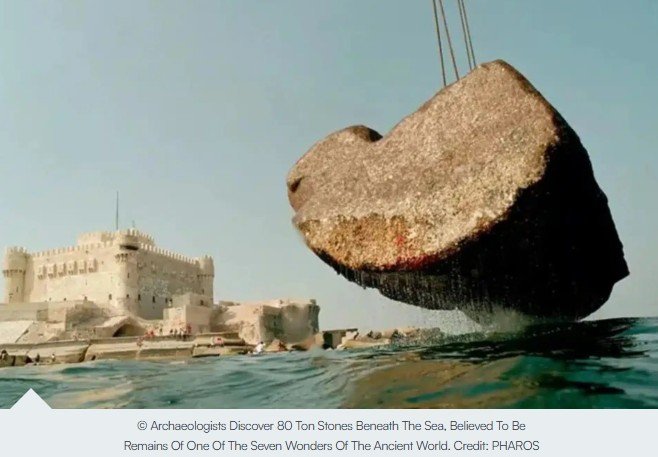
In a remarkable breakthrough for maritime archaeology and underwater heritage exploration, archaeologists have successfully recovered massive 70–80 ton stone blocks from the seabed off Alexandria, believed to be part of the legendary Lighthouse of Alexandria, one of the Seven Wonders of the Ancient World.
More than 1,600 years after its collapse, this iconic maritime navigation structure is slowly re-emerging through advanced underwater excavation and digital reconstruction. The discoveries are part of the PHAROS Project, an ambitious initiative focused on mapping and restoring submerged cultural assets in the Mediterranean, an area increasingly important for maritime tourism, offshore research, and heritage preservation.
Beneath the waters of the eastern Mediterranean shipping corridor, researchers have lifted 22 monumental architectural elements, including lintels, thresholds, paving slabs, and doorjambs. Each block, weighing up to 80 tons, highlights the extraordinary engineering scale of this ancient lighthouse, which once guided vessels safely through hazardous coastal waters, an early example of maritime safety infrastructure still relevant to modern shipping lanes and port navigation systems.
The excavation is led by Isabelle Hairy of the CNRS, who notes that these recovered stones likely formed part of the grand entrance of the lighthouse. The structure uniquely blended Egyptian and Greek architectural styles, reflecting the region’s role as a historic maritime trade hub connecting Africa, Europe, and Asia.
The site itself has been known since 1968, with major documentation efforts beginning in 1994 under Jean-Yves Empereur. His team cataloged over 3,300 submerged artifacts, including sphinxes, obelisks, and granite columns, further evidence of Alexandria’s importance as a global maritime center in antiquity.
What sets the latest phase apart is the integration of cutting-edge marine technology. Using high-precision photogrammetry and digital scanning supported by the Dassault Systèmes Foundation, researchers are creating detailed 3D models of each recovered block. These models are being assembled like a giant virtual puzzle, enabling experts to reconstruct the lighthouse with unprecedented accuracy.
Originally built in the 3rd century BCE under Ptolemy I Soter and designed by Sostratus of Cnidus, the lighthouse stood over 100 meters tall, making it one of the tallest man-made structures of its time. Positioned on Pharos Island, it served as a critical navigational beacon for more than a thousand years, guiding merchant ships through one of the busiest maritime trade routes of the ancient world.
Its destruction came after a series of earthquakes, particularly a devastating event in 1303. Centuries later, many of its remaining stones were repurposed to build the Citadel of Qaitbay in 1477, ironically preserving fragments of the lighthouse within a new coastal defense structure overlooking the same strategic maritime zone.
Today, as global interest in underwater archaeology, blue economy initiatives, and maritime heritage tourism continues to grow, the recovery of these massive stone blocks is more than a historical milestone; it is a powerful reminder of humanity’s long-standing relationship with the sea.
Read:Archaeologists Discover Centuries-Old Shipwrecks in Bay of Gibraltar
With each recovered fragment and digital reconstruction, the Lighthouse of Alexandria is gradually coming back to life, bridging ancient maritime innovation with modern ocean technology, and capturing the imagination of historians, researchers, and the global shipping community alike.