Dalian Maritime University Trains Future Maritime Leaders to Put IMO Policy into Practice
Dalian Maritime University (DMU) is preparing the next generation of maritime professionals to translate International Maritime Organization (IMO) policies into real-world maritime operations, supporting maritime excellence in line with the IMO World Maritime Day Theme 2026–2027.
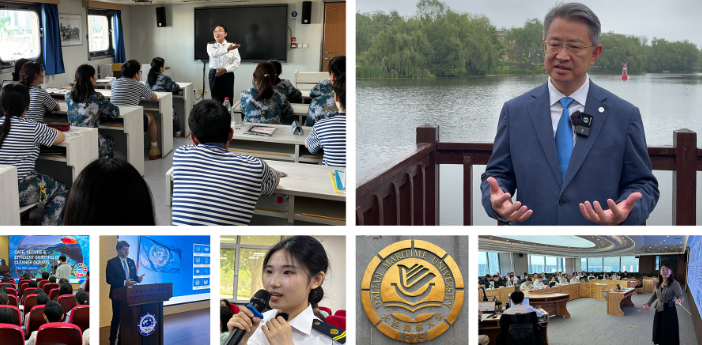
During a recent visit to the university, maritime educators, students, and faculty members demonstrated how IMO regulations are embedded across undergraduate, postgraduate, and doctoral programs, including maritime law, navigation, maritime management, maritime English, and marine engineering.
DMU President Dr. Shan Hongjun emphasized the growing influence of IMO regulations on maritime education and workforce development.
“IMO regulations set the course,” he said. “The development of new regulations, such as the non-mandatory International Code of Safety for Maritime Autonomous Surface Ships (MASS Code), as well as the comprehensive review of the STCW Convention, will profoundly impact our talent cultivation system.”
Highlighting the role of innovation, President Shan added that intelligent shipping technologies, green and low-carbon solutions, and digital education tools are increasingly being integrated into teaching programs, transforming the way maritime education is delivered.
Intelligent Training Ships Support Future Shipping Skills
Visits aboard the DMU Dual-Purpose Intelligent Training Ship Xin Hong Zhuan and the DMU Training Ship Yukun provided insight into the university’s practical training approach and the integration of intelligent shipping technologies into maritime education.
Captain Li Lianbo, Professor and Vice-Dean of the Navigation College, explained that training aboard the autonomous-ready vessel Xin Hong Zhuan provides students with an immersive and technology-driven learning environment.
According to Captain Li, the vessel employs digital twin technology to recreate real-world maritime scenarios, allowing students to understand and operate simulated ships from multiple perspectives while combining virtual and physical training experiences.
Captain Li described the IMO’s MASS Code as a critical milestone for the safe and orderly development of Maritime Autonomous Surface Ships worldwide and an important framework for future maritime education and training.
Hands-On Engine Room Experience Bridges Theory and Practice
Chief Engineer Song Liguo of the training vessel Yukun stressed the importance of onboard training in helping students transform theoretical knowledge into practical skills.
He noted that while students acquire extensive classroom knowledge, direct exposure to engine room operations, equipment handling, maintenance procedures, and shipboard systems enables them to connect academic principles with real-world maritime operations.
IMO Conventions Integrated into Practical Safety Training
Yukun Third Officer Lyu Wenyu, who teaches lifesaving and fire safety, incorporates IMO conventions directly into maritime training.
Students study key IMO regulations, including the International Convention for the Safety of Life at Sea (SOLAS), before applying those principles through practical exercises and emergency response training aboard the vessel.
This approach helps ensure that future seafarers understand both the regulatory and operational aspects of maritime safety.
WMU-DMU Maritime Affairs Program Develops Global Maritime Talent
During the 22nd intake of the joint World Maritime University (WMU)-DMU Master of Science (MSc) in Maritime Affairs, specializing in Maritime Safety and Environmental Management (MSEM), Program Coordinator Zhao Lu explained that the program focuses on maritime conventions, operations, and management.
She noted that more than 900 graduates have completed the program since its inception and have pursued careers with the China Maritime Safety Administration, shipping companies, and maritime organizations in various countries.
As part of broader exposure to international maritime governance, DMU students attended presentations by IMO officials covering the organization’s regulatory framework, policy-making processes, and career opportunities within the United Nations system.
To date, 41 DMU interns and externs have completed placements at the IMO, gaining valuable experience in international maritime affairs before moving into roles across the maritime sector.
Connecting Students with Emerging Maritime Challenges
Professor Ma Mingfei, Director of the International Cooperation and Exchange Office, welcomed students’ early engagement with international maritime institutions and global maritime issues.
She said the initiative helps the university remain connected to emerging priorities such as green shipping, maritime digitalization, sustainability, and the future development of the shipping industry.
“This is an important bridge connecting us with the international maritime community,” she said.
As global shipping advances toward greater automation, digital transformation, and environmental sustainability, Dalian Maritime University continues to play a key role in preparing maritime professionals capable of implementing IMO regulations and supporting the future growth of the maritime industry.