
Ballast Water Management System Cost: Installation, Maintenance, and Compliance Costs for Shipowners
By Noreen Fahad
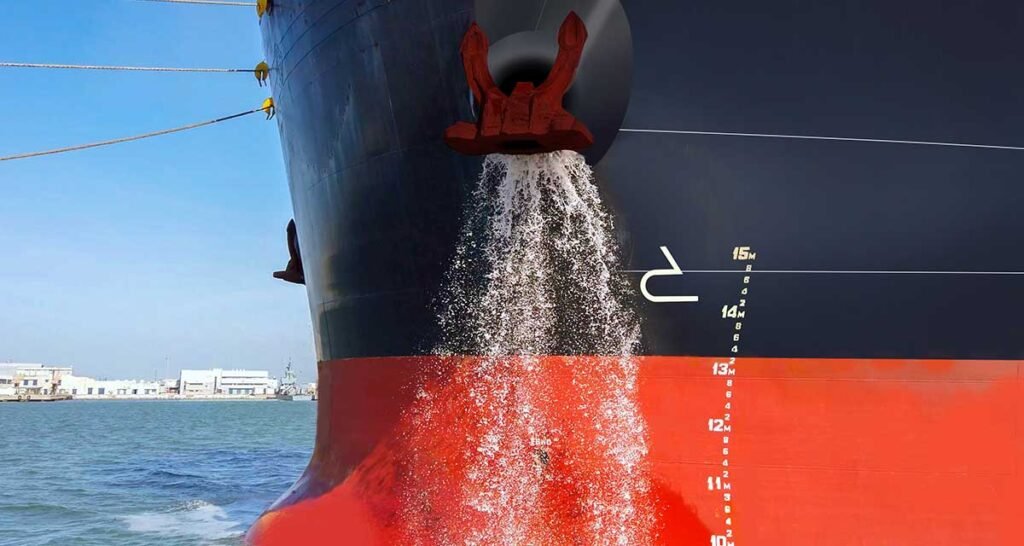
More than 90% of world trade moves by sea, and almost every one of the roughly 100,000 vessels carrying it also carries ballast water , seawater taken on to keep a ship stable and offloaded again at the next port, wherever in the world that happens to be . In the process, the global fleet transfers an estimated three billion tonnes of water, and whatever lives in it, between coastlines every year .A species that is harmless in the port where it was picked up can become a costly invasive one thousands of kilometres away, a problem with no regard for flag state, trade lane, or hemisphere, and the original justification for the IMO’s Ballast Water Management (BWM) Convention [8]. Since the Convention became fully mandatory for all seagoing vessels on 8 September 2024, ballast water treatment has moved from an emerging compliance issue to a fixed, substantial line item in every shipowner’s capital and operating budget, from bulk carriers on the Cape route to container ships calling Rotterdam, Singapore, and Los Angeles alike [1][7].
The question facing shipowners today, wherever their fleet trades, is no longer whether to comply, but how much compliance will cost over a vessel’s remaining service life ,and where that cost actually falls. Installation, maintenance, and paperwork behave differently everywhere they are incurred: capital cost is paid once, operating cost compounds annually regardless of currency or port, and compliance risk is driven as much by crew training and record-keeping as by the equipment itself. Treating these as a single number obscures the decisions that matter most to a fleet manager, and it also flattens real differences between regions: a retrofit budget that works for a European owner with easy yard access may not work for an operator in West Africa or Southeast Asia facing longer lead times and thinner margins [11].
1.Regulatory Background: Why Costs Keep Rising
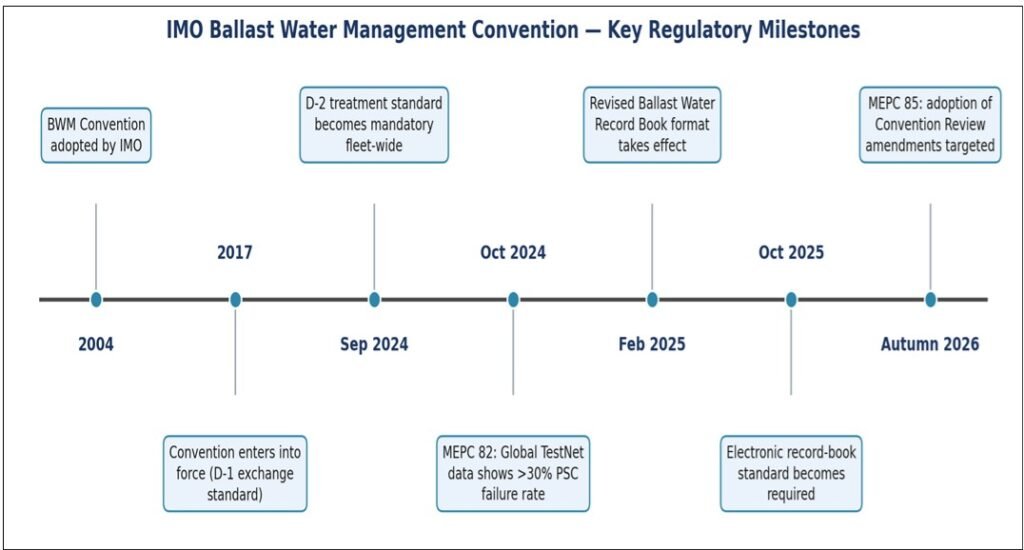
The BWM Convention was adopted in 2004 and entered into force in September 2017, initially allowing ships to meet the less demanding D-1 ballast water exchange standard. A phase-in schedule tied to each vessel’s IOPP certificate renewal pushed most of the fleet toward the stricter D-2 treatment standard, and as of 8 September 2024 every applicable ship must carry an approved BWMS [7]. The IMO is now in the “experience-building phase” review of the Convention, with a package of amendments targeted for adoption at MEPC 85 in autumn 2026, focused on BWMS maintenance, crew training, and performance in difficult water conditions such as high turbidity or low salinity [17][20].
2. Installation Costs: The First and Largest Hurdle
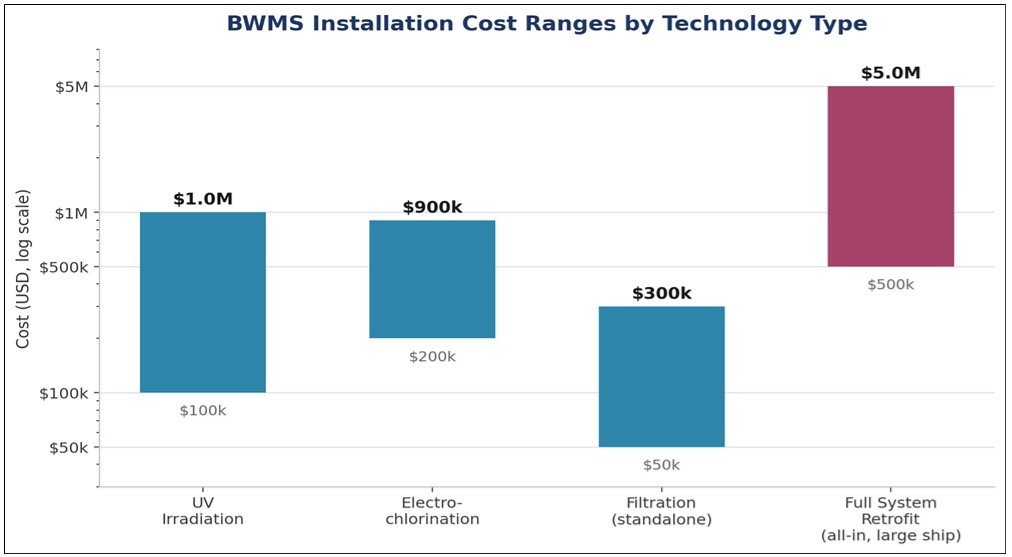
Multiple 2025 market analyses converge on a similar range: retrofitting a BWMS on an existing ship typically costs between $500,000 and $5 million, depending on vessel size, ballast pump capacity, and the treatment technology chosen [1][2][3]. New-build installations tend to be cheaper because the system can be engineered into the ship’s design rather than fitted around existing piping, tanks, and steelwork.
Technology choice materially changes the number. UV-based systems , currently around 40% of installations because they are chemical-free and comparatively low-maintenance ,range from roughly $100,000 for small vessels to over $1 million for large ones [1][16]. Electrochlorination systems, popular on larger vessels because they scale well to high ballast flow rates, typically fall between $200,000 and $900,000 [16]. Filtration-only components sit at the lower end but are almost always paired with a UV or chemical disinfection stage to meet the D-2 biological discharge standard.
Retrofitting older vessels is disproportionately expensive because most were not designed with the space, power capacity, or pipe routing a BWMS needs. Structural modification, extended dry-docking time, and the resulting loss of trading days are recurring themes in feasibility studies of tanker and bulk carrier retrofits [9][15]. A comparative study of four retrofit technologies on a Cape-sized bulk carrier found capital costs ranging from about $746,000 for an electrolysis and electrochlorination package to just over $1.08 million for a filtration-and-chemical system , before accounting for lifetime operating costs [26],
A 2018 Promet , Traffic & Transportation cost-efficiency study, frequently referenced in subsequent ballast water retrofit research, highlighted significant differences in the operational expenses of treatment technologies. The study found that UV-based Ballast Water Management Systems (BWMS) generally incur higher operating costs due to increased energy demand for ultraviolet lamp operation compared with electrochlorination systems under similar operating conditions. However, UV technology offers the advantage of avoiding the storage, handling, and management of active chemical substances, making it an attractive option for operators prioritizing chemical-free treatment solutions.
3. Market Context: A Growing but Cost-Sensitive Industry
The global ballast water treatment systems market was valued at roughly $6.94 billion in 2024 and is projected to reach $11.31 billion by 2030, a compound annual growth rate of 8.6% [10]. Other market trackers put the broader ballast water systems market at $7.1–7.4 billion in 2025, rising toward $15–18 billion by 2035 as retrofit and newbuild demand continue [1]. Market-size figures vary noticeably between trackers depending on scope (equipment only versus equipment-plus-services) and methodology, so any single number should be treated as an order-of-magnitude estimate rather than a precise figure. Asia Pacific dominates demand, accounting for about 40.6% of 2024 revenue, driven by shipbuilding volume in China, Japan, and South Korea. Bulk carriers are the single largest vessel-type segment in several trackers’ data, reflecting both fleet size and the scale of retrofit work still outstanding on older bulkers [10].
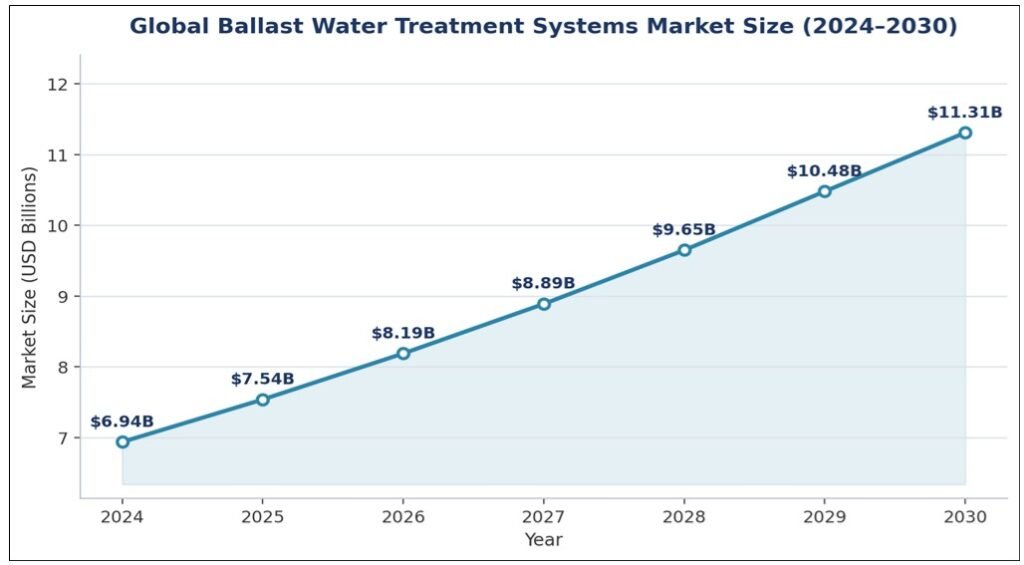
Source: Grand View Research, “Ballast Water Treatment Systems Market Report” (2024 actual: $6.94B; 2030 projection: $11.31B; CAGR 8.6%, 2025–2030) [10].
Industry estimates suggest tens of thousands of ships worldwide still required BWMS upgrades as of 2025, and installers have warned of yard and equipment bottlenecks as owners who delayed compliance now compete for retrofit slots [1][6]. For smaller owners and operators of older tonnage, the economics can tip toward scrapping rather than retrofitting, particularly for vessels nearing the end of their commercially useful life [3]. For smaller or short-sea fleets is shore-based, mobile port treatment of ballast water rather than an onboard system , a feasibility model published in Sustainability in 2022 found this can be cost-competitive for vessels with limited ballast volumes or infrequent long-haul voyages [12].
4. Case Study: Lifecycle Cost Comparison of Retrofit Technologies
A lifecycle cost analysis conducted by the Maritime Environmental Resource Center (MERC) evaluated four ballast water treatment retrofit options for a Cape-sized bulk carrier at an Asian shipyard. Although the cost estimates in the study are based on historical market conditions and do not represent current installation prices, the analysis provides valuable insights into the long-term economic performance of different technologies. The findings highlight an important consideration for shipowners: the lowest initial investment does not always result in the lowest overall cost. Systems with higher annual operating and maintenance expenses can significantly increase lifecycle expenditure, offsetting the benefits of lower upfront capital costs [26].
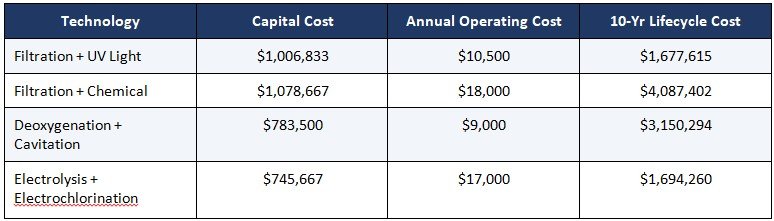
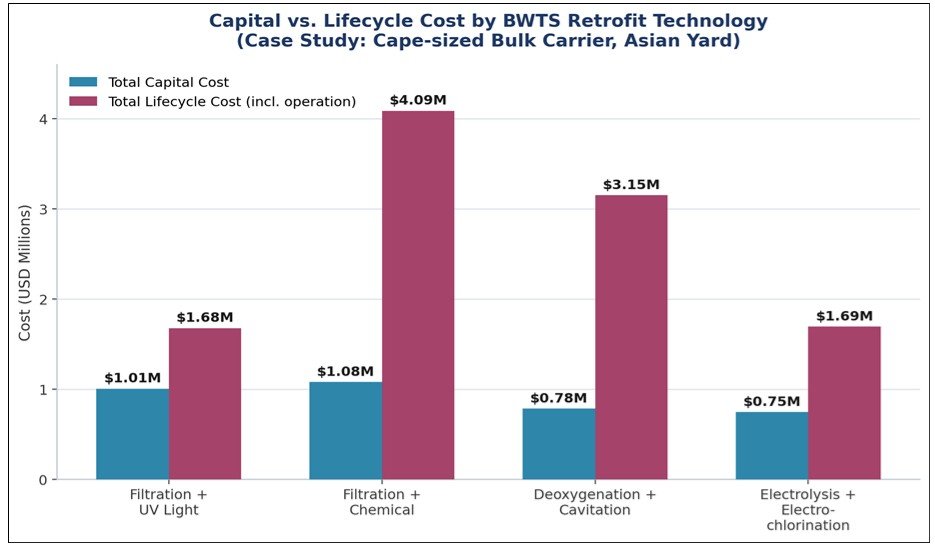
Source: Maritime Environmental Resource Center (MERC) [26].
The lesson for fleet managers and researchers alike is that procurement decisions based on capital cost alone can be misleading; total-cost-of-ownership modelling that includes consumables, energy, and cargo-capacity impact gives a materially different ranking of technologies [9][15][26]. A separate scenario-based cost-effectiveness analysis, published in Management of Biological Invasions, reaches a similar conclusion using a different modelling approach: strategy choice should be driven by total cost of ownership across a vessel’s remaining service life, not by the sticker price of the equipment [15].
5. Compliance Challenges: Where the Money Meets the Paperwork
Even fully installed, correctly type-approved systems fail Port State Control inspections at a surprisingly high rate. Data submitted by Global TestNet to IMO’s MEPC 82 in October 2024 found that over 30% of installed BWTS units fail D-2 compliance inspections, despite roughly 95% of vessels having a system on board and having passed commissioning tests. Paris MoU data for 2023 recorded 907 ballast water non-compliance deficiencies, resulting in 33 ship detentions, with record-keeping and administrative errors , not equipment failure , the single largest category [17]. A separate peer-reviewed sampling study of vessels calling at Shanghai similarly found that most D-2 non-compliance traced back to misuse of the BWMS rather than equipment malfunction, reinforcing that the human-operational side of compliance deserves at least as much attention as the hardware [14].
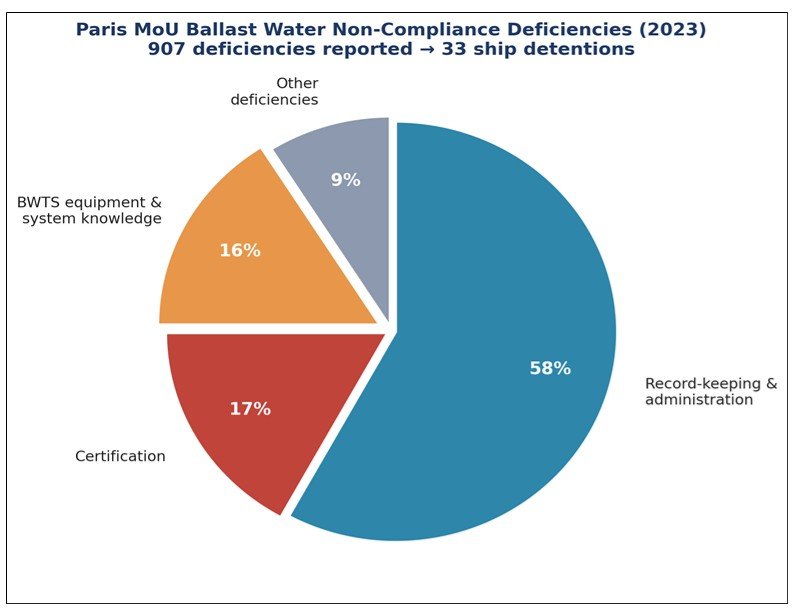
This pattern is consistent with IMO’s own experience-building data: approximately 70% of BWM Convention deficiencies since the Convention entered into force in 2017 have been traced to incorrect or inadequate record-keeping in the Ballast Water Record Book, prompting a revised record book format introduced in February 2025 and a requirement that electronic record books comply with a new IMO standard from October 2025 [19]. DNV’s 2025 PSC review similarly found that inspection focus has shifted from hardware toward crew familiarisation, training, and ongoing maintenance routines ,areas that sit squarely within a ship’s safety management system rather than its engineering specification [18]. Tokyo MoU data covering December 2023 to November 2024 tells a consistent story outside Europe: Australian biosecurity inspectors found ballast water non-compliance in almost 30% of nearly 13,000 inspections, with crew unfamiliarity and poor equipment maintenance behind roughly 70% of those findings [21].
For shipowners, this reframes “compliance cost” beyond the capital and maintenance figures discussed above. It also includes the administrative overhead of training crews on record-keeping procedures, auditing management systems, and , in the case of deliberate falsification ,exposure to USCG criminal enforcement and potential effects on P&I insurance cover [20].
6. Regional and Economic Considerations
Cost pressure is not evenly distributed. A 2023 Frontiers in Marine Science cost-benefit analysis of three major Chinese port clusters modelled projected annual compliance cost increases ranging from $456 million, using China-based cost assumptions, to $1.205 billion under U.S.-based cost assumptions, under stricter future regional rules , illustrating how much the choice of underlying cost data can swing national-level projections . The same study noted that vessels with high ballast water discharge volumes, such as bulk carriers, are comparatively better placed to absorb future policy tightening than smaller vessel types [13].
A 2022 study of compliance barriers among Nigerian shipping operators adds a useful counterpoint from a developing-market context: it found that limited access to finance, scarce local technical expertise, and yard capacity constraints , rather than the sticker price of a BWMS alone , were the dominant obstacles to timely retrofitting [11]. These regional and vessel-type differences matter for research and policy design alike: a uniform global compliance-cost estimate risks masking the disproportionate burden on smaller operators, older tonnage, and owners trading primarily in jurisdictions with stricter-than-IMO local rules such as the United States [3][13].
7. Practical Recommendations for Shipowners
i. To achieve long-term cost efficiency and regulatory compliance, shipowners should evaluate Ballast Water Management Systems (BWMS) beyond the initial purchase price. A comprehensive total cost of ownership (TCO) analysis, including installation, energy consumption, maintenance, spare parts, crew training, and compliance costs ,is essential, as the cheapest system to install may not always be the most economical option throughout the vessel’s operational life.
ii. Shipowners planning BWMS retrofits should secure shipyard availability well in advance. Delays in compliance planning can create significant scheduling challenges, as increasing numbers of vessels compete for limited repair and retrofit capacity.
iii. Investment in crew training and operational procedures is equally important. Proper understanding of ballast water treatment operations, monitoring requirements, and the updated Ballast Water Record Book format can help reduce deficiencies during Port State Control (PSC) inspections, where many violations are related to documentation and procedural issues rather than equipment failure.
iv. When selecting between treatment technologies such as ultraviolet (UV) systems and electrochlorination systems, operators should also consider future environmental costs, including carbon-related expenses for vessels operating on routes affected by emissions trading schemes. For smaller vessels and short-sea operators, alternative solutions such as shore-based ballast water treatment services should be assessed before committing to expensive onboard installations[25].
v. Shipowners should closely monitor upcoming regulatory developments, including the IMO MEPC 85 (2026) amendment package, which is expected to further clarify requirements related to BWMS maintenance, system performance, and operation under challenging water quality conditions. Proactive compliance planning will help reduce operational disruptions and protect long-term fleet competitiveness.
8. Where the Industry Goes From Here
Ballast water management has moved from a regulatory novelty to a mature, high-value compliance category , and its cost structure has matured accordingly. Installation remains the single largest expense, typically $500,000 to $5 million per vessel, but maintenance, energy, consumables, and above all administrative compliance now account for a growing share of total cost of ownership over a ship’s remaining life [1][5][16][17]. As the IMO moves toward its 2026 Convention Review amendments, and as PSC data continues to show documentation ,not hardware ,as the leading failure point, the practical challenge for shipowners is shifting from “which system to buy” toward “how to operate and document it correctly.” Researchers and students studying maritime environmental economics will find this an unusually well-documented case of how a single international convention can reshape both a multi-billion-dollar equipment market and the daily operating procedures of the entire world merchant fleet.
References
[1] Global Growth Insights (2025). Ships’ Ballast Water System Market Size & Share Trends, 2035.
[2] Market Growth Reports (2025). Ballast Water Management Market Size and Trends, 2025–2033.
[3] Ship Universe (2025). Ballast Water Management Compliance Remains a Challenge for Shipowners.
[4] Riviera Maritime Media (2016). Counting the Cost of Ballast Treatment. [Dated vendor-interview source; figures should be read as historical context, not current pricing.]
[5] Riviera Maritime Media (2024). Ballast Water Treatment Industry Navigates 2024 Challenges.
[6] Riviera Maritime Media (2026). Counting the Cost of Ballast Water Treatment Inaction by Shipowners.
[7] International Maritime Organization (2024). Ballast Water Management – The D-2 Standard Becomes Fully Effective, 8 September 2024. imo.org.
[8] Technavio (2024). Global Ballast Water Management Growth Analysis, 2024–2028.
[9] Ejder, E., Ceylan, B. O., Celik, M. S., & Arslanoğlu, Y. (2024). Sustainability in maritime transport: Selecting ballast water treatment for a bulk carrier. Marine Environmental Research, 198, Article 106511. https://doi.org/10.1016/j.marenvres.2024.106511
[10] Grand View Research (2024). Ballast Water Treatment Systems Market Report, 2030.
[11] Nwigwe, T. I., & Minami, K. (2022). Challenges hindering the ballast water management compliance in Nigeria. Journal of International Maritime Safety, Environmental Affairs, and Shipping, 6(2–3), 141–147. https://doi.org/10.1080/25725084.2022.2126128
[12] Ishola, A., & Kontovas, C. A. (2022). Managing ship’s ballast water: A feasibility assessment of mobile port-based treatment. Sustainability, 14(22), 14824. https://doi.org/10.3390/su142214824
[13] Frontiers in Marine Science (2023). Cost-Benefit Analysis of Ballast Water Treatment for Three Major Port Clusters in China.
[14] Feng, W., Chen, Y., Zhang, T., Xue, J., & Wu, H. (2023). Evaluate the compliance of ballast water management system on various types of operational vessels based on the D-2 standard. Marine Pollution Bulletin, 194, Article 115381. https://doi.org/10.1016/j.marpolbul.2023.115381
[15] Wang, Z., & Corbett, J. J. (2021). Scenario-based cost-effectiveness analysis of ballast water treatment strategies. Management of Biological Invasions, 12(1), 108–124. https://doi.org/10.3391/mbi.2021.12.1.08
[16] Ship Universe (2025). Cost-Benefit Analysis: Ballast Water Treatment Systems (BWTS).
[17] SAFETY4SEA (2024). Over 30% of Ballast Water Treatment Systems Fail PSC Inspections, citing Global TestNet data submitted to IMO MEPC 82 (October 2024).
[18] DNV (2025). PSC CIC 2025 on Ballast Water Management and DNV’s PSC Top 18.
[19] Britannia P&I Club (2025). New Ballast Water Record Book 2025 — BWM.2/Circ.80/Rev.1.
[20] ShipFinex (2026). Ballast Water Management Guide: D-1, D-2, BWTS & 2026 Updates.
[21] Gard AS (2025). Ballast Water Management on the PSC Agenda. gard.no, citing Tokyo MoU/Australia biosecurity inspection data (Dec 2023–Nov 2024) and MEPC 83/4/14.
[22] Tonyes, S. G., Ramona, Y., Rukayadi, Y., & Ciawi, Y. (2025). Sustainable ballast water management: Mitigating ecological impacts and supporting marine and coastal biodiversity. BIOTROPIA, 33(1), 12–27. https://doi.org/10.11598/btb.2026.33.1.2504
[23] Ship Universe (2025). Cost-Benefit Analysis: Ballast Water Treatment Systems (BWTS) — maintenance cost assumptions.
[24] Vorkapić, A., Radonja, R., & Zec, D. (2018). Cost efficiency of ballast water treatment systems based on ultraviolet irradiation and electrochlorination. Promet – Traffic & Transportation, 30(3), 343–348.
[25] Demir, M. E. (2025). ORC-assisted ballast water treatment under the EU ETS: Comparative assessment of UV, electrochlorination, and thermal options. Environmental Research and Technology, 8(3), 724–740. https://doi.org/10.35208/ert.1761210
[26] Maritime Environmental Resource Center (MERC) (2009). Preliminary Cost Analysis of Ballast Water Treatment Systems.
[27] Riviera Maritime Media (2016). Counting the Cost of Ballast Treatment — vendor maintenance-cost interviews.
Noreen Fahad is a content writer who writes on maritime, shipping, logistics, and global trade. She is committed to producing accurate, informative, and accessible content that helps readers understand evolving trends and regulations across the maritime industry.