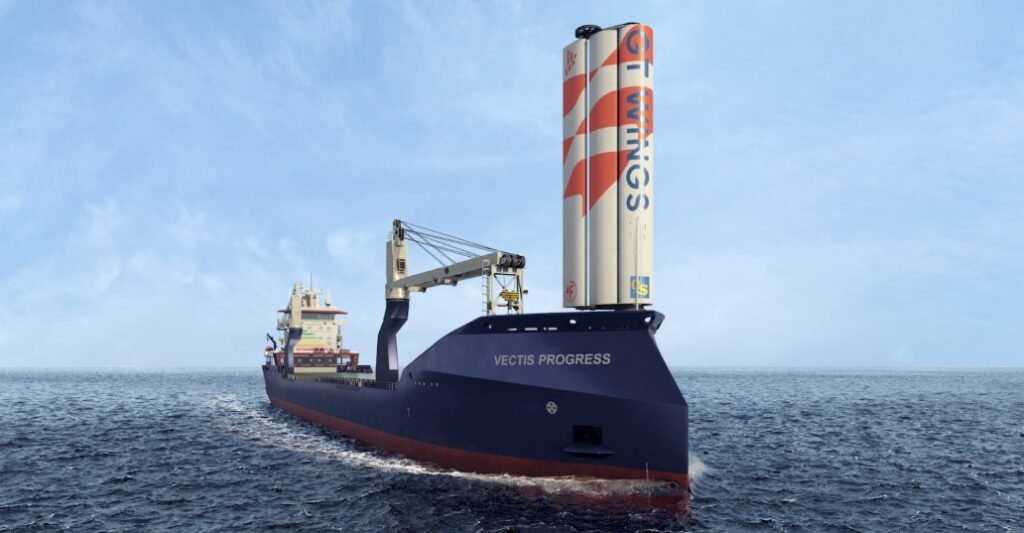
GT Wings Launches AirWing™S to Cut Ship Emissions
GT Wings has expanded its wind-assisted propulsion technology portfolio with the launch of AirWing™S, a compact, lightweight Jet Sail designed to help smaller commercial vessels reduce emissions and improve fuel efficiency. The new system addresses the operational constraints of smaller ships, where limited deck space, vessel dimensions and weight can affect the adoption of low-carbon shipping technology.
The launch reflects the growing importance of marine fuel efficiency, shipping decarbonisation and sustainable maritime investment as shipowners explore technologies to reduce emissions across diverse vessel types. By developing a lighter, more compact version of its AirWing™ system, GT Wings aims to make wind propulsion accessible to a broader segment of the global commercial fleet.
George Thompson, CEO of GT Wings, said the new product responds to the varied requirements of the shipping industry. He added that developing a compact system for smaller vessels would extend the potential emissions-reduction benefits of wind propulsion to more shipowners.
Commercial Production Marks a Milestone for Wind Propulsion
The AirWing™S launch coincides with a major step in the commercialisation of GT Wings’ technology. The company hosted an Open House at the manufacturing facility of its partner, Zunsion Technology, in Nantong, China, where guests viewed the first customer-ordered AirWing™ units nearing completion.
GT Wings announced its strategic manufacturing partnership with Zunsion Technology in March 2026. The agreement established a framework for industrial-scale production of AirWing™ systems in China, combining GT Wings’ expertise in wind propulsion and systems integration with Zunsion’s manufacturing and assembly capabilities.
The event showcased the new AirWing™S alongside the first commercial AirWing™20 units, highlighting the company’s strategy to develop a scalable product range for vessels with different operational requirements.
Xu Jinbiao, CEO of Zunsion Technology, welcomed GT Wings, its partners and guests to the Nantong facility. He said the units under construction demonstrated the progress achieved through the partnership and expressed confidence in its continued development as the technology and product portfolio expand.
Read:Baltic Shipping Adds Two Hybrid Coasters with Wind-Assisted Propulsion
International Partnership Supports Maritime Innovation
During the Open House, attendees toured the manufacturing facility and viewed two nearly completed 20-metre AirWing™ units ahead of delivery. The programme also featured a keynote address by Ms. Marie Langrishe, Trade Counsellor for Technology and Industry at the UK Embassy in Beijing, representing the UK Department for Business, Innovation, Science and Trade Technology, alongside a technical update on AirWing™ product development.
Langrishe highlighted the value of combining British innovation with international manufacturing expertise. She noted that the partnership could create export opportunities, support sustainable economic growth and contribute to the maritime sector’s decarbonisation.
The event attracted representatives from China, France, Hong Kong, Japan, Norway and the United Kingdom, alongside participants from the wider international shipping industry. Discussions focused on the role of advanced manufacturing and maritime technology in supporting the transition towards lower-carbon shipping operations.
What AirWing™S Means for Shipping Decarbonisation
The development of a compact wind-assisted propulsion system addresses an important challenge in maritime decarbonisation: adapting emissions-reduction technologies to vessels with different sizes, deck configurations and operating requirements.
For smaller commercial ships, equipment weight and available installation space can influence whether wind propulsion is technically and operationally suitable. A lightweight, compact design could broaden the range of vessels able to consider this technology, although its practical benefits will depend on vessel characteristics, operating routes, wind conditions and installation requirements.
Wind-assisted propulsion uses wind energy to supplement a vessel’s conventional propulsion system, potentially reducing fuel consumption and associated emissions. Its performance varies according to operating conditions, meaning shipowners must assess expected fuel savings, installation costs, maintenance requirements and potential returns on investment before making procurement decisions.
GT Wings’ expanding AirWing™ portfolio reflects an approach to marine emissions reduction that seeks to accommodate a wider range of commercial vessels rather than focus on a single vessel category. However, the actual environmental and financial benefits of AirWing™S will need to be assessed through operational performance data as the system moves towards commercial deployment.
GT Wings Expands Its Commercial Product Strategy
Summarising the significance of the event, Thompson said the nearly completed AirWing™20 units in Nantong represented the company’s transition from technology development towards repeatable commercial production.
He added that GT Wings would continue expanding its AirWing™ product family to meet the needs of a broader range of vessels and operating conditions.
The introduction of AirWing™S, alongside the progress of the AirWing™20 units, signals the company’s effort to combine product development with manufacturing scale-up. As shipping companies face increasing pressure to manage fuel costs and reduce emissions, wind-assisted propulsion technologies could become part of wider strategies for improving operational efficiency and advancing the transition to lower-carbon maritime transport.